66 articles tagged NVIDIA
Research
🎓 MIT Tech Review AI

Why physical AI is becoming manufacturings next advantage

The next phase of manufacturing transformation centers on "physical AI," which enables machines to sense, reason, and act reliably within the physical environment, moving beyond traditional automation and narrow optimization. Microsoft and NVIDIA are collaborating to facilitate this shift, helping manufacturers transition from experimental AI applications to large-scale, trustworthy deployment that enhances human capabilities, accelerates innovation, and manages increasing operational complexity. This evolution emphasizes intelligence and trust over mere automation, aiming to unlock new value streams while maintaining safety, quality, and governance standards.

Microsoft NVIDIA +1
Read More
Business
📄 AI News

ABB: Physical AI simulation boosts ROI for factory automation

The partnership between ABB Robotics and NVIDIA introduces RobotStudio HyperReality, a platform that leverages physical AI simulation to bridge the gap between digital models and real-world factory conditions. By integrating NVIDIA Omniverse libraries into ABB's existing RobotStudio software, this innovation enables highly accurate digital testing of industrial robotics, accounting for variables such as lighting, material physics, and part variations that traditionally hinder reliable deployment outside controlled environments. This development promises significant operational efficiencies, with potential reductions in deployment costs by up to 40% and a 50% acceleration in time-to-market for new automation solutions. The platform facilitates comprehensive

NVIDIA Robotics
Read More
Research
📄 AI News

Physical AI is having its momentand everyone wants a piece of it

Physical AI, which integrates AI systems capable of perceiving, reasoning, and acting in the real world, is experiencing a significant convergence of advancements, marking a shift from research to mainstream commercial deployment. Nvidia exemplifies this momentum by positioning robotics as a new platform for AI monetization, launching innovations such as the Cosmos and GR00T open models for robot learning and reasoning, alongside the energy-efficient Blackwell-powered Jetson T4000 module designed to enhance robotics computing performance.

NVIDIA Robotics +1
Read More
Business
📄 AI Weekly

AI News Weekly - Issue #467: Anthropic has receipts. And nobody wants to pay for AI. - Feb 26th 2026

The AI industry is experiencing unprecedented financial growth, with global investments reaching $2.5 trillion in 2026, surpassing historic mega-projects like Apollo and Manhattan combined, driven by surging data center demand and advancements from companies like Nvidia, which reported a record Q4 revenue of $68.1 billion. Concurrently, geopolitical tensions have intensified, with Chinese labs allegedly engaging in industrial-scale espionage on Anthropic's Claude, including the use of banned Nvidia chips to train models in violation of US export controls, highlighting the strategic and security risks associated with AI development. Despite these technological and financial

Claude NVIDIA +1
Read More
Research
📄 Towards Data Science

Optimizing Token Generation in PyTorch Decoder Models

The article discusses a novel technique for optimizing GPU performance in deep learning workflows by hiding host-device synchronization delays through CUDA stream interleaving. This approach allows for more efficient token generation in PyTorch decoder models by overlapping data transfer and computation, thereby reducing latency and improving throughput in large-scale neural network training and inference.

NVIDIA Deep Learning
Read More
Research
📄 AI News

Hitachi bets on industrial expertise to win the physical AI race

Hitachi is emphasizing the importance of industrial expertise in advancing Physical AI, asserting that effective real-world AI control systems require a foundational understanding of physics and industrial processes, rather than solely relying on large-scale multimodal foundation models developed by companies like OpenAI and Google. Unlike the top-tier AI models focused on general multimodal capabilities or Nvidias platform development, Hitachi leverages its extensive experience in infrastructure and industrial control to create more grounded and practical Physical AI solutions, moving from theoretical research to actual deployment on factory floors. This approach underscores a shift in the Physical AI hierarchy, highlighting the value of domain-specific

GPT Google AI +1
Read More
Business
📄 AI Weekly

AI News Weekly - Issue #464: 5 reasons will will not get AGI soon - Feb 5th 2026

Recent research indicates that scaling up large language models (LLMs) no longer guarantees progress toward artificial general intelligence (AGI), as evidenced by diminishing returns and emerging failure modes. Studies from Anthropic, Apple, and Nature reveal that larger models tend to become less reliable on complex tasks due to inverse scaling, where error rates increase with size, and they often hallucinate or produce unsafe outputs, undermining their utility in autonomous applications. Additionally, evidence from Apples GSM-Symbolic benchmark demonstrates that LLMs rely heavily on fragile pattern matching rather than genuine reasoning, as minor variable changes drastically reduce accuracy

GPT Claude +2
Read More
Technology
📄 AI News

Agentic AI scaling requires new memory architecture

Agentic AI is evolving from simple, stateless chatbots to systems capable of managing complex workflows that require extensive long-term memory, necessitating new memory architectures to scale effectively. As foundation models grow to trillions of parameters with context windows reaching millions of tokens, the computational burden of maintaining historical context surpasses current hardware capabilities, creating a bottleneck in deploying real-time, long-term AI agents. To address this challenge, NVIDIA has introduced the Inference Context Memory Storage (ICMS) platform within its Rubin architecture, a specialized storage tier designed to efficiently handle the high-velocity, ephemeral memory demands of

Research
📄 Towards Data Science

Breaking the Hardware Barrier: Software FP8 for Older GPUs

Feather introduces a software-based FP8 emulation technique that enables older RTX 30 and 20 series GPUs to overcome memory bandwidth limitations in deep learning workloads. By employing bitwise packing to emulate FP8 precision, this approach achieves nearly fourfold (3.3x measured) improvements in data transfer efficiency, effectively mitigating the memory bottleneck without requiring costly hardware upgrades. This development broadens access to efficient deep learning processing on existing GPU infrastructure, leveraging software solutions to extend hardware longevity and performance.

NVIDIA Deep Learning
Read More
Technology
📄 MarkTechPost

Thinking Machines Lab Makes Tinker Generally Available: Adds Kimi K2 Thinking And Qwen3-VL Vision Input

Thinking Machines Lab has announced the general availability of its Tinker training API, which now supports the Kimi K2 Thinking reasoning model, OpenAI-compatible sampling, and image input via Qwen3-VL vision language models. This development enhances Tinker's utility for AI engineers by enabling fine-tuning of large language models without the need for complex distributed training infrastructure, simplifying the process through a straightforward Python interface that maps training loops onto GPU clusters. Tinker functions as a lightweight, user-friendly API that abstracts the complexities of distributed training, focusing on large language model fine-tuning with minimal setup. It

GPT NVIDIA
Read More
Technology
📄 MarkTechPost

Interview: From CUDA to Tile-Based Programming: NVIDIAs Stephen Jones on Building the Future of AI

NVIDIA's recent software innovations, led by Distinguished Engineer Stephen Jones, focus on advancing CUDA programming through the introduction of tile-based abstraction, known as CUDA Tile. This new approach enables developers to program directly to arrays and tensors rather than managing individual threads, facilitating higher-level optimization and better alignment with evolving hardware architectures such as larger, denser Tensor Cores. By extending CUDA to support array- and tensor-oriented programming, NVIDIA aims to simplify the development process and unlock new performance efficiencies as hardware complexity continues to grow, addressing challenges posed by the slowing of Moore's Law.

Business
📈 VentureBeat AI

Nvidia's new AI framework trains an 8B model to manage tools like a pro

Researchers at Nvidia and the University of Hong Kong have developed Orchestrator, an 8-billion-parameter model that effectively coordinates multiple tools and large language models (LLMs) to solve complex problems with higher accuracy and lower cost than larger monolithic models. Trained via a novel reinforcement learning framework, Orchestrator acts as an intelligent coordinator, managing a diverse set of specialized models and external resources to enhance AI reasoning and task execution, demonstrating a scalable and practical approach for enterprise AI systems. This innovation addresses limitations in current LLM tool use by emphasizing a composite, multi-agent approach rather than relying on

GPT NVIDIA
Read More
Ethics
📄 AI News

EY and NVIDIA to help companies test and deploy physical AI

EY has developed a comprehensive physical AI platform leveraging NVIDIA's Omniverse, Isaac, and AI Enterprise software to facilitate the deployment and management of AI-driven robots, drones, and edge devices in real-world environments. This platform enables organizations to create digital twins for modeling and testing physical systems before deployment, enhancing safety, efficiency, and operational continuity across sectors such as manufacturing, energy, and healthcare. The platform is structured around three core components: synthetic data generation for diverse physical scenarios, digital twins and robotics training for real-time performance monitoring, and governance frameworks to ensure safety, ethics, and compliance. By establishing

NVIDIA Robotics
Read More
Technology
📄 AI News

Amidst the Ongoing AI Infrastructure Crunch, Singularity Compute Launches Swedish GPU Cluster

Singularity Compute, the infrastructure division of decentralized AI pioneer SingularityNET, has launched its first enterprise-grade NVIDIA GPU cluster in Sweden, featuring next-generation H200 and L40S GPUs in a high-density, renewable energy-powered data center operated by Conapto. This deployment addresses the critical shortage and high cost of AI computational resources by providing affordable, cutting-edge GPU infrastructure to support both traditional enterprise AI workloads and projects within the Artificial Superintelligence (ASI) Alliance decentralized ecosystem.

Research
📄 AI News

Singularity Compute launches Swedish GPU cluster amid the AI infrastructure crunch

Singularity Compute, the infrastructure division of decentralized AI pioneer SingularityNET, has launched its first enterprise-grade NVIDIA GPU cluster in a renewable energy-powered data center in Stockholm, Sweden, addressing the current AI infrastructure shortage. This high-density cluster features cutting-edge NVIDIA hardware, including H200 and L40S GPUs, and aims to provide more affordable, scalable computational power for AI research and enterprise workloads, contrasting sharply with the high costs of traditional cloud GPU instances like AWSs $98/hour 8-GPU servers.

Technology
📄 MarkTechPost

Meta AI Researchers Introduce Matrix: A Ray Native a Decentralized Framework for Multi Agent Synthetic Data Generation

Meta AI researchers have developed Matrix, a decentralized framework designed to enhance the generation of synthetic data for large language models (LLMs) by leveraging peer-to-peer agent scheduling on a Ray cluster. Unlike traditional centralized control systems that bottleneck scalability and GPU utilization, Matrix serializes control and data flow into message objects called orchestrators, enabling more efficient and diverse synthetic conversations while achieving 2 to 15 times higher token throughput on real workloads. This approach addresses the limitations of existing systems by distributing control logic across multiple agents, reducing coordination overhead, and significantly improving scalability for synthetic data generation. By replacing centralized controllers

Meta AI NVIDIA
Read More
Business
📈 VentureBeat AI

Black Forest Labs launches Flux.2 AI image models to challenge Nano Banana Pro and Midjourney

Black Forest Labs has announced the release of FLUX.2, an advanced image generation and editing system designed for production-grade creative workflows, featuring multi-reference conditioning, higher-fidelity outputs, and improved text rendering. The release includes a fully open-source Flux.2 VAE (Variational Autoencoder) under the Apache 2.0 license, which plays a critical role in compressing images into latent space for high-quality reconstructions, enabling 4-megapixel editing and more efficient training across multiple model variants. In addition to the open-source VAE, Black Forest Labs offers several proprietary models

Claude Google AI +2
Read More
Technology
📄 AI News

ZAYA1: AI model using AMD GPUs for training hits milestone

Zyphra, AMD, and IBM have successfully trained ZAYA1, a large-scale Mixture-of-Experts foundation model built entirely on AMD's Instinct MI300X GPUs, marking a significant milestone in AI infrastructure independence from NVIDIA. This achievement demonstrates that enterprise-grade AI training can be effectively supported by AMD's hardware and networking solutions, utilizing Pensando networking and ROCm software within IBM Cloud's infrastructure, and achieving performance comparable or superior to established models in reasoning, mathematics, and coding tasks. The deployment of AMD's MI300X GPUs, each equipped with 192GB of high-band

Business
📈 VentureBeat AI

ScaleOps' new AI Infra Product slashes GPU costs for self-hosted enterprise LLMs by 50% for early adopters

ScaleOps has introduced a new AI Infra Product to enhance cloud resource management for enterprises operating self-hosted large language models (LLMs) and GPU-based AI applications. This platform automates real-time GPU resource allocation and scaling, addressing challenges such as performance variability, long load times, and underutilization, while ensuring predictable performance and reducing operational overhead. Already deployed in enterprise environments, the system has demonstrated significant efficiency gains, cutting GPU costs by 50% to 70%. It employs proactive and reactive mechanisms to handle traffic spikes seamlessly, minimizing GPU cold-start delays and maintaining instant response times during surges

Business
📈 VentureBeat AI

Google unveils Gemini 3 claiming the lead in math, science, multimodal, and agentic AI benchmarks

Google has launched Gemini 3, its most advanced proprietary AI model family since 2023, featuring a comprehensive portfolio that includes the flagship Gemini 3 Pro, Deep Think reasoning enhancements, and Gemini Agent for multi-step task execution. These models are exclusively accessible through Googles ecosystem via APIs, developer platforms, and third-party integrations, with the Gemini 3 engine embedded in the new Antigravity development environment. The release marks a significant leap in AI capabilities, with independent benchmarks crowning Gemini 3 Pro as the world's leading AI model, achieving a top score of 73 on Analysis's index

GPT Claude +3
Read More
Technology
📄 AI News

SC25 showcases the next phase of Dell and NVIDIAs AI partnership

At SC25, Dell Technologies and NVIDIA unveiled enhancements to their joint AI platform, the Dell AI Factory with NVIDIA, designed to support a broader spectrum of AI workloadsfrom legacy models to advanced agent-based systemsby simplifying deployment and management across diverse hardware and software environments. This integrated platform leverages Dells comprehensive infrastructure solutions alongside NVIDIAs AI tools, supported by professional services, to facilitate seamless transition from AI concepts to operational results while mitigating technical complexity. Key technical advancements include the integration of Dells storage engines, ObjectScale and PowerScale, with NVIDIAs NIXL library from NVIDIA Dynamo, enabling scalable

Technology
📄 AI News

Re-engineering for better results: The Huawei AI stack

Huawei has introduced the CloudMatrix 384 AI chip cluster, leveraging interconnected Ascend 910C processors via optical links to create a distributed architecture that surpasses traditional GPU setups in resource efficiency and on-chip processing time. Despite individual Ascend chips being less powerful than competitors' GPUs, this architecture enables Huawei to challenge Nvidia's dominance in AI hardware, especially under ongoing US sanctions. To optimize performance with the new system, data engineers must adapt their workflows to Huaweis MindSpore framework, which is tailored for Ascend processors. Transitioning from popular frameworks like PyTorch or TensorFlow involves converting or retr

Business
📈 VentureBeat AI

New 'Markovian Thinking' technique unlocks a path to million-token AI reasoning

Researchers at Mila have developed a novel technique called Thinking, implemented through an environment named Delethink, which significantly enhances the efficiency of large language models (LLMs) in performing complex reasoning tasks. This approach addresses the longstanding quadratic scaling problem associated with chain-of-thought (CoT) reasoning, where the computational cost increases exponentially with the length of the reasoning chain, by structuring reasoning into fixed-size chunks rather than accumulating an ever-growing state. By breaking down the reasoning process into manageable segments, Delethink enables LLMs, such as a 1.5 billion parameter model, to perform

GPT NVIDIA +1
Read More
General
📄 MarkTechPost

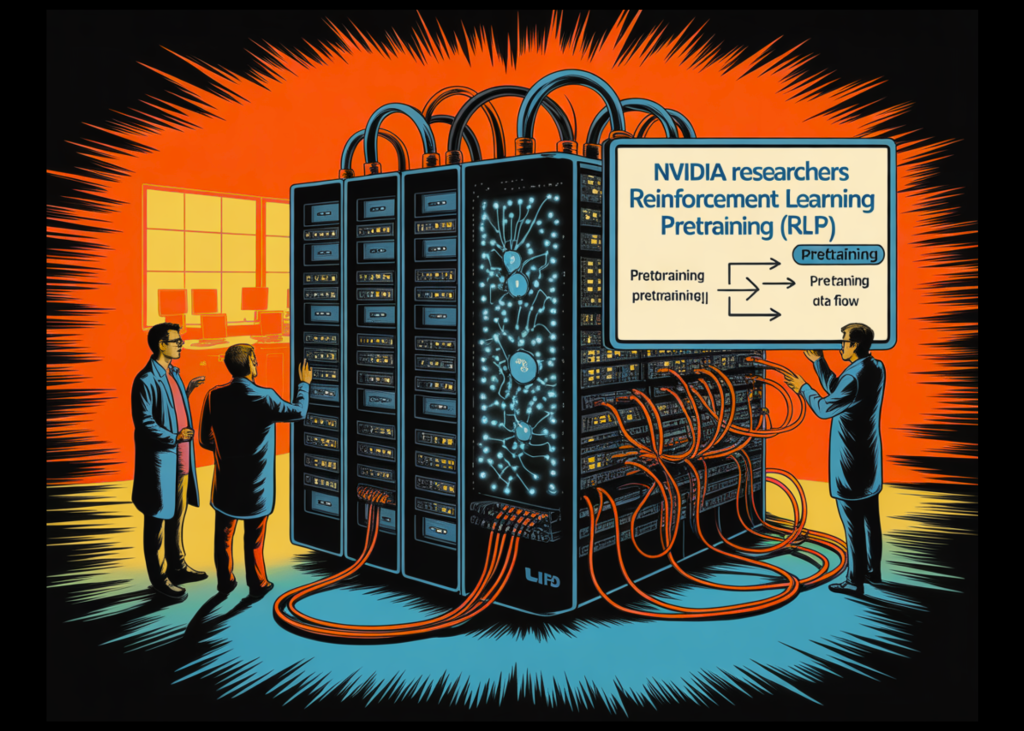
NVIDIA Researchers Propose Reinforcement Learning Pretraining (RLP): Reinforcement as a Pretraining Objective for Building Reasoning During Pretraining

NVIDIA AI has developed Reinforcement Learning Pretraining (RLP), a novel approach that integrates reinforcement learning directly into the pretraining phase of language models, rather than applying it post-training. This method treats short chain-of-thought (CoT) sequences as actions sampled before next-token prediction, rewarding them based on the information gain they provide, measured against an EMA-based no-think baseline. The approach employs a single shared-parameter network to sample CoT policies and score subsequent tokens, with a slowly updated EMA teacher network providing a counterfactual baseline, enabling dense, position-wise rewards without the

Research
📈 VentureBeat AI

Nvidia researchers boost LLMs reasoning skills by getting them to 'think' during pre-training

Researchers at Nvidia have introduced Reinforcement Learning Pre-training (RLP), a novel approach that incorporates reinforcement learning into the initial training phase of large language models (LLMs), encouraging models to develop independent reasoning capabilities early on. Unlike traditional methods that rely on sequential pre-training followed by fine-tuning with curated datasets, RLP enables models to learn complex reasoning directly from plain text, fostering more autonomous and adaptable AI systems. This technique treats reasoning as an action within the pretraining process, allowing models to "think for themselves" before predicting subsequent tokens, which significantly enhances their ability to perform complex reasoning tasks downstream

GPT NVIDIA +3
Read More
Technology
📄 AI News

Can Ciscos new AI data centre router tackle the industrys biggest infrastructure bottleneck?

Cisco has introduced the 8223 routing system, claiming it to be the industrys first fixed router capable of delivering 51.2 terabits per second, specifically designed to enhance AI data center interconnectivity across multiple facilities. Powered by the new Silicon One P200 chip, this hardware aims to address the growing infrastructure bottleneck faced by AI workloads, enabling scalable and high-bandwidth connections essential for distributed AI processing. This development positions Cisco within a competitive landscape that includes Broadcom and Nvidia, both of which have announced high-capacity networking solutionsBroadcom with its Jericho 4 switch

Business
📈 VentureBeat AI

Samsung AI researcher's new, open reasoning model TRM outperforms models 10,000X larger on specific problems

Alexia Jolicoeur-Martineau of Samsung's Advanced Institute of Technology has developed the Tiny Recursion Model (TRM), a neural network with only 7 million parameters that rivals or outperforms much larger language models like OpenAI's o3-mini and Google's Gemini 2.5 Pro on challenging reasoning benchmarks. This innovation demonstrates that highly effective AI models can be created affordably through recursive reasoning techniques, challenging the prevailing reliance on massive, resource-intensive foundational models and suggesting a new direction for efficient AI development.

GPT Google AI +3
Read More
Business
📈 VentureBeat AI

AI21s Jamba reasoning 3B redefines what 'small' means in LLMs 250K context on a laptop

AI21 Labs has introduced Jamba Reasoning 3B, a compact open-source AI model capable of extended reasoning, code generation, and ground-truth responses, designed to run efficiently on edge devices such as laptops and smartphones. Leveraging the Mamba architecture combined with Transformers, the model supports a 250,000-token window, enabling it to perform inference 2-4 times faster than previous models, with tested speeds of 35 tokens per second on a MacBook Pro, while significantly reducing memory and computational requirements. This development addresses a key industry challenge by shifting inference workloads from data centers to

Google AI Meta AI +2
Read More
Research
📈 VentureBeat AI

Huawei's new open source technique shrinks LLMs to make them run on less powerful, less expensive hardware

Huaweis Computing Systems Lab in Zurich has developed SINQ (Sinkhorn-Normalized Quantization), an open-source quantization method that significantly reduces the memory footprint of large language models (LLMs) by 6070% without compromising output quality. This calibration-free, fast technique can be seamlessly integrated into existing workflows, enabling models that previously demanded over 60 GB of memory to operate on much more affordable hardware, such as a single Nvidia GeForce RTX 4090, instead of high-end enterprise GPUs like the A100 or H100. The implications of SINQ are substantial, as it

Meta AI NVIDIA
Read More
Technology
📄 MarkTechPost

How to Build an Advanced End-to-End Voice AI Agent Using Hugging Face Pipelines?

A recent tutorial demonstrates the development of an advanced end-to-end voice AI agent utilizing freely available Hugging Face models, optimized for execution on Google Colab. The pipeline integrates Whisper for speech recognition, FLAN-T5 for natural language reasoning, and Bark for speech synthesis, all connected through transformer-based pipelines, enabling real-time voice interactions without heavy dependencies or API keys. This approach highlights a streamlined method for converting voice input into meaningful conversational responses and natural-sounding speech output, emphasizing accessibility and ease of deployment. By leveraging these open-source models and optimizing device usage with GPU support, the solution offers a practical

Google AI NVIDIA +2
Read More
Technology
📄 MarkTechPost

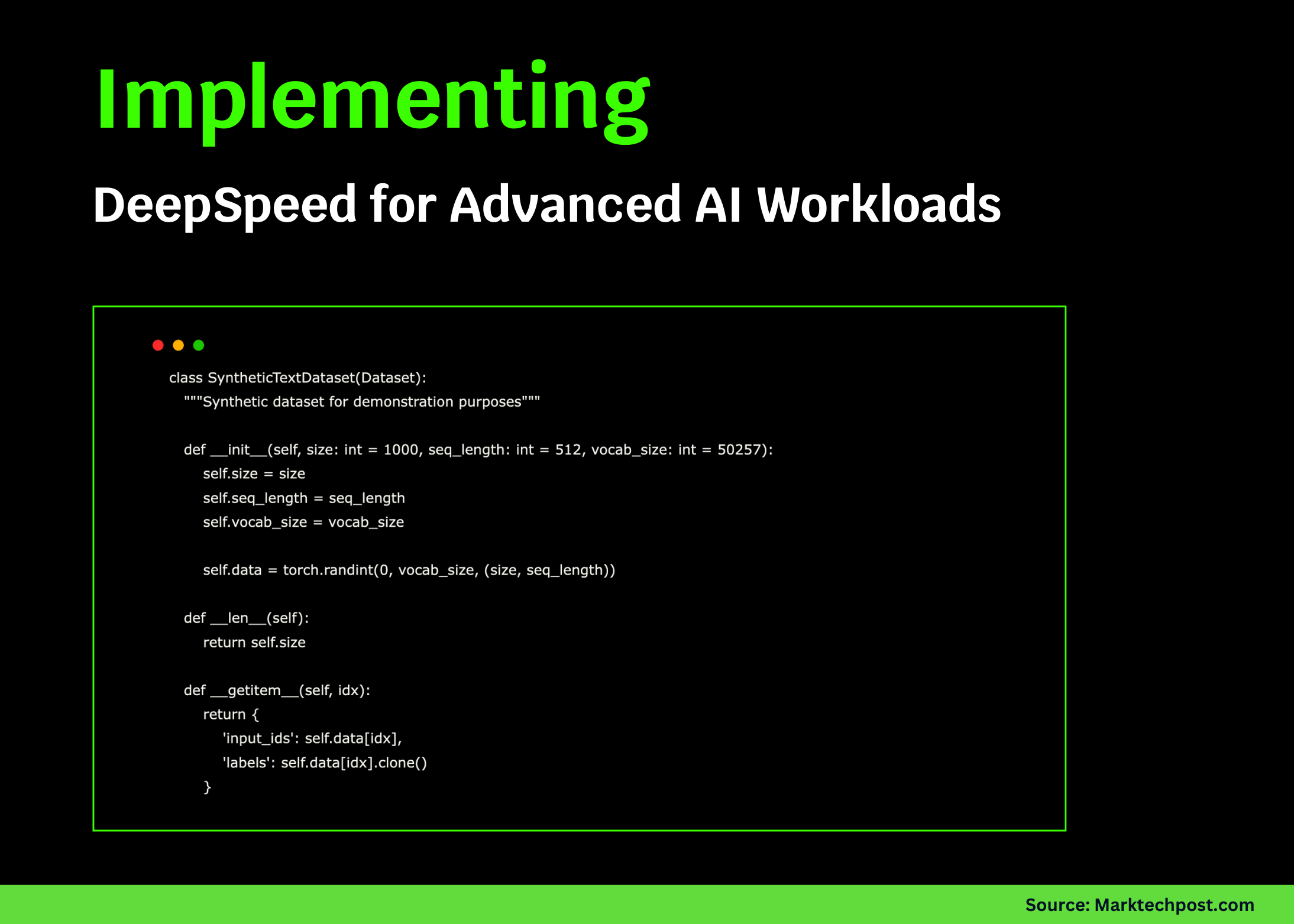
Implementing DeepSpeed for Scalable Transformers: Advanced Training with Gradient Checkpointing and Parallelism

The article highlights the integration of advanced optimization techniques within DeepSpeed to enhance the training efficiency of large language models, particularly in resource-constrained environments like Colab. Key innovations include the combined use of ZeRO optimization, mixed-precision training, gradient accumulation, and sophisticated DeepSpeed configurations, which collectively maximize GPU memory utilization, reduce training overhead, and facilitate the scaling of transformer models. This comprehensive approach not only improves training performance but also encompasses practical aspects such as inference optimization, checkpointing, and benchmarking of different ZeRO stages. By providing detailed code implementations and performance monitoring strategies, the tutorial empowers practitioners to

NVIDIA Transformers
Read More
Technology
📄 MarkTechPost

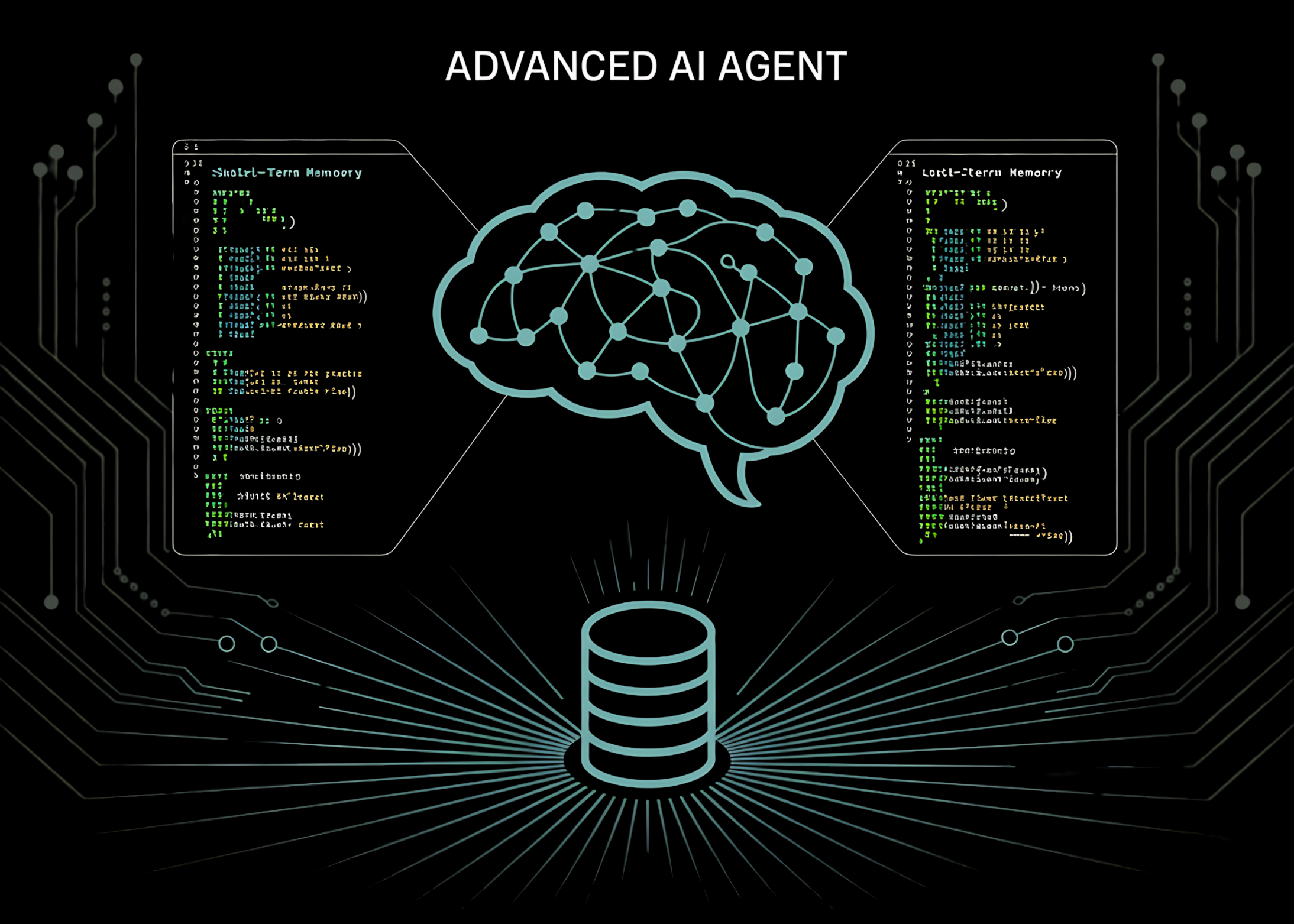
How to Build an Advanced AI Agent with Summarized Short-Term and Vector-Based Long-Term Memory

A new tutorial demonstrates how to develop an advanced AI agent capable of both engaging in conversations and maintaining memory over time by integrating a lightweight large language model (LLM) with FAISS vector search and summarization techniques. This approach enables the agent to utilize short-term memory for immediate context and long-term memory through vector-based embeddings and auto-distilled facts, allowing it to recall relevant information in future interactions and adapt to user instructions efficiently. The implementation leverages tools such as transformers, sentence-transformers, and FAISS, optimized for GPU or CPU environments, to create a scalable and intelligent conversational system. This

Research
📄 MarkTechPost

Microsoft AI Lab Unveils MAI-Voice-1 and MAI-1-Preview: New In-House Models for Voice AI

Microsoft AI Lab has launched two new in-house AI models, MAI-Voice-1 and MAI-1-preview, marking a significant step in the companys independent AI research efforts. MAI-Voice-1 is a transformer-based speech synthesis model capable of generating high-fidelity, natural-sounding audio in under one second per minute using a single GPU, supporting multilingual and multi-speaker scenarios with applications in interactive assistants and podcast narration, and is integrated into Microsoft products like Copilot Daily.

Microsoft NVIDIA +1

Read More
Research
📄 MarkTechPost

How to Cut Your AI Training Bill by 80%? Oxfords New Optimizer Delivers 7.5x Faster Training by Optimizing How a Model Learns

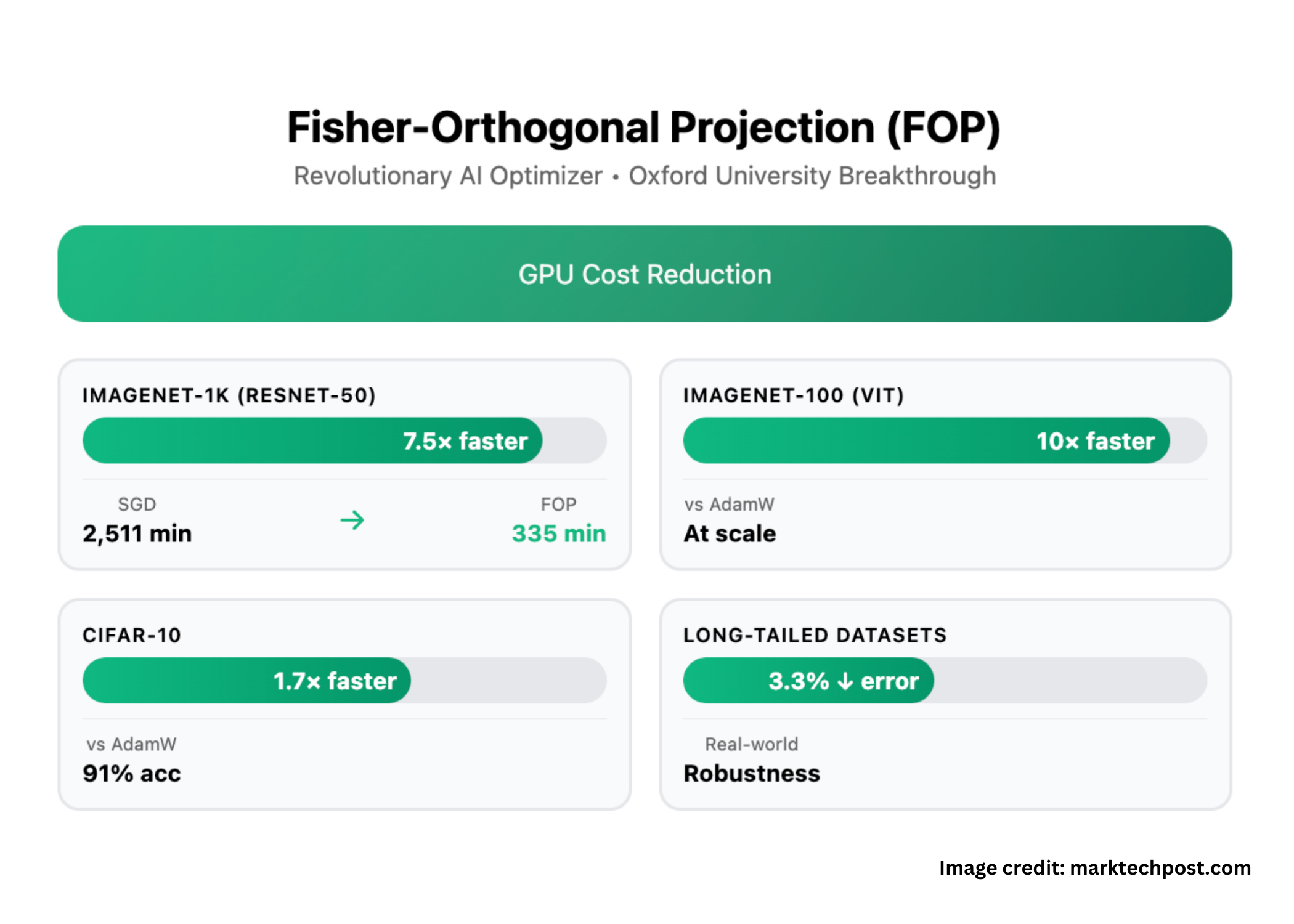
Researchers at the University of Oxford have developed a novel optimizer called Fisher-Orthogonal Projection (FOP) that significantly reduces the computational costs associated with AI model training, achieving up to an 87% reduction in GPU expenses. By rethinking the way gradients are handled during training, FOP effectively optimizes the learning process, enabling models such as vision transformers trained on ImageNet-1K to be trained 7.5 times faster and more efficiently. This innovation addresses a critical bottleneck in AI development, where the high cost of GPU compute limits experimentation and progress across startups, research labs, and

NVIDIA Transformers
Read More
Technology
📄 MarkTechPost

GPZ: A Next-Generation GPU-Accelerated Lossy Compressor for Large-Scale Particle Data

Researchers from multiple institutions have developed GPZ, a GPU-accelerated, error-bounded lossy compressor designed to efficiently reduce the size of large-scale particle and point-cloud datasets. This innovative tool significantly enhances data throughput, compression ratios, and fidelity, outperforming five leading existing solutions, thereby addressing the critical challenge of managing the explosive growth of scientific and commercial data generated by particle-based simulations and applications. The core technical advancement lies in GPZs ability to handle the irregular, low-redundancy nature of particle datacharacterized by vast, multidimensional point cloudswithout bottlenecking modern

Research
📄 MarkTechPost

Top 10 AI Blogs and News Websites for AI Developers and Engineers in 2025

The OpenAI Blog remains a pivotal resource for AI developers, offering detailed insights into the latest advancements in large language models, AI safety, and deployment strategies, thereby shaping the future trajectory of AI research and application. Complementing this, the NVIDIA Developer Blog emphasizes GPU-accelerated AI, providing technical guidance on optimizing deep learning workflows through CUDA programming, performance benchmarks, and hardware architecture analysis, which are crucial for maximizing computational efficiency. Together, these platforms highlight the ongoing focus on both innovative model development and hardware optimization, reflecting the industrys dual priorities of advancing AI capabilities while ensuring scalable, high-performance deployment.

GPT NVIDIA +1
Read More
Business
📄 AI News

DeepSeek: The Chinese startup challenging Silicon Valley

Chinese startup DeepSeek has rapidly disrupted the AI industry by developing competitive models that outperform or match those of established Silicon Valley giants while utilizing substantially fewer resources. Their innovative approach leverages advanced techniques such as Multi-head Latent Attention (MLA) to mitigate memory bottlenecks and Group Relative Policy Optimization (GRPO) to enhance reinforcement learning efficiency, enabling cost-effective scaling and deployment. This technological breakthrough has had immediate market implications, causing notable declines in major tech stocks like Nvidia, Microsoft, and Meta, as investors reassess the competitive landscape. DeepSeek's successful launch of a free AI assistant app for

Meta AI Microsoft +2
Read More
Ethics
📄 MarkTechPost

NVIDIA AI Releases ProRLv2: Advancing Reasoning in Language Models with Extended Reinforcement Learning RL

NVIDIA's ProRLv2 represents a significant advancement in large language model (LLM) reasoning capabilities by extending reinforcement learning (RL) steps from 2,000 to 3,000, enabling the exploration of more complex solution spaces and fostering higher-level reasoning and creativity. This iteration introduces key innovations such as the REINFORCE++ baseline for stable long-horizon optimization, KL divergence regularization combined with reference policy resets to maintain stable progress, and Decoupled Clipping & Dynamic Sampling (DAPO) techniques that promote diversity in generated solutions by emphasizing less likely tokens and intermediate difficulty prompts

Research
📄 AI News

NVIDIA latest: Blackwell GPU and software updates

NVIDIA's upcoming RTX PRO 6000 Blackwell Server Edition GPU will be integrated into enterprise 2U servers from major vendors such as Cisco, Dell, HPE, Lenovo, and Supermicro, offering significant advancements in AI, graphics, simulation, and analytics workloads. These GPUs are designed to deliver up to 45 times the performance and 18 times the energy efficiency of traditional CPU-only systems, enabling faster AI model training, content creation, and scientific research within data centers. This development marks a pivotal shift in enterprise computing, as NVIDIA emphasizes that AI is transforming on-premises data center architectures

Research
📄 MarkTechPost

NVIDIA XGBoost 3.0: Training Terabyte-Scale Datasets with Grace Hopper Superchip

NVIDIA has released XGBoost 3.0, enabling training of gradient-boosted decision tree models on datasets up to 1 terabyte using a single GH200 Grace Hopper Superchip. This breakthrough leverages the new External-Memory Quantile DMatrix and the chips coherent memory architecture with 900GB/s NVLink-C2C bandwidth to stream compressed data directly from host RAM to GPU, overcoming previous memory limitations and simplifying large-scale machine learning workflows.

NVIDIA Machine Learning
Read More
Technology
📄 MarkTechPost

DeepReinforce Team Introduces CUDA-L1: An Automated Reinforcement Learning (RL) Framework for CUDA Optimization Unlocking 3x More Power from GPUs

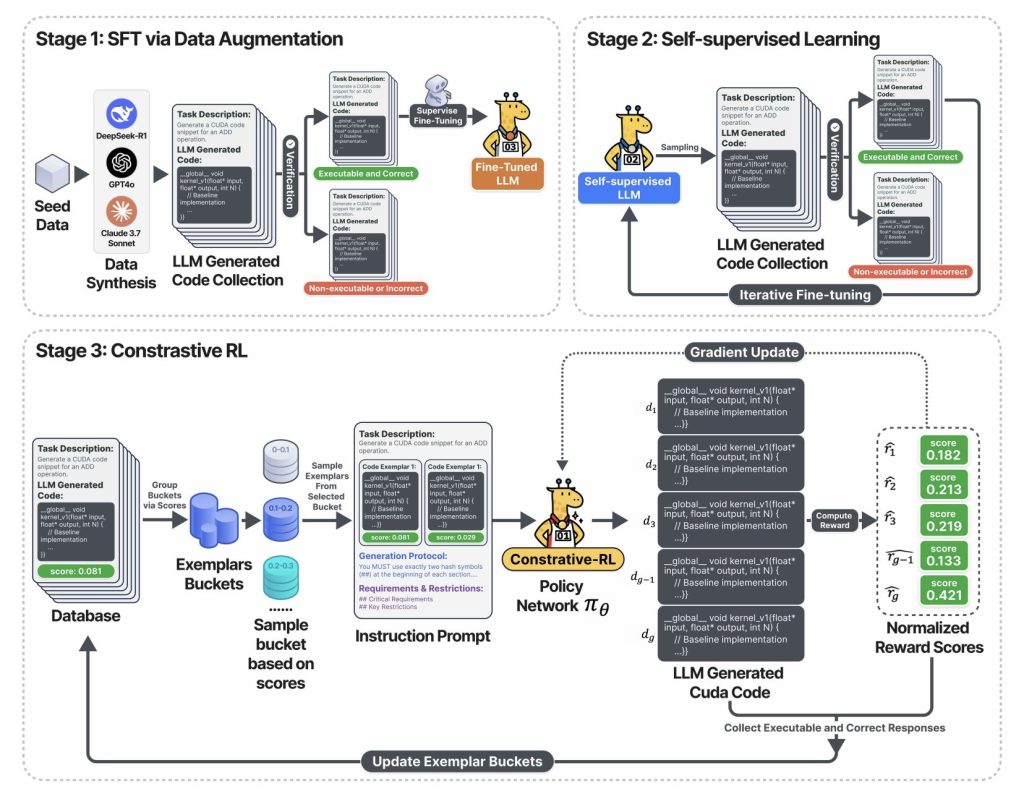
The DeepReinforce Team has developed CUDA-L1, an automated reinforcement learning framework that leverages Contrastive Reinforcement Learning (Contrastive-RL) to optimize CUDA code, achieving an average 3.12 speedup and up to 120 peak acceleration across 250 real-world GPU tasks on NVIDIA hardware. Unlike traditional reinforcement learning, Contrastive-RL incorporates performance feedback and code variant analysis into each optimization cycle, enabling the AI to generate natural language performance reflections that guide successive improvements without human intervention.

NVIDIA NLP
Read More
Research
📄 MarkTechPost

NVIDIA AI Presents ThinkAct: Vision-Language-Action Reasoning via Reinforced Visual Latent Planning

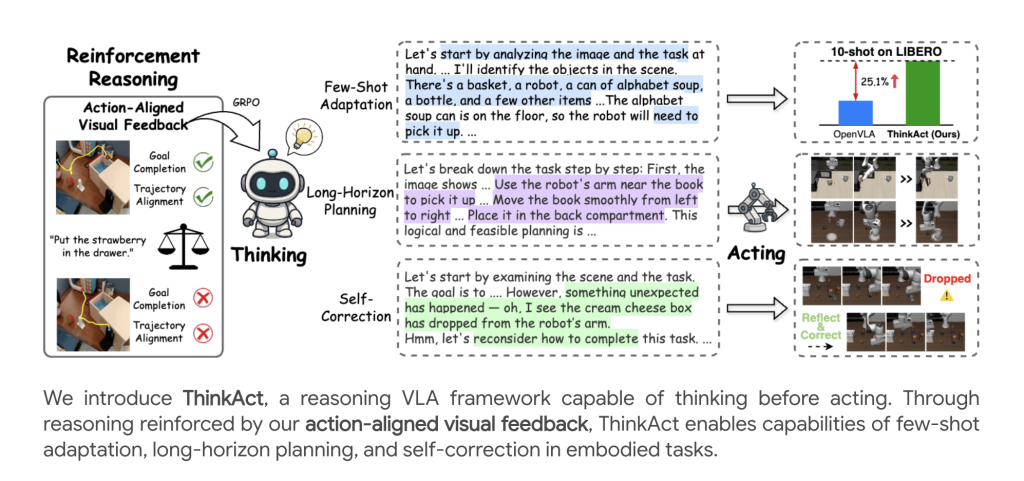
NVIDIA and National Taiwan University researchers have developed ThinkAct, an embodied AI framework that advances vision-language-action (VLA) reasoning by integrating reinforced visual latent planning to connect high-level multimodal reasoning with low-level robotic control. Unlike traditional end-to-end VLA models, ThinkAct employs a dual-system architecture featuring a multimodal large language model (MLLM) that generates structured, step-by-step visual plan latents, enabling improved long-term planning, adaptability, and robustness in complex, dynamic environments.

NVIDIA Robotics
Read More
Research
📄 MarkTechPost

NVIDIA AI Released DiffusionRenderer: An AI Model for Editable, Photorealistic 3D Scenes from a Single Video

NVIDIA, in collaboration with the University of Toronto, Vector Institute, and University of Illinois Urbana-Champaign, has introduced DiffusionRenderer, an AI framework that enables editable, photorealistic 3D scene reconstruction from a single video. This innovation overcomes previous limitations by allowing professional-level control and realistic editssuch as changing lighting conditions or object materialsbridging the gap between video generation and manipulation. DiffusionRenderer marks a paradigm shift from traditional physically based rendering (PBR) methods by integrating AI-driven diffusion models to both understand and modify 3D scenes seamlessly. This advancement unlock

Business
📄 MarkTechPost

Why Small Language Models (SLMs) Are Poised to Redefine Agentic AI: Efficiency, Cost, and Practical Deployment

Recent developments in agentic AI highlight a strategic shift from large language models (LLMs) to smaller, more efficient models (SLMs) for specialized, repetitive tasks. While LLMs continue to underpin decision-making and complex interactions due to their human-like conversational abilities, researchers from NVIDIA and Georgia Tech advocate for integrating SLMs, citing their superior efficiency and cost-effectiveness for routine operations. This approach aims to optimize resource utilization and reduce reliance on centralized cloud APIs, which dominate current AI deployment strategies. The growing adoption of AI agents by over half of major IT companies underscores the importance of scalable,

Technology
📄 MarkTechPost

AREAL: Accelerating Large Reasoning Model Training with Fully Asynchronous Reinforcement Learning

The article introduces AREAL, a novel approach to accelerate the training of Large Reasoning Models (LRMs) by employing fully asynchronous reinforcement learning (RL), addressing the significant bottlenecks associated with traditional synchronous batch processing. This method enables more efficient utilization of GPU resources by allowing intermediate reasoning steps to be processed independently and concurrently, thereby improving scalability and training speed for complex reasoning tasks such as math and coding. By leveraging asynchronous RL, AREAL enhances the ability of LRMs to generate intermediate "thinking" steps without waiting for the slowest outputs in a batch, which traditionally hampers performance. This innovation

Startups
📄 AI News

NVIDIA helps Germany lead Europes AI manufacturing race

Germany and NVIDIA are collaborating to establish Europe's first industrial AI cloud, a project aimed at transforming manufacturing through advanced AI infrastructure. This initiative, resulting from a partnership with Deutsche Telekom, will create an "AI factory" designed to provide European industrial companies with the computational resources necessary for innovation in areas such as design, robotics, and simulation-driven manufacturing, thereby enhancing Europe's technological sovereignty. The project signifies a strategic move to position Europe at the forefront of AI-driven industrial innovation, with NVIDIA's CEO Jensen Huang emphasizing the importance of dual factoriesone for manufacturing and one for AI developmentin the modern industrial landscape.

NVIDIA Robotics
Read More
Business
📄 MarkTechPost

How Much Do Language Models Really Memorize? Metas New Framework Defines Model Capacity at the Bit Level

Researchers from Metas FAIR, Google DeepMind, Cornell University, and NVIDIA have developed a novel framework to quantify language model memorization at the bit level, distinguishing between unintended memorization of specific training data and genuine generalization of underlying data patterns. This approach addresses limitations of prior methods by providing a scalable, precise measurement of how much information large transformer models, such as an 8-billion parameter model trained on 15 trillion tokens, retain about individual datapoints versus broader data distributions.

Google AI Meta AI +2
Read More
Technology
📄 MarkTechPost

Meta Introduces LlamaRL: A Scalable PyTorch-Based Reinforcement Learning RL Framework for Efficient LLM Training at Scale

Meta has introduced LlamaRL, a scalable reinforcement learning framework built on PyTorch designed to enhance the fine-tuning of large language models (LLMs) at scale. This development addresses the critical challenge of applying reinforcement learning (RL) to massive models with hundreds of billions of parameters, where resource demands such as memory, communication latency, and GPU utilization pose significant hurdles. LlamaRL aims to optimize the training process by improving GPU efficiency and reducing bottlenecks, enabling more effective adaptation of LLM outputs based on structured feedback. The integration of RL into LLM fine-tuning is increasingly vital for

Meta AI NVIDIA
Read More
General
📄 MarkTechPost

NVIDIA Introduces ProRL: Long-Horizon Reinforcement Learning Boosts Reasoning and Generalization

NVIDIA has introduced ProRL, a long-horizon reinforcement learning framework designed to enhance reasoning and generalization in AI language models. This development addresses key limitations in current reasoning-focused models by enabling extended training periods that foster the emergence of novel reasoning capabilities, moving beyond mere optimization of sampling efficiency. Unlike traditional approaches constrained by domain-specific overtraining and premature training termination, ProRL leverages reinforcement learning with verifiable rewards to facilitate sustained, scalable learning, akin to breakthroughs seen in systems like AlphaZero. This innovation signifies a major step forward in AI's ability to perform complex, multi-step reasoning tasks, particularly

Technology
📄 Unite.AI

DeepSeek-V3 Unveiled: How Hardware-Aware AI Design Slashes Costs and Boosts Performance

DeepSeek-V3 showcases a significant advancement in cost-effective AI development by leveraging hardware-software co-design to achieve state-of-the-art performance using only 2,048 NVIDIA H800 GPUs. Key innovations include Multi-head Latent Attention for enhanced memory efficiency, a Mixture of Experts architecture for optimized computation, and FP8 mixed-precision training, enabling smaller teams to compete with large tech companies without relying on massive computational resources.

NVIDIA Transformers
Read More
Technology
📄 MarkTechPost

Hugging Face Releases SmolVLA: A Compact Vision-Language-Action Model for Affordable and Efficient Robotics

Hugging Face has introduced SmolVLA, a lightweight and open-source vision-language-action (VLA) model designed to make robotic control more accessible and cost-effective. Unlike traditional VLA models that rely on large transformer architectures with billions of parameters, SmolVLA employs a streamlined architecture combining a compact pretrained vision-language model (SmolVLM-2) with a transformer-based action expert, enabling efficient operation on single-GPU or CPU setups. This innovation addresses the high hardware and data requirements that have historically limited deployment and experimentation in robotics, facilitating broader research and practical applications across diverse platforms

NVIDIA Robotics +1
Read More
Research
📄 NVIDIA Blog

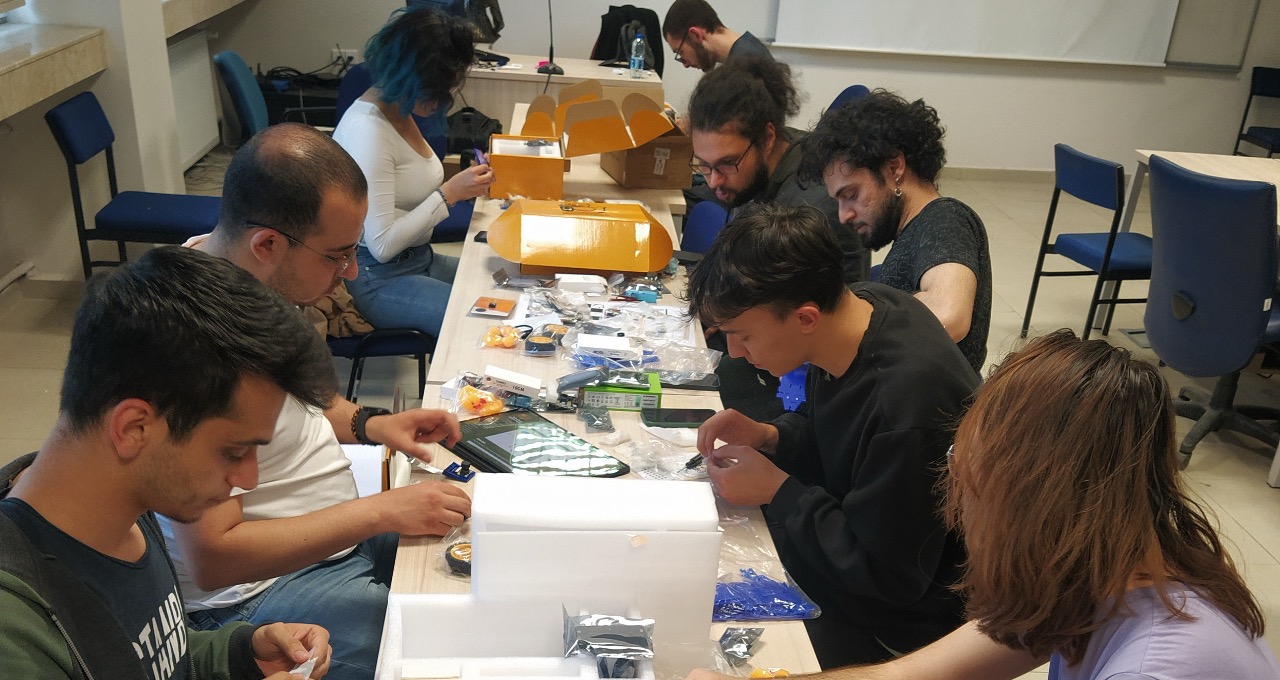
Researchers and Students in Trkiye Build AI, Robotics Tools to Boost Disaster Readiness

Since the devastating 7.8-magnitude earthquake in Syria and Trkiye two years ago, researchers and developers have been leveraging AI robotics technologies to improve disaster preparedness in the region. Supported by a NVIDIA Disaster Response Innovation and Education Grant, these efforts include AI-powered search and rescue tools, robotics training, and contamination testing, aiming to enhance response capabilities and community resilience.

NVIDIA Robotics
Read More