Technology AI News

Showing 12 of 201 articles

Live feed
Technology
📄 The Hacker News

Researchers Uncover Mining Operation Using ISO Lures to Spread RATs and Crypto Miners

The threat actor operation REF1695 has been actively deploying fake installers since November 2023 to distribute remote access trojans (RATs) and cryptocurrency miners, enhancing their monetization strategies. In addition to cryptomining, they exploit infected systems for CPA fraud by redirecting victims to content locker pages under the pretense of software registration, illustrating a multifaceted approach to financial gain.

Technology
📄 AI News

RPA matters, but AI changes how automation works

Robotic Process Automation (RPA) has traditionally provided a practical solution for automating repetitive, rule-based tasks such as data entry and invoice processing, primarily in sectors like finance and customer support. However, as business processes become more complex and involve unstructured data like documents and messages, RPA's limitations become evident, especially in handling variability and changing inputs, which can lead to increased maintenance and reduced efficiency. Recent advancements integrate AI capabilities into automation platforms, transforming RPA into more adaptive systems that leverage machine learning and natural language processing. Companies like Appian and Blue Prism now offer AI-enhanced automation

Machine Learning NLP
Read More
Technology
📄 AI News

Google makes its industrial robotics AI play officialand this time, it means business

Google's integration of Intrinsic into its core operations marks a strategic move to advance industrial robotics through AI, leveraging the company's Gemini AI models and Google Cloud infrastructure. Intrinsic, originally a moonshot project within Alphabet's X division, specializes in developing accessible AI software like Flowstate, which simplifies programming robotic arms by enabling users to create applications without extensive coding, making industrial robotics more approachable for manufacturers lacking specialized engineering resources. This development signifies Google's broader commitment to embedding AI-driven automation into manufacturing, with Intrinsic remaining a distinct entity within Google to focus on democratizing robotics technology. By combining Intrinsic's hardware

Google AI Robotics
Read More
Technology
📄 AI News

Upgrading agentic AI for finance workflows

Sentient's launch of Arena represents a significant advancement in improving trust and transparency in agentic AI for finance workflows by providing a live, production-grade environment that stress-tests AI agents against complex, real-world scenarios. The platform enables developers to evaluate different computational approaches by feeding agents incomplete, ambiguous, or conflicting data, and crucially, records detailed reasoning traces rather than just output correctness, facilitating debugging and enhancing explainability. This development addresses the critical challenge of automation opacity in financial institutions, where traceable decision-making is essential for regulatory compliance and accurate asset management, ultimately aiming to improve the reliability and interpretability

Technology
📄 The Algorithmic Bridge

The Most Important Skill in AI Right Now: How to Know When to Stop

The article emphasizes the importance of strategic boundaries in AI tool usage to prevent cognitive burnout and maintain productivity, highlighting Siddhant Khare's practical approach of time-boxed sessions, a three-prompt rule, and dedicated AI-free periods to preserve mental clarity. This methodology underscores a broader principle that effective AI integration requires deliberate limits to ensure it enhances human reasoning rather than depletes it, positioning mindful AI use as a form of mental engineering. By advocating for intentional engagement with AIknowing when to stop, when to refine outputs, and when to rely on personal effortthe article underscores that the

Technology
📄 AI News

Banking AI in multiple business functions at NatWest

NatWest Group has significantly expanded its deployment of artificial intelligence across multiple operational areas, including customer service, document management, and software development, with large-scale implementation beginning in 2025. A key innovation is the enhancement of its digital assistant, Cora, which now supports 21 different customer journeys through generative AI based on OpenAI models, enabling quicker resolutions and reducing human intervention, particularly in handling transactions, spending inquiries, and fraud reporting. The bank's AI initiatives have also delivered substantial internal efficiencies, such as automated call summaries and complaint drafting tools that have saved over 70,000 hours of

Technology
📄 MarkTechPost

The Statistical Cost of Zero Padding in Convolutional Neural Networks (CNNs)

Zero padding is a fundamental technique in convolutional neural networks (CNNs) that involves adding zero-valued pixels around the borders of an input image. This approach enables convolutional kernels to process edge pixels effectively and helps maintain the spatial dimensions of feature maps, preventing excessive shrinking after multiple convolutional layers. By controlling the amount of padding, researchers and engineers can preserve important spatial information and facilitate the construction of deeper, more complex neural network architectures. Recent analyses highlight the trade-offs associated with zero padding, particularly its impact on the statistical cost and computational efficiency of CNNs. While zero padding allows for better feature

Deep Learning
Read More
Technology
📄 MarkTechPost

How an AI Agent Chooses What to Do Under Tokens, Latency, and Tool-Call Budget Constraints?

A recent development in AI involves creating a cost-aware planning agent capable of balancing output quality with real-world resource constraints such as token limits, latency, and tool-call budgets. This agent generates multiple candidate actions, estimates their expected costs and benefits, and selects an optimal execution plan that maximizes value while adhering to strict resource budgets, thereby enabling more efficient and reliable deployment in constrained environments. This approach marks a significant shift from traditional "always use the LLM" behavior, as it incorporates explicit reasoning about trade-offs, efficiency, and resource management. By designing agents that can reason about and optimize their actions based

Technology
📄 MarkTechPost

Understanding the Layers of AI Observability in the Age of LLMs

AI observability has become crucial for understanding and monitoring large language models (LLMs) and generative AI systems, which are inherently probabilistic and lack transparent execution paths. Unlike traditional software, these models operate as "black boxes," making it challenging to trace decision-making processes, especially in high-stakes environments, thereby necessitating advanced observability techniques similar to logging, metrics, and distributed tracing used in conventional software engineering. To address these challenges, a layered approach to AI observability is emerging, where each stage of an AI pipelinesuch as input processing, model response, and downstream actionsis monitored

Technology
📄 AI News

Agentic AI scaling requires new memory architecture

Agentic AI is evolving from simple, stateless chatbots to systems capable of managing complex workflows that require extensive long-term memory, necessitating new memory architectures to scale effectively. As foundation models grow to trillions of parameters with context windows reaching millions of tokens, the computational burden of maintaining historical context surpasses current hardware capabilities, creating a bottleneck in deploying real-time, long-term AI agents. To address this challenge, NVIDIA has introduced the Inference Context Memory Storage (ICMS) platform within its Rubin architecture, a specialized storage tier designed to efficiently handle the high-velocity, ephemeral memory demands of

Technology
📄 MarkTechPost

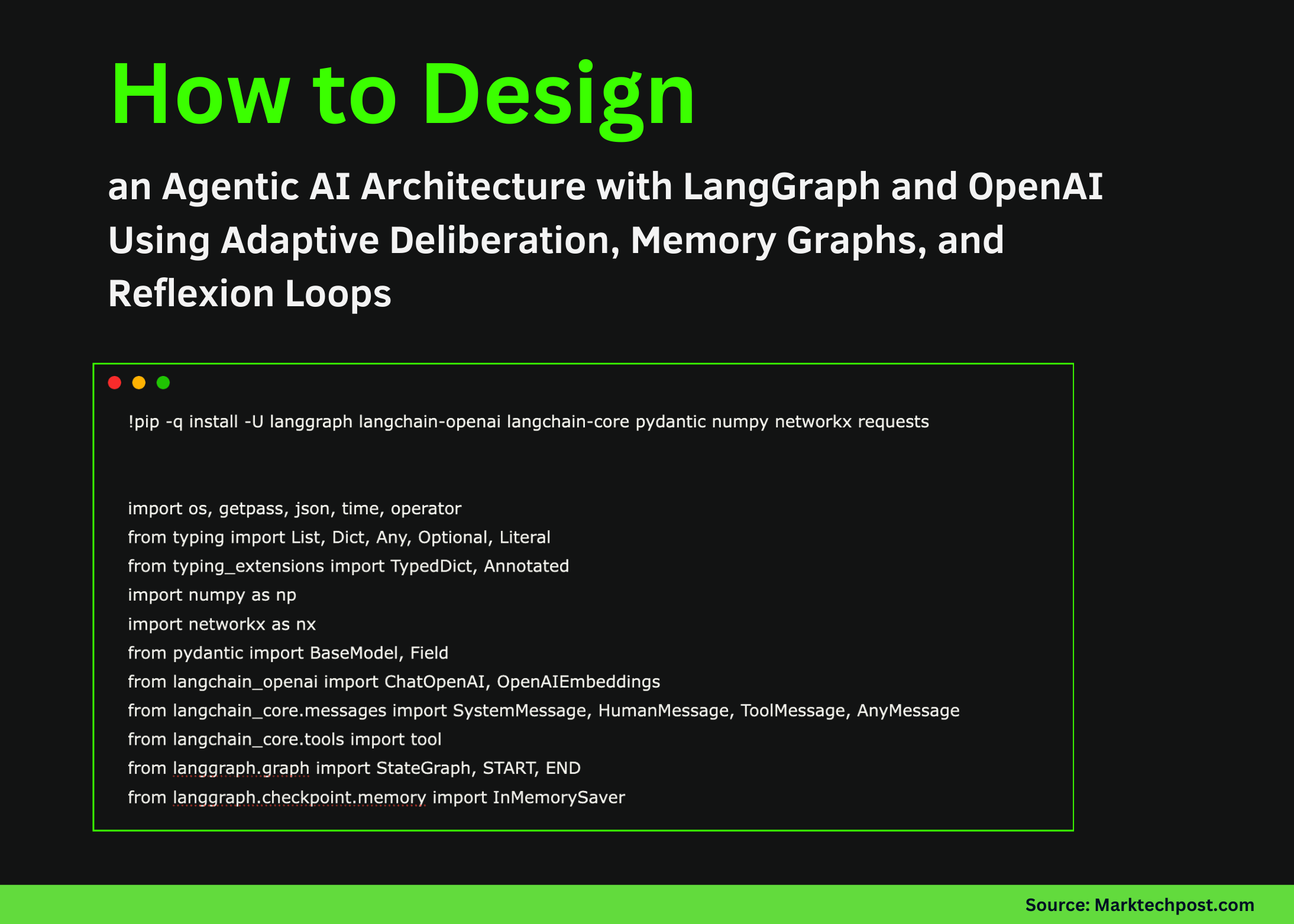
How to Design an Agentic AI Architecture with LangGraph and OpenAI Using Adaptive Deliberation, Memory Graphs, and Reflexion Loops

A recent development in AI architecture leverages LangGraph and OpenAI models to create a truly advanced agentic system that surpasses traditional planner-executor loops. This system incorporates adaptive deliberation, enabling the agent to dynamically switch between rapid and in-depth reasoning processes, and employs a Zettelkasten-style memory graph that autonomously links atomic knowledge and related experiences, enhancing contextual understanding and learning. Additionally, the architecture features a governed tool-use mechanism that enforces operational constraints during execution, integrating structured state management, memory-aware retrieval, reflexive learning, and controlled tool invocation. This combination allows the agent to

Technology
📄 AI News

What PubMatics AgenticOS signals for enterprise marketing

PubMatic's launch of AgenticOS signifies a major advancement in operationalizing agentic AI within digital advertising, transforming it from experimental to a core system-level capability integrated into programmatic infrastructure. This platform enables multiple AI agents to autonomously transact and optimize advertising campaigns aligned with human-defined objectives and guardrails, streamlining decision-making processes and reducing operational complexity across diverse formats, devices, and regulatory constraints. By functioning as an 'operating system' for programmatic advertising, AgenticOS addresses the inefficiencies and operational overhead faced by large marketing teams, promising faster decision cycles and a shift in human