Page 58 of 130 • 1560 Total Articles

createLiveAI

Continue exploring the latest AI breakthroughs, technology insights, and industry analysis. Page 58 of our comprehensive AI news collection.

📰 Latest Intelligence

Showing 12 articles on page 58 of 130

Live feed
Technology
📄 MarkTechPost

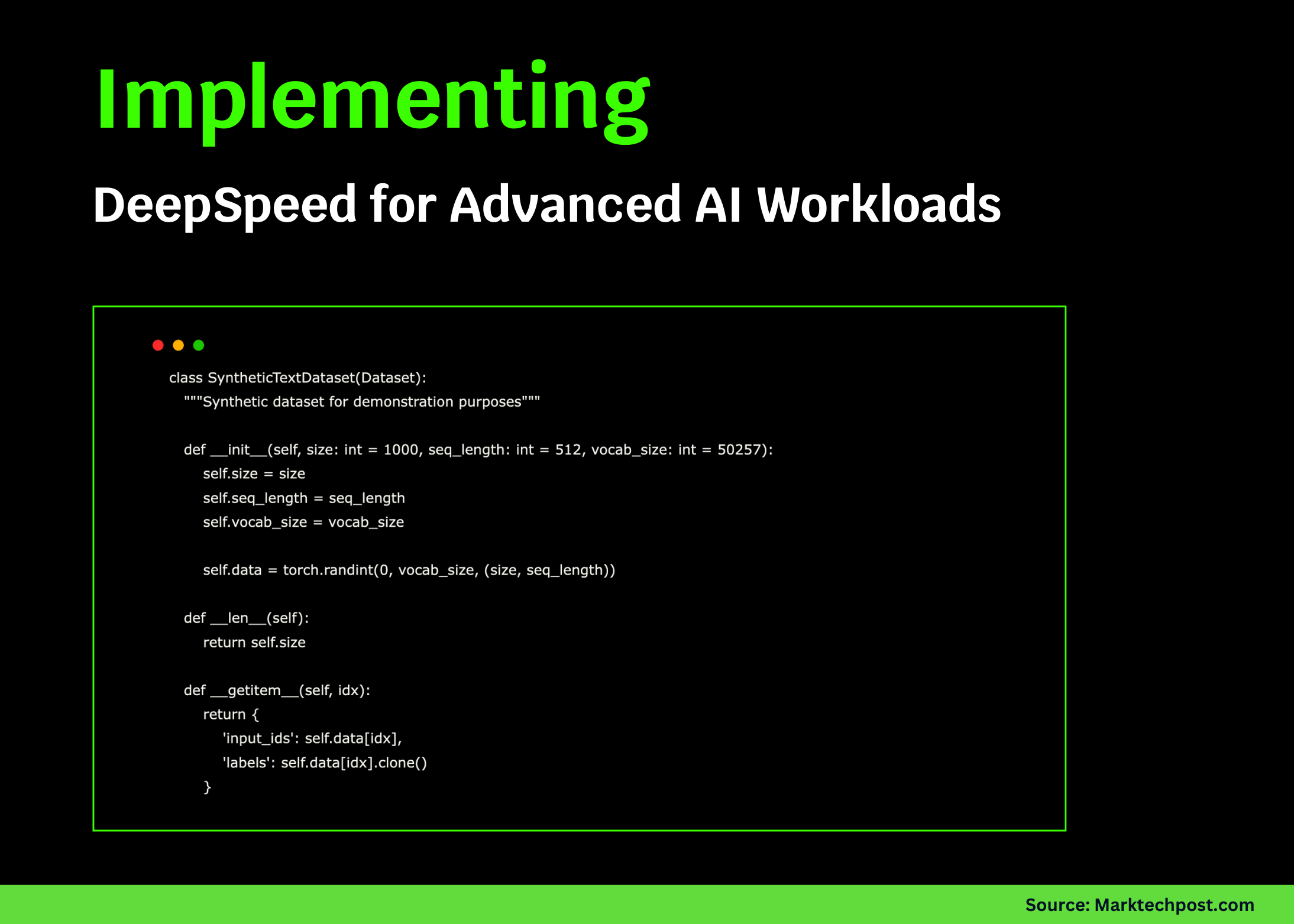
Implementing DeepSpeed for Scalable Transformers: Advanced Training with Gradient Checkpointing and Parallelism

The article highlights the integration of advanced optimization techniques within DeepSpeed to enhance the training efficiency of large language models, particularly in resource-constrained environments like Colab. Key innovations include the combined use of ZeRO optimization, mixed-precision training, gradient accumulation, and sophisticated DeepSpeed configurations, which collectively maximize GPU memory utilization, reduce training overhead, and facilitate the scaling of transformer models. This comprehensive approach not only improves training performance but also encompasses practical aspects such as inference optimization, checkpointing, and benchmarking of different ZeRO stages. By providing detailed code implementations and performance monitoring strategies, the tutorial empowers practitioners to


NVIDIA Transformers
Read More
Technology
📄 MarkTechPost

Alibaba AI Unveils Qwen3-Max Preview: A Trillion-Parameter Qwen Model with Super Fast Speed and Quality

Alibabas Qwen team has introduced Qwen3-Max-Preview (Instruct), a flagship large language model boasting over one trillion parameters, making it the largest in Alibabas lineup. The model features a substantial context window of up to 262,144 tokens, including 258,048 input tokens and 32,768 output tokens, and incorporates context caching to enhance multi-turn session speed. It demonstrates superior performance on benchmarks such as SuperGPQA, AIME25, and LiveCodeBench v6, outperforming models like Qwen3-235B-A22B-2507 and competing

Business
📄 Towards Data Science

Showcasing Your Work on HuggingFace Spaces

Hugging Face Spaces has emerged as a user-friendly, free platform for deploying and sharing machine learning applications, filling the gap left by the discontinuation of free tiers on services like Heroku. The platform simplifies the deployment process for small apps, such as a Streamlit-based stock financial visualization tool, enabling developers to make their projects live and accessible with minimal effort. This development democratizes app sharing, making it easier for data scientists and developers to showcase their work without incurring costs or complex setup procedures. By leveraging Hugging Face Spaces, users can deploy interactive machine learning demos quickly through a streamlined interface

Machine Learning
Read More
Business
📄 MarkTechPost

Google AI Releases EmbeddingGemma: A 308M Parameter On-Device Embedding Model with State-of-the-Art MTEB Results

Google has introduced EmbeddingGemma, a highly efficient open-source text embedding model optimized for on-device AI applications. With only 308 million parameters, EmbeddingGemma achieves a remarkable balance between compactness and performance, enabling deployment on mobile devices and offline environments while maintaining competitive retrieval accuracy. Its architecture is based on a Gemma 3style transformer encoder with mean pooling, optimized for text rather than multimodal inputs, and it demonstrates low inference latency (sub-15 ms for 256 tokens on EdgeTPU), making it suitable for real-time semantic search and cross-lingual retrieval tasks

Google AI Transformers
Read More
Research
📄 Towards Data Science

MobileNetV1 Paper Walkthrough: The Tiny Giant

The article provides a comprehensive guide to understanding and implementing MobileNetV1 from scratch using PyTorch, emphasizing its efficiency for mobile and embedded applications. It details the architecture's core components, such as depthwise separable convolutions, which significantly reduce computational complexity while maintaining accuracy, enabling developers to build lightweight models suitable for resource-constrained environments.

Business
📄 MarkTechPost

Google DeepMind Finds a Fundamental Bug in RAG: Embedding Limits Break Retrieval at Scale

Google DeepMind has identified a fundamental architectural limitation in Retrieval-Augmented Generation (RAG) systems stemming from the fixed-dimensional nature of dense embeddings, which restricts their ability to scale effectively as document databases grow. The research reveals that the representational capacity of embeddingsdetermined by their dimensionalitylimits the number of documents that can be accurately retrieved: approximately 500,000 for 512-dimensional vectors, 4 million for 1024 dimensions, and up to 250 million for 4096 dimensions, based on theoretical bounds. This limitation persists despite improvements in model size or training techniques,

Google AI
Read More
Research
🎓 MIT Tech Review AI

Imagining the future of banking with agentic AI

Agentic AI is reaching a level of maturity that enables large-scale process automation in financial services, surpassing traditional rules-based systems like robotic process automation. This advancement allows banks to optimize operations, improve customer experiences, and reduce costs by automating complex tasks such as loan approvals, customer service responses, and contract analysis, often with minimal human intervention. Experts like Sameer Gupta from EY highlight that the technological capabilities of agentic AI now make it feasible to handle unstructured data and complex decision-making processes at scale, which was previously unattainable. The rapid adoption of agentic AI in banking underscores its

Academic
Read More
Research
📄 Towards Data Science

Boosting Your Anomaly Detection With LLMs

The article highlights seven emerging application patterns for artificial intelligence, emphasizing their growing significance across various industries. Notably, it discusses the use of large language models (LLMs) for anomaly detection, showcasing how these advanced models can identify unusual patterns and deviations in data more effectively, thereby enhancing predictive analytics and operational efficiency.

General
📄 AI News

From minutes to milliseconds: How CrateDB is tackling AI data infrastructure

CrateDB is advancing AI infrastructure by providing a unified data layer capable of handling real-time analytics, search, and AI workloads, addressing the limitations of traditional batch and asynchronous pipelines. Its architecture enables the ingestion, aggregation, and serving of complex, high-volume data in milliseconds, significantly reducing query times from minutes to milliseconds, which is critical for applications like predictive maintenance and real-time decision-making in manufacturing. This development facilitates faster insights and feedback loops between operational data and AI models, supporting more responsive and scalable AI systems essential for future technological demands.

Page 58 of 130 • Showing articles 685-696 of 1560