Page 72 of 130 • 1560 Total Articles

createLiveAI

Continue exploring the latest AI breakthroughs, technology insights, and industry analysis. Page 72 of our comprehensive AI news collection.

📰 Latest Intelligence

Showing 12 articles on page 72 of 130

Live feed
Research
📄 Towards Data Science

Stellar Flare Detection and Prediction Using Clustering and Machine Learning

Researchers have developed a novel approach that integrates unsupervised clustering with supervised machine learning techniques to enhance the detection and prediction of stellar flares. This hybrid methodology leverages clustering algorithms to identify patterns in stellar data without prior labels, which are then used to train supervised models for accurate flare prediction, potentially improving real-time monitoring of stellar activity and advancing astrophysical research.

Machine Learning
Read More
Research
📄 Towards Data Science

Mechanistic View of Transformers: Patterns, Messages, Residual Stream and LSTMs

A recent development in transformer models proposes shifting from traditional concatenation-based attention mechanisms to a decomposition-based approach, offering a novel perspective on how attention operates within neural networks. This method emphasizes breaking down the attention process into more interpretable components, potentially enhancing the understanding of message passing and residual streams in models like Transformers and LSTMs. By decomposing attention, researchers aim to improve model interpretability and efficiency, paving the way for more transparent and potentially more effective deep learning architectures.

Deep Learning Transformers
Read More
Business
🎓 MIT Tech Review AI

A glimpse into OpenAIs largest ambitions

OpenAI is advancing its dual mission of developing artificial general intelligence (AGI) while ensuring its benefits are widely shared, with recent achievements highlighting its progress in creating AI systems that can outperform humans in specific domains. Notably, OpenAI's models secured second place in a top-tier coding competition and achieved gold-medal-level results at the 2025 International Math Olympiad, demonstrating significant strides in AI's mathematical and analytical capabilities. These accomplishments underscore AI's growing proficiency in complex reasoning tasks traditionally associated with human intelligence, challenging perceptions that AI lacks competitive potential in such areas. The company's focus extends beyond mere

GPT Academic
Read More
Business
📄 AI News

Tencent releases versatile open-source Hunyuan AI models

Tencent has expanded its open-source Hunyuan AI model family, offering versatile pre-trained and instruction-tuned models ranging from 0.5 billion to 7 billion parameters, optimized for diverse computational environments including edge devices and high-concurrency systems. These models, developed using training strategies similar to the high-performance Hunyuan-A13B, feature a notable 256K context window, enabling advanced handling of long-text tasks such as complex document analysis and extended conversations. This development provides developers and businesses with flexible, high-capability AI tools suitable for a broad spectrum of applications, from resource-constrained devices

Research
📄 The Algorithmic Bridge

GPT-5: OpenAIs Flagship Model Faces Great Expectations

OpenAI's upcoming GPT-5 model is generating significant anticipation, with expectations that it will push the boundaries of AI capabilities despite potential limitations. While unofficial leaks suggest GPT-5 will be a robust model, it is likely to still exhibit issues such as hallucinations, unreliability in complex scenarios, and challenges in real-world application integration, reflecting the ongoing gap between benchmark performance and practical utility. The article emphasizes that the hype surrounding GPT-5 may lead to unfair disappointment, as the model's advancements will be accompanied by persistent technical hurdles, underscoring the need for realistic expectations in AI development and

Business
📄 MarkTechPost

Now Its Claudes World: How Anthropic Overtook OpenAI in the Enterprise AI Race

Anthropic's Claude has overtaken OpenAI as the leading enterprise language model provider, capturing 32% of the market share compared to OpenAIs 25%, marking a significant shift in the enterprise AI landscape. This change reflects Anthropics strategic focus on serving large organizations with tailored features such as advanced data privacy, regulatory compliance, and seamless integration, which have driven its revenue growth from $1 billion to $4 billion within six months. The company's emphasis on addressing complex enterprise needs has solidified Claudes position, particularly in sectors requiring high trust and rigorous governance, and has led to its dominance

GPT Claude
Read More
Technology
📄 MarkTechPost

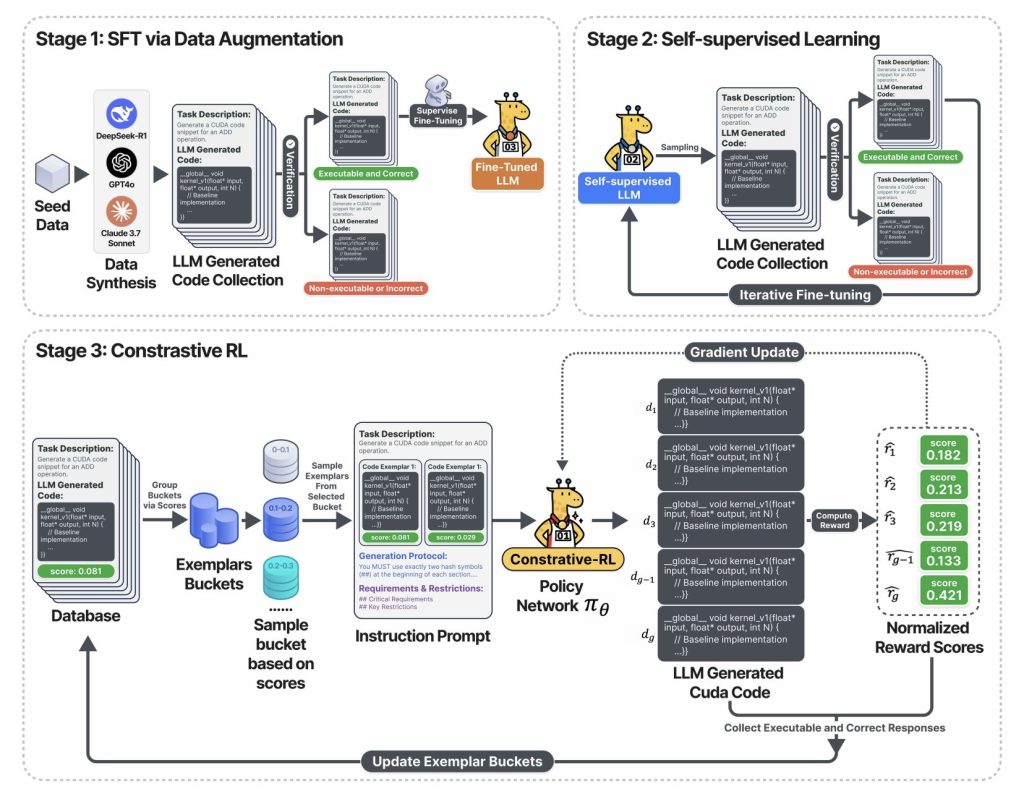
DeepReinforce Team Introduces CUDA-L1: An Automated Reinforcement Learning (RL) Framework for CUDA Optimization Unlocking 3x More Power from GPUs

The DeepReinforce Team has developed CUDA-L1, an automated reinforcement learning framework that leverages Contrastive Reinforcement Learning (Contrastive-RL) to optimize CUDA code, achieving an average 3.12 speedup and up to 120 peak acceleration across 250 real-world GPU tasks on NVIDIA hardware. Unlike traditional reinforcement learning, Contrastive-RL incorporates performance feedback and code variant analysis into each optimization cycle, enabling the AI to generate natural language performance reflections that guide successive improvements without human intervention.

NVIDIA NLP
Read More
Research
📄 MarkTechPost

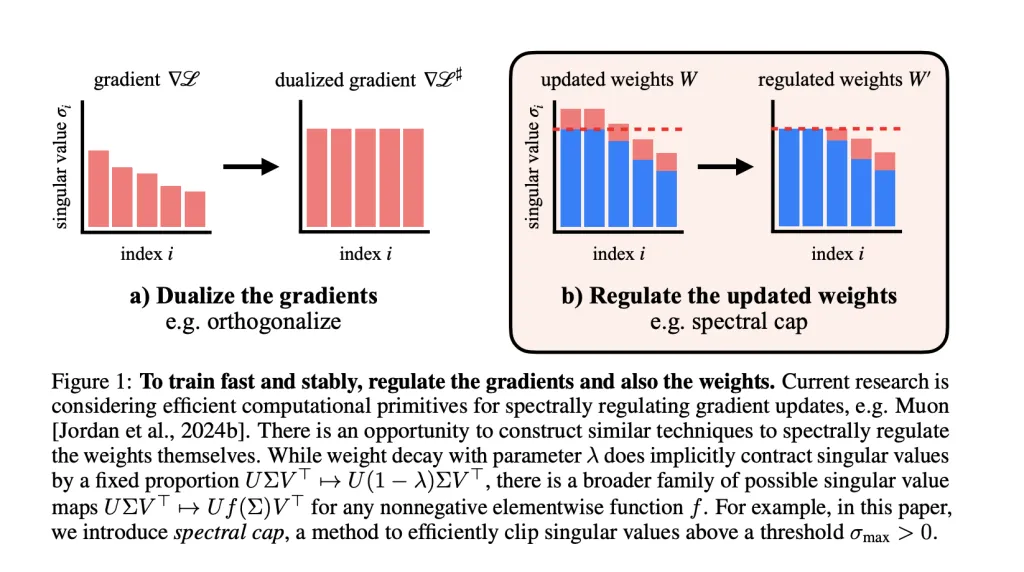
MIT Researchers Develop Methods to Control Transformer Sensitivity with Provable Lipschitz Bounds and Muon

MIT researchers have developed a novel approach to stabilize the training of large-scale transformer models by enforcing provable Lipschitz bounds through spectral regulation of weights, eliminating the need for traditional normalization techniques such as activation normalization or QK norm adjustments. This method directly addresses the core issue of activation explosion and loss spikes caused by unconstrained weight and activation norms, ensuring that the model's sensitivity to input perturbations remains bounded and predictable. By mathematically constraining the Lipschitz constant, the approach enhances the robustness, stability, and generalization capabilities of transformers, which are critical for applications requiring adversarial robustness and

Deep Learning Transformers
Read More

Page 72 of 130 • Showing articles 853-864 of 1560