Page 71 of 130 • 1560 Total Articles

createLiveAI

Continue exploring the latest AI breakthroughs, technology insights, and industry analysis. Page 71 of our comprehensive AI news collection.

📰 Latest Intelligence

Showing 12 articles on page 71 of 130

Live feed
Ethics
📄 MarkTechPost

Alibaba Introduces Group Sequence Policy Optimization (GSPO): An Efficient Reinforcement Learning Algorithm that Powers the Qwen3 Models

Alibaba has introduced Group Sequence Policy Optimization (GSPO), an innovative reinforcement learning algorithm designed to enhance the training stability of large-scale language models like Qwen3. Unlike previous methods such as GRPO, which suffer from high-variance noise and catastrophic failures due to improper importance sampling and clipping mechanisms, GSPO aims to address these stability issues by refining the policy optimization process, enabling more reliable and efficient training of models capable of complex reasoning tasks. This development marks a significant step forward in scaling reinforcement learning for large language models, potentially improving their performance in tasks requiring deep reasoning, such as advanced mathematics and programming

Business
📄 MarkTechPost

MoE Architecture Comparison: Qwen3 30B-A3B vs. GPT-OSS 20B

Alibabas Qwen3 30B-A3B and OpenAIs GPT-OSS 20B represent advanced implementations of Mixture-of-Experts (MoE) transformer architectures, with Qwen3 featuring 30.5 billion parameters and GPT-OSS 20B comprising 21 billion. Qwen3 employs a deeper architecture with 48 layers and 128 experts per layer, activating 8 experts per token to optimize computational efficiency while maintaining high performance, utilizing Grouped Query Attention with 32 query heads and 4 key-value heads. In contrast, GPT-OSS adopts a shallower

GPT Transformers
Read More
Research
📄 AI News

AI obsession is costing us our human skills

Emerging research highlights a concerning paradox: while organizations heavily invest in AI to drive economic growth, over-reliance on these technologies may be diminishing essential human skills necessary for effective AI utilization. Studies from institutions like MIT and insights from Multiverse reveal that neglecting the cultivation of human capabilitiessuch as critical thinking, problem-solving, and adaptabilitycould undermine the very benefits AI aims to deliver, potentially leading to a human skills deficit that hampers long-term productivity and innovation. This development underscores the importance of balancing technological adoption with targeted human skills development, as experts warn that without actively fostering these competencies

General
📄 AI News

Generative AI trends 2025: LLMs, data scaling & enterprise adoption

In 2025, generative AI has matured significantly, with models being optimized for greater accuracy, efficiency, and reliability, enabling their integration into routine enterprise workflows. A key development is the dramatic reduction in the cost of response generationby a factor of 1,000 over two yearsmaking real-time AI applications more feasible for business tasks, while the focus shifts from sheer size to model responsiveness, reasoning ability, and integration capacity. Leading large language models such as Claude Sonnet 4, Gemini Flash 2.5, Grok 4, and DeepSeek V3 are designed to

Claude Google AI
Read More
Research
📄 MarkTechPost

This AI Paper Introduces C3: A Bilingual Benchmark Dataset and Evaluation Framework for Complex Spoken Dialogue Modeling

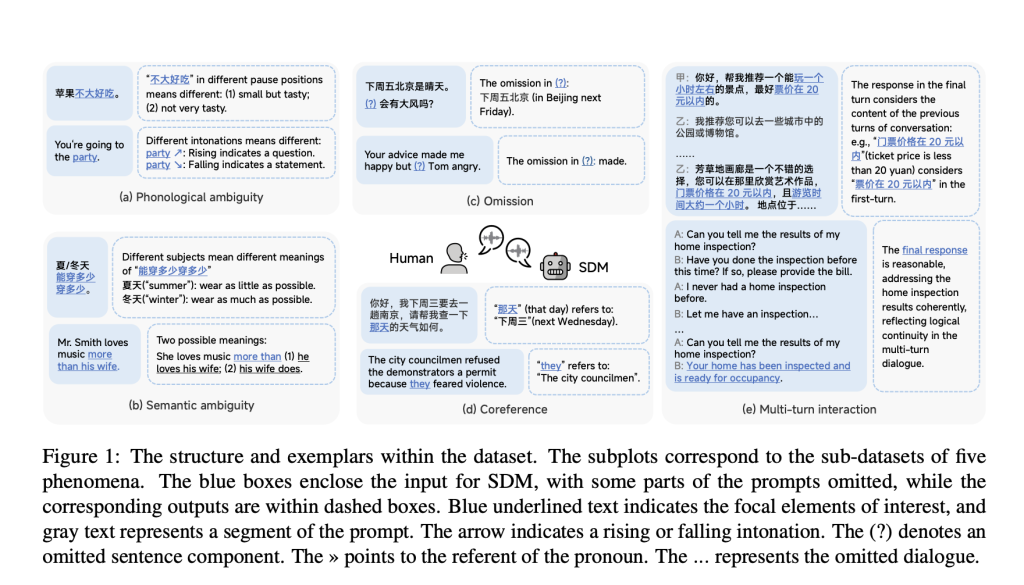
A new research paper from China introduces C3, a bilingual benchmark dataset and evaluation framework designed to rigorously assess Spoken Dialogue Models (SDMs) in handling the complex, real-world challenges of spoken interactions, such as phonological ambiguity, semantic ambiguity, omission, coreference, and multi-turn dialogue coherence. This development addresses a critical gap in conversational AI evaluation by focusing on the unique difficulties of spoken language, particularly in tonal languages like Chinese, thereby advancing the reliability and effectiveness of SDMs in applications like digital assistants and customer service bots.

Research
📄 Towards Data Science

How a Research Lab Made Entirely of LLM Agents Developed Molecules That Can Block a Virus

A research lab utilizing an ecosystem of large language model (LLM) agents has successfully designed novel molecules capable of blocking a virus, marking a significant advancement in AI-driven drug discovery. By leveraging reasoning AI agents, the team demonstrated how autonomous LLMs can collaboratively generate and evaluate potential therapeutic compounds, streamlining the traditionally complex and time-consuming process of molecular design. This development highlights the transformative potential of large language models in biomedical research, enabling rapid, scalable, and cost-effective solutions for combating viral diseases.

Autonomous Systems
Read More

Page 71 of 130 • Showing articles 841-852 of 1560