Page 67 of 130 • 1560 Total Articles

createLiveAI

Continue exploring the latest AI breakthroughs, technology insights, and industry analysis. Page 67 of our comprehensive AI news collection.

📰 Latest Intelligence

Showing 12 articles on page 67 of 130

Live feed
Business
📄 MarkTechPost

Meet dots.ocr: A New 1.7B Vision-Language Model that Achieves SOTA Performance on Multilingual Document Parsing

dots.ocr is an open-source, 1.7-billion-parameter vision-language transformer model that advances multilingual document layout parsing and OCR by integrating layout detection and content recognition into a unified architecture. Supporting over 100 languages and various document formats, it streamlines workflows by eliminating the need for separate detection and OCR pipelines, allowing task switching through input prompts and accommodating both images and PDFs with preprocessing options for enhanced accuracy. The model achieves state-of-the-art performance on multilingual document parsing benchmarks, accurately extracting plain text, tabular data, and mathematical formulas while preserving document structure and reading order. Its flexible output

Transformers
Read More
Research
📄 MarkTechPost

R-Zero: A Fully Autonomous AI Framework that Generates Its Own Training Data from Scratch

Researchers from Tencent AI Seattle Lab, Washington University, the University of Maryland, and the University of Texas have developed R-Zero, an innovative autonomous AI framework that enables large language models (LLMs) to self-evolve without dependence on external, human-annotated datasets. This approach addresses a significant bottleneck in advancing reasoning capabilities by eliminating the need for resource-intensive data curation, instead leveraging a co-evolutionary process where one instance of the model generates challenging tasks, and another attempts to solve them, fostering continuous improvement. R-Zero's core innovation lies in its ability to generate and solve

NLP Autonomous Systems
Read More
Research
📄 MarkTechPost

This AI Paper Introduces ReaGAN: A Graph Agentic Network That Empowers Nodes with Autonomous Planning and Global Semantic Retrieval

Researchers from Rutgers University have developed ReaGAN (Retrieval-augmented Graph Agentic Network), a novel approach that transforms each node in a graph into an autonomous reasoning agent capable of personalized decision-making, adaptive retrieval, and planning. Unlike traditional Graph Neural Networks (GNNs), which rely on static message passing and treat all nodes uniformlyoften leading to issues like information imbalance and limited contextual awarenessReaGAN empowers nodes to actively engage with their data, leveraging retrieval mechanisms to access relevant, distant semantic information beyond immediate neighbors. This innovation addresses key limitations of conventional GNNs by enabling nodes

Autonomous Systems
Read More
Technology
📄 MarkTechPost

An Implementation Guide to Design Intelligent Parallel Workflows in Parsl for Multi-Tool AI Agent Execution

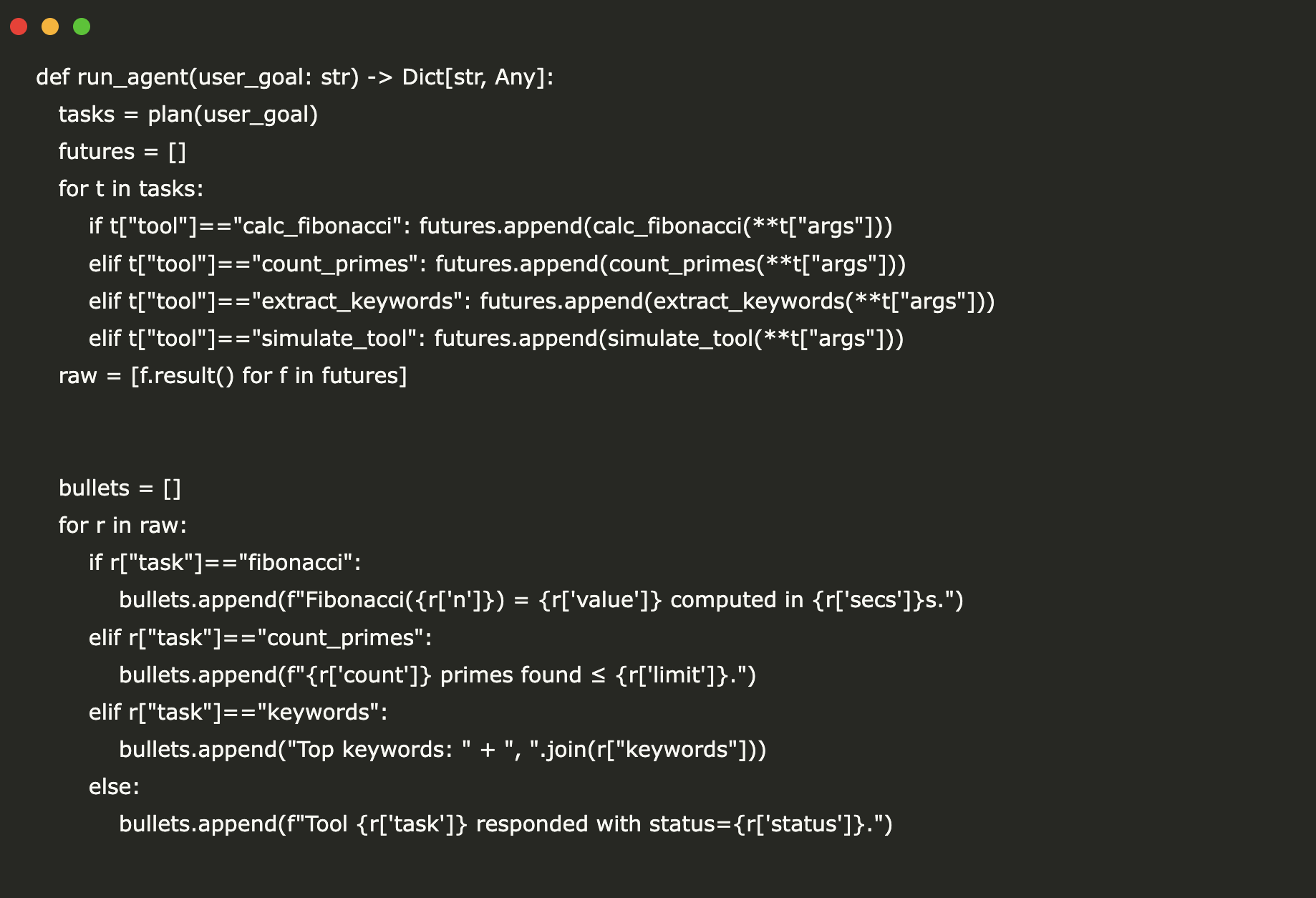
A recent tutorial demonstrates the implementation of an AI agent pipeline using Parsl, a parallel execution framework that enables concurrent processing of multiple computational tasks as independent Python applications. By configuring a local ThreadPoolExecutor, the pipeline efficiently runs specialized tools such as Fibonacci calculations, prime counting, keyword extraction, and simulated API calls, all coordinated through a lightweight planner that maps user goals to specific task invocations. The pipeline's outputs are aggregated and processed through a Hugging Face text-generation model to generate coherent, human-readable summaries, showcasing how parallel task execution combined with advanced language models can streamline complex AI workflows. This development

Business
📄 AI News

DeepSeek: The Chinese startup challenging Silicon Valley

Chinese startup DeepSeek has rapidly disrupted the AI industry by developing competitive models that outperform or match those of established Silicon Valley giants while utilizing substantially fewer resources. Their innovative approach leverages advanced techniques such as Multi-head Latent Attention (MLA) to mitigate memory bottlenecks and Group Relative Policy Optimization (GRPO) to enhance reinforcement learning efficiency, enabling cost-effective scaling and deployment. This technological breakthrough has had immediate market implications, causing notable declines in major tech stocks like Nvidia, Microsoft, and Meta, as investors reassess the competitive landscape. DeepSeek's successful launch of a free AI assistant app for

Meta AI Microsoft +2
Read More
Research
📄 MarkTechPost

Top 6 Model Context Protocol (MCP) News Blogs (2025 Update)

The Model Context Protocol (MCP) is emerging as a universal standard for integrating AI agents with diverse tools and data sources, akin to a "USB-C port for AI applications." This development aims to replace fragmented APIs with a single, streamlined protocol, facilitating seamless enterprise integration, development, and research. Key resources such as Anthropics official MCP site provide comprehensive documentation, reference implementations, and guidance on building agentic applications, making it an essential hub for developers and architects working with MCP-enabled systems. Additionally, the GitHub repository wong2/awesome-mcp-servers offers a curated, community-driven

General
📄 MarkTechPost

Dynamic Fine-Tuning (DFT): Bridging the Generalization Gap in Supervised Fine-Tuning (SFT) for LLMs

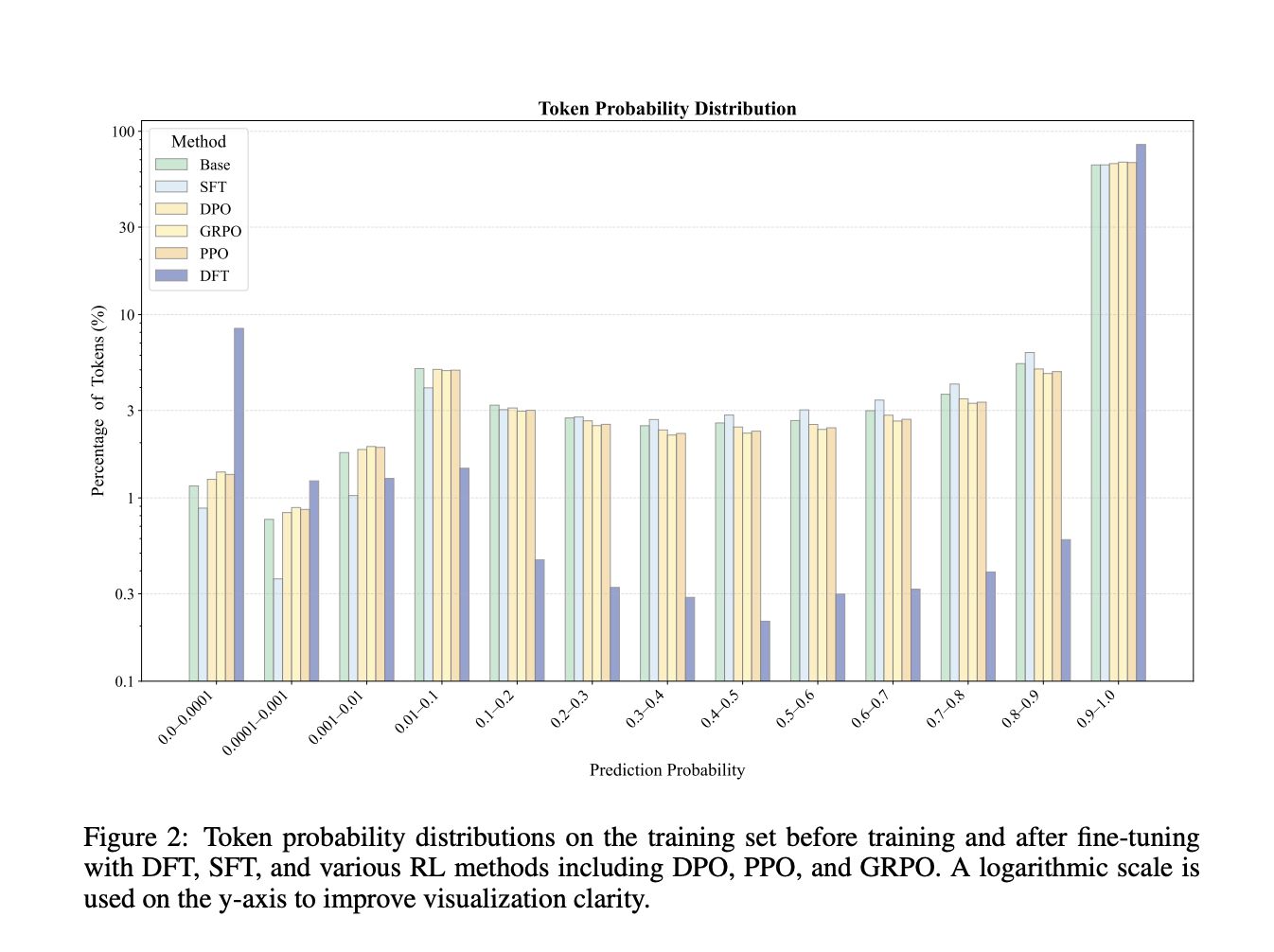
The article introduces Dynamic Fine-Tuning (DFT), a novel approach designed to enhance the generalization capabilities of Supervised Fine-Tuning (SFT) in large language models (LLMs). While SFT is efficient for task adaptation using expert demonstration datasets, it often struggles with generalization compared to reinforcement learning (RL), which explores diverse strategies but at a higher computational cost. DFT aims to bridge this gap by dynamically integrating elements of RL into the SFT process, potentially enabling models to achieve better generalization without the extensive resource demands associated with pure RL methods. This development addresses a critical challenge

General
📄 MarkTechPost

Microsoft Releases POML (Prompt Orchestration Markup Language): Bringing Modularity and Scalability to LLM Prompts

Microsoft has introduced Prompt Orchestration Markup Language (POML), an open-source, HTML/XML-inspired framework designed to enhance prompt engineering for Large Language Models (LLMs). POML addresses the increasing complexity of promptsincorporating dynamic components, multiple roles, structured data, and varied output formatsby providing a modular, systematic approach to creating maintainable and reusable prompts, thereby overcoming limitations of unstructured text methods. The framework enables developers to define prompt structures using semantic elements such as <role>, <task>, and <example>, facilitating

Microsoft
Read More

Page 67 of 130 • Showing articles 793-804 of 1560