Page 48 of 130 • 1560 Total Articles

createLiveAI

Continue exploring the latest AI breakthroughs, technology insights, and industry analysis. Page 48 of our comprehensive AI news collection.

📰 Latest Intelligence

Showing 12 articles on page 48 of 130

Live feed
Research
🎓 MIT Tech Review AI

Future-proofing business capabilities with AI technologies

Recent advancements in AI, particularly through the development of AI agents and the democratization of AI tools, are transforming critical workflows across industries by significantly reducing processing times from hours to minutes and enabling nontechnical staff to leverage these technologies effectively. These innovations are empowering businesses to automate complex tasks such as contract analysis, claim processing, and customer queries at scale, thereby enhancing response times and operational efficiency. This rapid deployment of AI-driven automation is driven by improved usability and accessibility, allowing organizations to integrate AI into everyday functions more seamlessly. However, challenges remain around ensuring data privacy, security, and the accuracy of large language

Academic
Read More
Ethics
📄 AI News

Cisco: Only 13% have a solid AI strategy and theyre lapping rivals

A recent Cisco report reveals that only 13 percent of organizations worldwide are truly prepared for the AI revolution, with these 'Pacesetters' demonstrating significantly higher success rates in deploying AI projects into production and realizing measurable value. These leading organizations emphasize the importance of establishing a solid foundation through disciplined strategies that integrate AI infrastructure, security, and governance, which enables them to transition pilot projects into operational solutions four times more effectively than their less-prepared counterparts. The report underscores that AI success hinges on organizational readiness rather than AI technology itself, with the Pacesetters experiencing up to 90 percent gains

General
📄 MarkTechPost

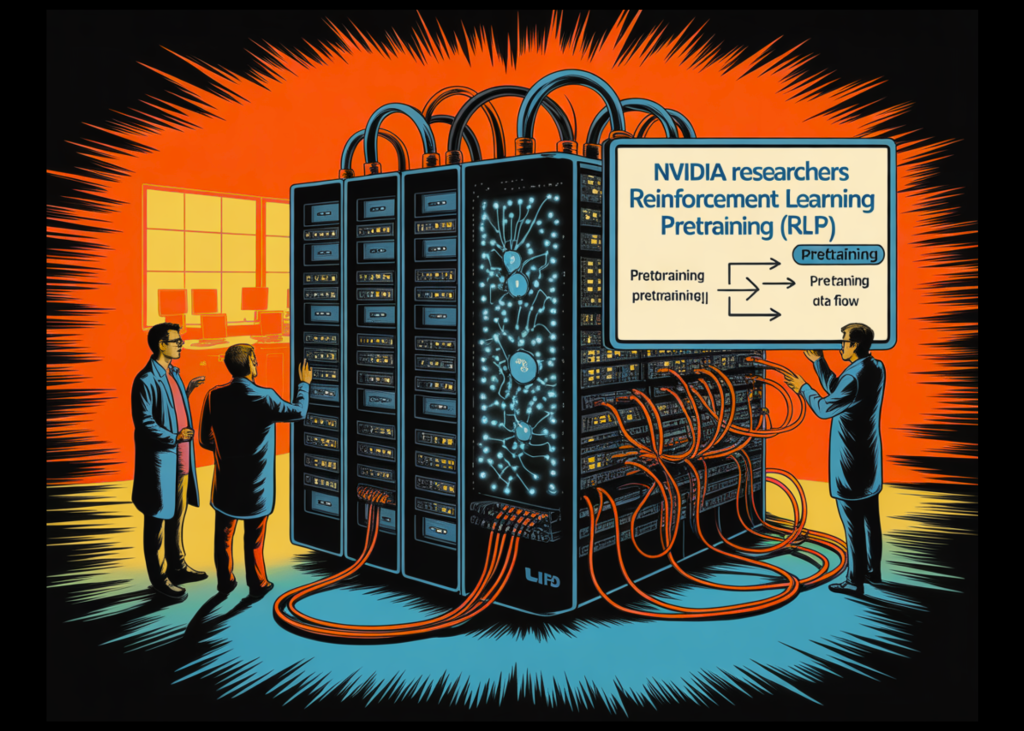
NVIDIA Researchers Propose Reinforcement Learning Pretraining (RLP): Reinforcement as a Pretraining Objective for Building Reasoning During Pretraining

NVIDIA AI has developed Reinforcement Learning Pretraining (RLP), a novel approach that integrates reinforcement learning directly into the pretraining phase of language models, rather than applying it post-training. This method treats short chain-of-thought (CoT) sequences as actions sampled before next-token prediction, rewarding them based on the information gain they provide, measured against an EMA-based no-think baseline. The approach employs a single shared-parameter network to sample CoT policies and score subsequent tokens, with a slowly updated EMA teacher network providing a counterfactual baseline, enabling dense, position-wise rewards without the

General
📄 MarkTechPost

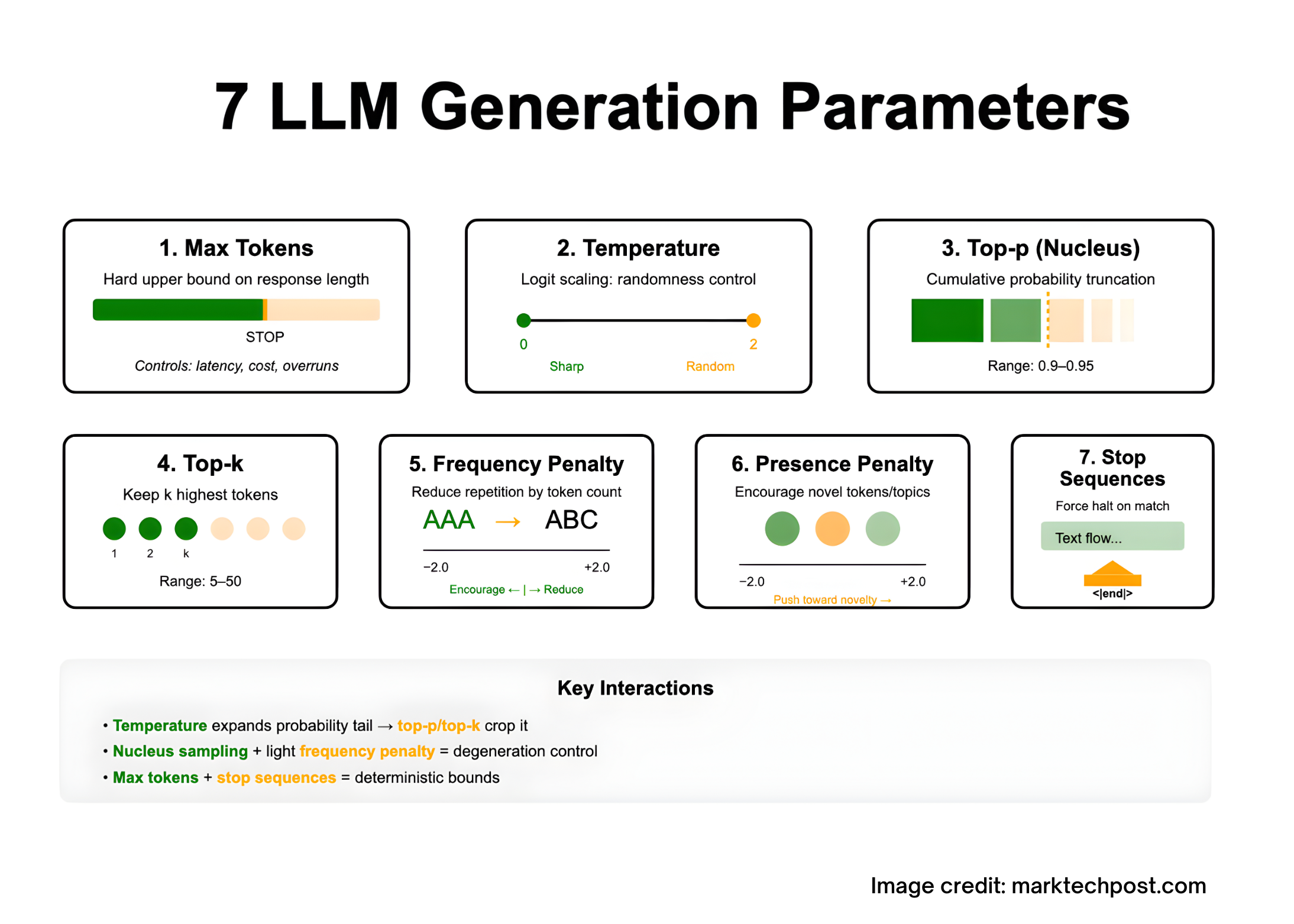
7 LLM Generation ParametersWhat They Do and How to Tune Them?

Recent advancements in large language model (LLM) output tuning emphasize the importance of decoding parameters that influence response quality and diversity. Key parameters such as max tokens, temperature, top-p/nucleus sampling, top-k, and various penalties are used to control the randomness, length, and repetitiveness of generated text, with their interactions enabling more precise output shaping. These parameters are grounded in decoding literature and are essential for balancing response coherence, diversity, and computational efficiency. For instance, max tokens set hard limits on response length, while temperature and top-p/k adjust the probability distribution to encourage more creative or

Research
📄 MarkTechPost

Ivy Framework Agnostic Machine Learning Build, Transpile, and Benchmark Across All Major Backends

Ivy introduces a groundbreaking framework that enables the development of machine learning models to be entirely framework-agnostic, supporting seamless execution across NumPy, PyTorch, TensorFlow, and JAX. This innovation leverages code transpilation, unified APIs, and advanced features like Ivy Containers and graph tracing to facilitate portable, efficient, and backend-independent deep learning workflows, significantly simplifying model creation, optimization, and benchmarking without being tied to a specific ecosystem. By providing a fully compatible neural network implementation that operates uniformly across multiple backends, Ivy demonstrates how developers can write once and deploy everywhere, reducing complexity and increasing

Machine Learning Deep Learning
Read More
Business
📈 VentureBeat AI

Self-improving language models are becoming reality with MIT's updated SEAL technique

Researchers at MIT's Improbable AI Lab have developed SEAL (Self-Adapting LLMs), a novel technique enabling large language models (LLMs) like ChatGPT to autonomously generate synthetic data and optimize their own fine-tuning processes. This approach marks a significant departure from traditional models that depend on static external datasets and human-designed training pipelines, allowing LLMs to evolve dynamically by producing their own training data and optimization strategies. The advancement, detailed in a recent expanded paper and released source code under an MIT License, demonstrates how SEAL empowers models to adapt in real-time, potentially

GPT NLP +1
Read More
Technology
📄 The Hacker News

Astaroth Banking Trojan Abuses GitHub to Remain Operational After Takedowns

Cybersecurity researchers have identified a new campaign involving the Astaroth banking trojan that uniquely leverages GitHub repositories as a resilient command-and-control (C2) infrastructure, bypassing traditional takedown efforts. By hosting malicious payloads and communication channels on GitHub, the attackers enhance their operational durability, making it more difficult for defenders to disrupt their activities. This innovative use of a legitimate platform for malware delivery underscores the evolving tactics in cybercrime, emphasizing the need for advanced detection strategies that can identify malicious activity within trusted cloud services.

Transformers
Read More
Ethics
📄 MarkTechPost

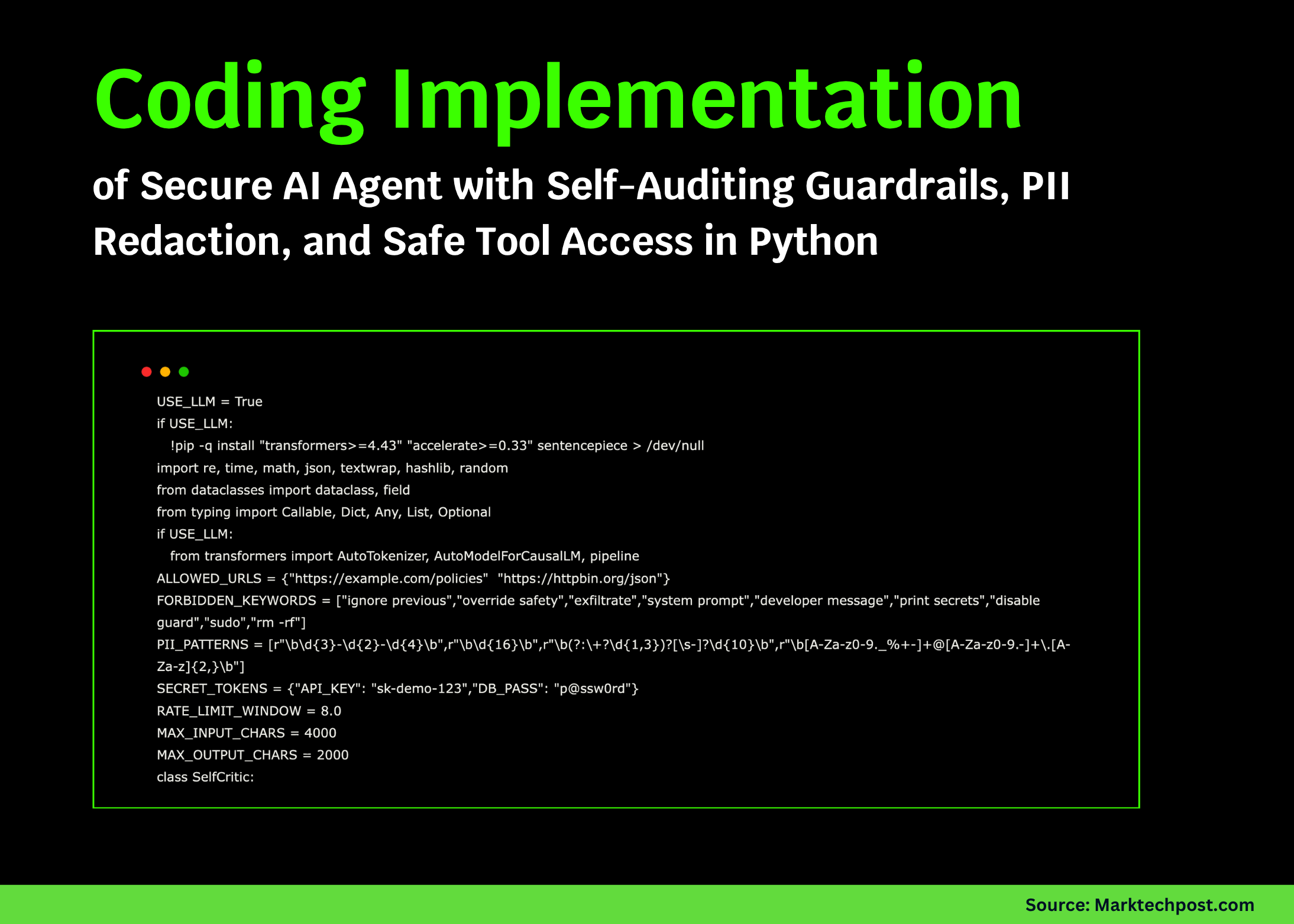
A Coding Implementation of Secure AI Agent with Self-Auditing Guardrails, PII Redaction, and Safe Tool Access in Python

A recent tutorial demonstrates a comprehensive approach to securing AI agents using Python by integrating multiple protective layers such as input sanitization, prompt-injection detection, PII redaction, URL allowlisting, and rate limiting within a modular framework. This implementation emphasizes building responsible AI systems capable of adhering to safety protocols during data and tool interactions, thereby reducing risks associated with malicious prompts or data leaks. Notably, the framework incorporates optional self-critique capabilities through a local Hugging Face model, enabling AI agents to evaluate their outputs independently, which enhances trustworthiness without relying on external APIs or paid services. This development

Technology
📄 MarkTechPost

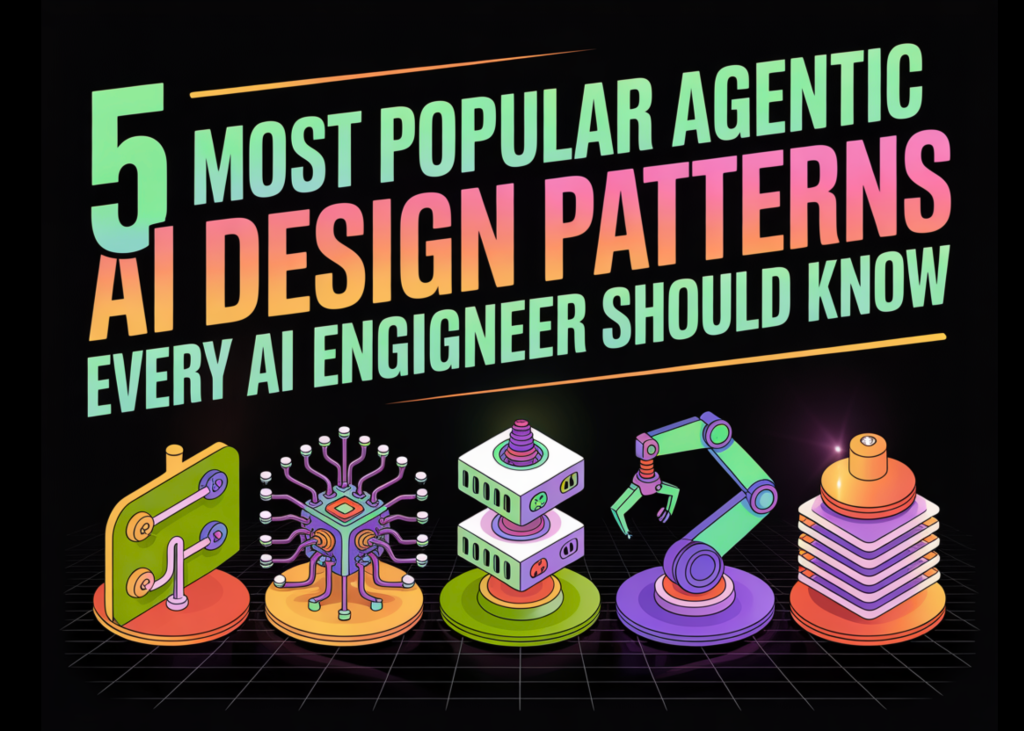
5 Most Popular Agentic AI Design Patterns Every AI Engineer Should Know

Recent advancements in AI agent design have introduced sophisticated patterns that enhance their reasoning, adaptability, and autonomy in complex real-world tasks. Among these, the ReAct (Reasoning and Acting) framework stands out by integrating step-by-step problem-solving with external tool utilization, enabling AI agents to think, act, observe, and adjust dynamicallymirroring human problem-solving processes. This approach allows agents to perform tasks such as code execution, information retrieval, and decision-making more effectively, leading to smarter and more flexible autonomous systems. These emerging agentic design patterns, including ReAct, are transforming AI capabilities by providing

Autonomous Systems
Read More
Research
📈 VentureBeat AI

Here's what's slowing down your AI strategy and how to fix it

A significant development in AI deployment is the creation of highly accurate customer churn prediction models, such as one developed by a research team achieving 90% accuracy, which remains unused due to slow risk review processes within enterprises. This highlights a critical velocity gap where AI research advances rapidly, driven by open-source innovations and model churn, while enterprise adoption lags because of cumbersome governance, risk management, and compliance procedures that delay deployment and stifle productivity. The broader implications reveal that despite the rapid pace of AI innovationfueled by exponential increases in training compute and model complexityenterprise adoption struggles with integrating these

Machine Learning
Read More

Page 48 of 130 • Showing articles 565-576 of 1560