
Page 42 of 130 • 1560 Total Articles

createLiveAI

Continue exploring the latest AI breakthroughs, technology insights, and industry analysis. Page 42 of our comprehensive AI news collection.

📰 Latest Intelligence

Showing 12 articles on page 42 of 130

Live feed
Ethics
📄 MarkTechPost

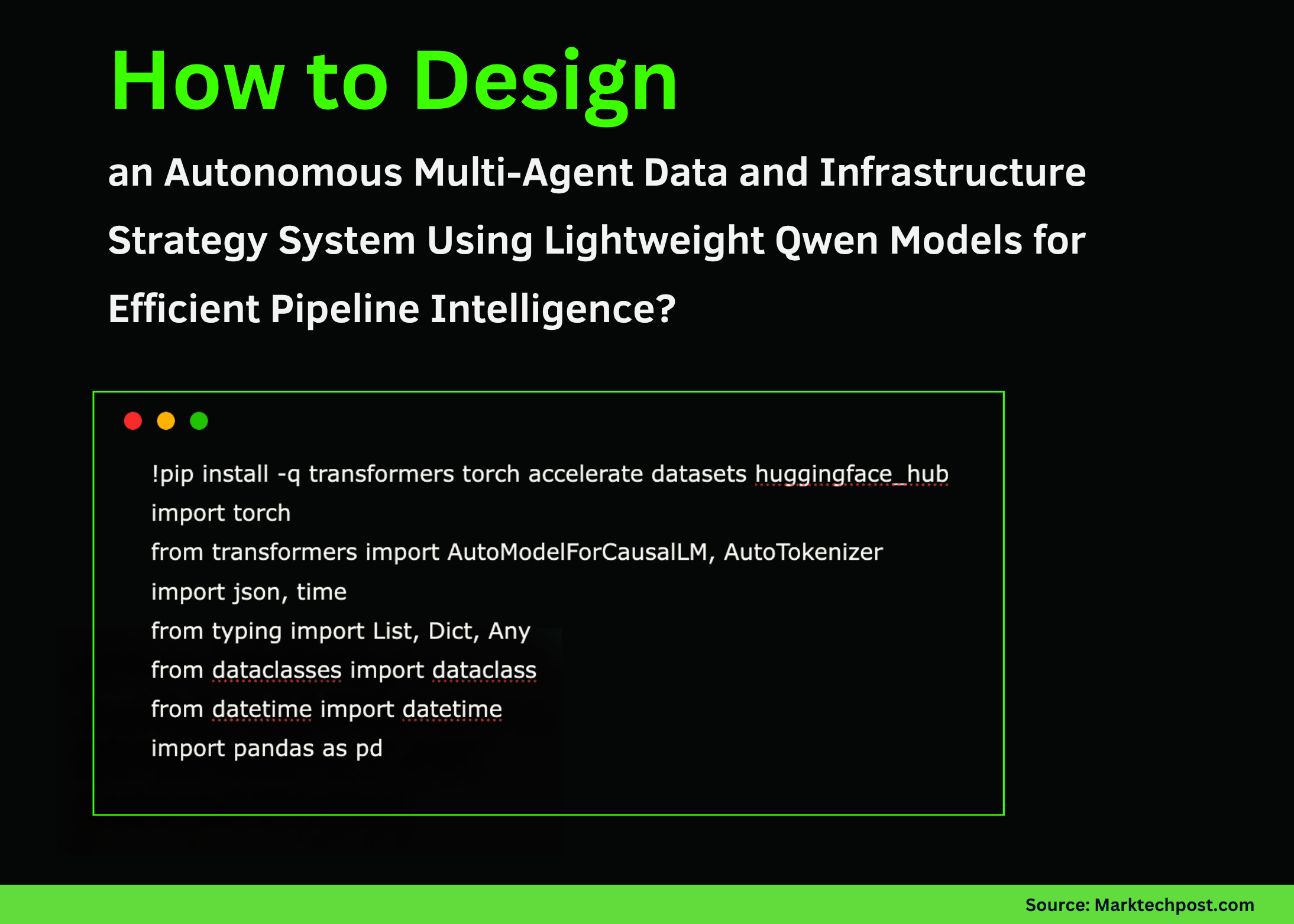
How to Design an Autonomous Multi-Agent Data and Infrastructure Strategy System Using Lightweight Qwen Models for Efficient Pipeline Intelligence?

A new multi-agent data and infrastructure strategy system has been developed utilizing the lightweight Qwen2.5-0.5B-Instruct model, enabling efficient autonomous management of complex data pipelines. This system employs a flexible framework of specialized large language model (LLM) agents responsible for tasks such as data ingestion, quality analysis, and infrastructure optimization, coordinated by an orchestrator to facilitate seamless multi-agent collaboration. Demonstrated through practical applications in e-commerce and IoT environments, this approach showcases how autonomous decision-making can significantly streamline data operations, reduce manual intervention, and enhance pipeline intelligence.

Autonomous Systems
Read More
Business
📄 AI News

Thailand becomes one of the first in Asia to get the Sora app

Thailand has become one of the first Asian countries to access OpenAIs new AI video tool, Sora, which is designed to enhance visual storytelling by enabling users to generate, remix, and personalize video content through the Sora 2 model. The app, now available for free on iOS without an invite, has already surpassed one million downloads globally within five days of its US and Canada launch, demonstrating rapid adoption and strong user interest, especially with features like Cameos that allow users to appear within scenes through identity verification. The Sora apps technical foundation, Sora 2, leverages

Ethics
📄 MarkTechPost

Microsoft Releases Agent Lightning: A New AI Framework that Enables Reinforcement Learning (RL)-based Training of LLMs for Any AI Agent

Microsoft's open-source framework, Agent Lightning, enables reinforcement learning (RL) training for large language models (LLMs) and multi-agent systems without requiring modifications to existing agent architectures. By formalizing agents as partially observable Markov decision processes (POMDPs), the framework extracts clean RL transitions from real agent tracesfocusing solely on policy calls, inputs, outputs, and rewardsthereby simplifying the conversion of complex multi-step interactions into standard RL training data. Agent Lightning introduces LightningRL, a hierarchical method that converts multi-step agent runs into single-turn RL transitions compatible with common trainers like PPO

Microsoft
Read More
Research
📄 Towards Data Science

Bringing Vision-Language Intelligence to RAG with ColPali

The article discusses advancements in integrating vision-language intelligence into retrieval-augmented generation (RAG) systems through the ColPali framework, enabling more effective utilization of non-textual content such as images and videos within knowledge bases. This development enhances the ability of AI models to understand and leverage multimodal data, significantly improving the accuracy and richness of information retrieval and generation tasks across diverse applications.

Technology
📄 AI News

Cursor 2.0 pivots to multi-agent AI coding, debuts Composer model

Cursor has launched its upgraded AI software development platform, featuring a new multi-agent interface and the debut of its "frontier" coding model, Composer, which is claimed to be four times faster than comparable models. Designed specifically for low-latency, agentic coding, Composer can complete most conversational interactions in under 30 seconds, significantly enhancing developer workflow and enabling rapid iteration on complex, multi-step tasks. The platform's advancements include training Composer with tools like codebase-wide semantic search, improving its ability to understand and operate within large, intricate codebases. Additionally, the user interface has been redesigned to

Research
🎓 MIT Tech Review AI

DeepSeek may have found a new way to improve AIs ability to remember

DeepSeek's recently released OCR model introduces a novel approach to enhancing AI memory capabilities by transforming textual information into visual representations, akin to capturing images of pages from a book. This technique diverges from traditional token-based storage, which becomes computationally expensive and prone to "context rot" during extended interactions, thereby impairing the AI's ability to retain long-term information. By leveraging this image-based memory encoding, the model aims to reduce the computational resources required for processing and storing large amounts of data, potentially mitigating AI's growing carbon footprint. Although the OCR performance aligns with top-tier models on key benchmarks,

Academic
Read More
Business
📄 AI News

OpenAI unveils open-weight AI safety models for developers

OpenAI has introduced the 'gpt-oss-safeguard' family of open-weight models, including the 120-billion and 20-billion parameter versions, designed to empower developers with customizable safety controls for content classification. These models, released under the permissive Apache 2.0 license, enable organizations to freely modify and deploy them, shifting the safety paradigm from fixed rules to reasoning-based interpretation aligned with specific policies at inference time. Unlike traditional black-box classifiers, the 'gpt-oss-safeguard' models utilize a chain-of-thought reasoning process, allowing developers to understand and

Research
📈 VentureBeat AI

From static classifiers to reasoning engines: OpenAIs new model rethinks content moderation

OpenAI has introduced two open-source models, gpt-oss-safeguard-120b and gpt-oss-safeguard-20b, under the permissive Apache 2.0 license, aimed at providing greater flexibility for enterprises to implement safety policies during inference rather than solely during pre-deployment. These models leverage a chain-of-thought (CoT) reasoning approach to interpret developer-defined safety policies in real-time, allowing for dynamic classification of user interactions and enabling iterative policy adjustments without retraining the entire model. This development marks a shift from traditional safety measures that are baked

GPT Microsoft
Read More

Page 42 of 130 • Showing articles 493-504 of 1560