Page 29 of 130 • 1560 Total Articles

createLiveAI

Continue exploring the latest AI breakthroughs, technology insights, and industry analysis. Page 29 of our comprehensive AI news collection.

📰 Latest Intelligence

Showing 12 articles on page 29 of 130

Live feed
Research
📄 MarkTechPost

From Transformers to Associative Memory, How Titans and MIRAS Rethink Long Context Modeling

Google Research has introduced Titans and MIRAS, innovative approaches to enhance sequence models with usable long-term memory while maintaining parallel training and near-linear inference efficiency. Titans is a novel architecture that integrates a deep neural memory modulea multi-layer perceptroninto a Transformer backbone to provide precise long-term memory, whereas MIRAS offers a general framework interpreting sequence models as online optimization over associative memory, addressing the quadratic scaling limitations of traditional attention mechanisms and improving performance on tasks requiring extremely long context, such as genomic modeling.

Google AI Transformers
Read More
Research
📄 MarkTechPost

Google Colab Integrates KaggleHub for One Click Access to Kaggle Datasets, Models and Competitions

Google has integrated Kaggle's dataset, model, and competition search capabilities directly into Google Colab through a new built-in Data Explorer, streamlining the process of accessing Kaggle resources without leaving the notebook environment. This feature allows users to search Kaggle's extensive repository using an intuitive panel in Colab, apply filters such as resource type or relevance, and import data seamlessly via KaggleHub code snippets, significantly simplifying workflows that previously required manual setup of API credentials and multiple steps. By embedding Kaggle search and import functions within Colab, Google effectively bridges the gap between the two platforms, reducing the

Google AI
Read More
Research
📄 Towards Data Science

The Machine Learning Advent Calendar Day 7: Decision Tree Classifier

The article highlights how Decision Tree Classifiers determine optimal split points using impurity measures such as Gini and Entropy, especially when working with a single numerical feature and two classes. By visually estimating potential splits and comparing impurity reductions, the process can be demonstrated step-by-step in Excel, illustrating the practical differences these measures make in selecting the best data partition. This approach emphasizes understanding the decision-making process behind classification trees and the impact of different impurity criteria on model performance.

Machine Learning
Read More
Research
📈 VentureBeat AI

Why AI coding agents arent production-ready: Brittle context windows, broken refactors, missing operational awareness

Recent developments in AI coding agents highlight significant limitations in their ability to reliably integrate high-quality, enterprise-grade code into production environments. While generating code has become relatively straightforward, these agents struggle with understanding complex, large-scale codebases due to their limited domain knowledge, fragmented internal documentation, and the vast size of enterprise repositories, often exceeding 2,500 files or 500 KB per file, which hampers indexing and search capabilities. These technical challenges are compounded by service constraints such as memory limitations and indexing failures, which reduce the effectiveness of AI agents in real-world enterprise settings. As a result, despite the

Microsoft Machine Learning +1
Read More
Technology
📄 MarkTechPost

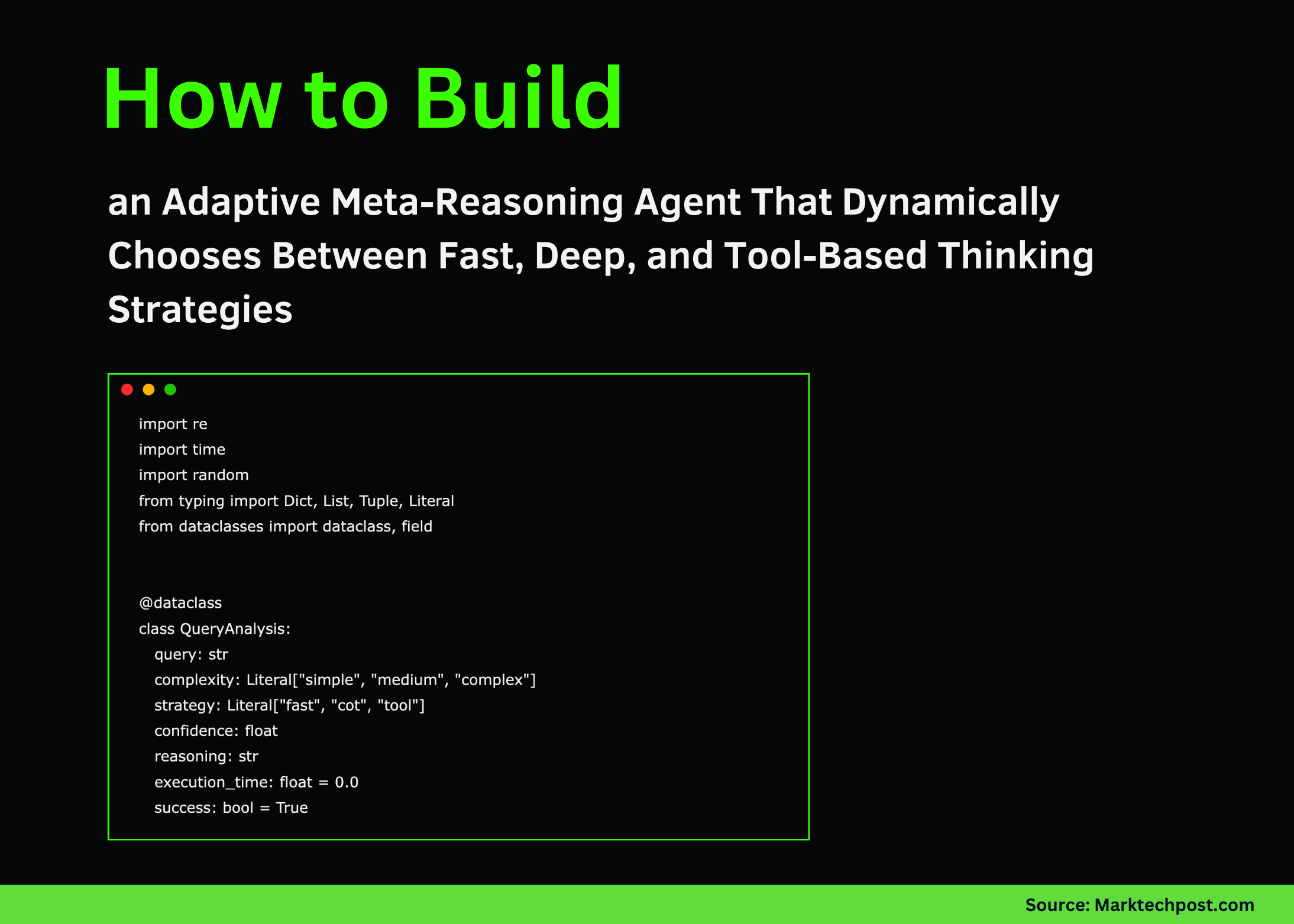
How to Build an Adaptive Meta-Reasoning Agent That Dynamically Chooses Between Fast, Deep, and Tool-Based Thinking Strategies

A novel meta-reasoning agent has been developed to dynamically select appropriate thinking strategiessuch as fast heuristics, deep chain-of-thought reasoning, or tool-based computationbased on the complexity of each query. This system evaluates the nature of the problem in real time, enabling it to adapt its approach to optimize the balance between speed and accuracy, thereby transitioning from reactive responses to strategic, context-aware reasoning. The implementation involves analyzing query features, classifying their complexity, and choosing the most suitable reasoning method, which enhances the agent's efficiency and effectiveness across diverse tasks.

Meta AI
Read More
Research
📄 Towards Data Science

Reading Research Papers in the Age ofLLMs

The article discusses a hybrid approach to staying current with research papers by combining manual reading with AI-assisted tools, highlighting how large language models (LLMs) can streamline the literature review process. This method leverages AI to quickly identify relevant papers, extract key insights, and summarize content, significantly enhancing efficiency in managing the growing volume of scientific publications.

Research
📄 Towards Data Science

The Machine Learning Advent Calendar Day 6: Decision Tree Regressor

The article highlights a fundamental approach to understanding Decision Tree regressors by illustrating how the first split is determined using a simple one-feature dataset. By enumerating all potential split points and calculating the Mean Squared Error (MSE) for each, the method demonstrates how the optimal split minimizes prediction error, providing intuitive insight into the tree-building process. This step-by-step visualization emphasizes the importance of the initial split in shaping the decision tree's structure and predictive accuracy. The approach, which can be replicated in tools like Excel, offers a transparent and educational perspective on how decision trees grow and make predictions, contrasting with

Machine Learning
Read More
Research
📄 Towards Data Science

The Machine Learning Advent Calendar Day 5: GMM in Excel

The article highlights the Gaussian Mixture Model (GMM) as an advanced clustering technique that extends k-Means by incorporating probabilistic assignments and utilizing the Mahalanobis distance to account for variances within clusters. Unlike k-Means, which assigns data points with hard boundaries, GMM employs the ExpectationMaximization (EM) algorithm to iteratively estimate the parameters of multiple Gaussian distributions, resulting in a more flexible and nuanced data modeling approach. By demonstrating the implementation of EM in Excel for one- and two-dimensional data, the article emphasizes how visualizing the movement and adjustment of Gaussian curves

Machine Learning
Read More
Business
🎓 MIT Tech Review AI

Harnessing human-AI collaboration for an AI roadmap that moves beyond pilots

Despite record-high investments in AI, most enterprises remain stuck in experimentation, struggling to transition from pilot projects to scalable, operational solutions. The core challenge lies in overcoming rigid, fragmented workflows, incompatible technology systems, and talent focused on low-value tasks, which hinder the integration of AI into business processes. To unlock AI's full potential, organizations must fundamentally rethink how people, processes, and technology collaborate, emphasizing adaptable decision-making frameworks and redefining human roles to ensure effective oversight and verification of AI-generated content.

Academic
Read More
Research
📄 Towards Data Science

YOLOv1 Paper Walkthrough: The Day YOLO First Saw theWorld

The article provides an in-depth exploration of the YOLOv1 (You Only Look Once version 1) architecture, highlighting its innovative approach to real-time object detection by framing it as a single regression problem. It also offers a comprehensive guide to implementing YOLOv1 from scratch using PyTorch, emphasizing the technical details and design choices that contributed to its efficiency and accuracy in detecting multiple objects within images.

Page 29 of 130 • Showing articles 337-348 of 1560