
Page 28 of 130 • 1560 Total Articles

createLiveAI

Continue exploring the latest AI breakthroughs, technology insights, and industry analysis. Page 28 of our comprehensive AI news collection.

📰 Latest Intelligence

Showing 12 articles on page 28 of 130

Live feed
Business
📄 MarkTechPost

Mistral AI Ships Devstral 2 Coding Models And Mistral Vibe CLI For Agentic, Terminal Native Development

Mistral AI has launched Devstral 2, a state-of-the-art coding model family designed for software engineering agents, featuring a 123-billion-parameter dense transformer with a 256,000-token context window that achieves 72.2% on SWE-bench Verified. Accompanying this is the open-source Mistral Vibe CLI, a command-line coding assistant compatible with terminal and IDE environments supporting the Agent Communication Protocol, enabling seamless integration into developer workflows. Compared to larger models like Claude Sonnet, Devstral 2 demonstrates up to seven times greater cost efficiency on

Claude Transformers
Read More
Business
📄 MarkTechPost

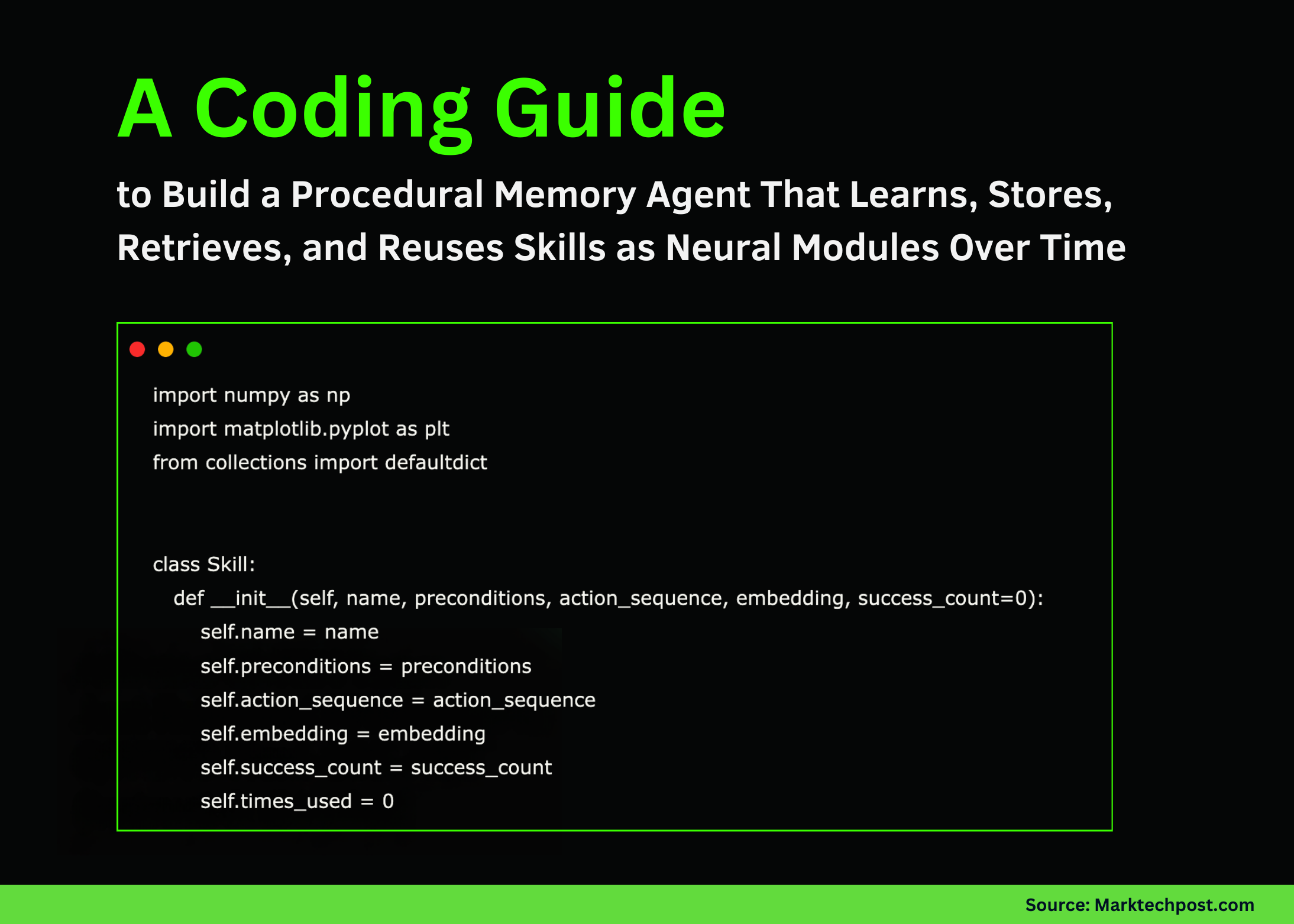
A Coding Guide to Build a Procedural Memory Agent That Learns, Stores, Retrieves, and Reuses Skills as Neural Modules Over Time

This tutorial introduces a framework for developing an intelligent agent capable of forming procedural memory by learning and reusing skills as neural modules through environmental interactions. These neural modules store action sequences, contextual embeddings, and are retrieved based on similarity to current situations, enabling the agent to progressively shift from primitive exploration to efficient behavior by leveraging a growing library of learned skills. The approach emphasizes modularity and similarity-based retrieval, facilitating scalable skill acquisition and reuse over multiple episodes. The technical implementation involves defining skills as neural modules with attributes such as preconditions, action sequences, and embeddings, which are stored in a skill library. As

Research
📄 Towards Data Science

The Machine Learning Advent Calendar Day 9: LOF in Excel

The article discusses the Local Outlier Factor (LOF) algorithm, illustrating its process through three steps: calculating distances and neighbors, determining reachability distances, and computing the final LOF score. By applying LOF to small datasets, it demonstrates how different algorithms may identify anomalies differently, emphasizing that in unsupervised learning, outlier definitions are subjective rather than absolute. This highlights the importance of understanding the underlying criteria used by various anomaly detection methods, as there is no single "true" outlier, but rather multiple valid perspectives based on the chosen algorithm and parameters.

Machine Learning
Read More
Research
📄 Towards Data Science

GraphRAG in Practice: How to Build Cost-Efficient, High-Recall Retrieval Systems

Recent advancements in retrieval system design have demonstrated that hybrid pipelines combining multiple retrieval techniques can surpass traditional dense graph-based methods in both efficiency and recall performance. These innovative strategies leverage a combination of sparse and dense representations to achieve high recall rates at a lower computational cost, making them more scalable and cost-effective for large-scale information retrieval applications.

Research
📄 AI News

How people really use AI: The surprising truth fromanalysingbillions of interactions

A comprehensive study by OpenRouter analyzing over 100 trillion tokens from billions of interactions with large language models reveals that real-world AI usage diverges significantly from popular narratives, with a substantial portion of activity driven by open-source models, which are projected to account for about one-third of total usage by late 2025. The research highlights that more than half of AI interactions originate outside the United States, emphasizing the global and diverse deployment of AI across different regions, use cases, and user demographics, while maintaining user privacy by analyzing metadata rather than conversation content. This data-driven insight underscores the evolving landscape of

Research
📄 Towards Data Science

The Machine Learning Advent Calendar Day 8: Isolation Forest in Excel

The Isolation Forest algorithm offers an innovative approach to anomaly detection by leveraging random partitioning to isolate data points, where the speed of isolation indicates the likelihood of an anomaly. Unlike traditional methods that focus on modeling normal data distributions, it constructs multiple random trees, measuring the number of splits needed to isolate each point; shorter paths suggest anomalies, while longer paths indicate normal points. This method is notable for its scalability across high-dimensional datasets, its independence from distributional assumptions, and its ability to handle categorical data effectively. Despite the complexity of implementing it in tools like Excel, the core concept remains elegant: instead of

Machine Learning
Read More
Technology
📄 MarkTechPost

Interview: From CUDA to Tile-Based Programming: NVIDIAs Stephen Jones on Building the Future of AI

NVIDIA's recent software innovations, led by Distinguished Engineer Stephen Jones, focus on advancing CUDA programming through the introduction of tile-based abstraction, known as CUDA Tile. This new approach enables developers to program directly to arrays and tensors rather than managing individual threads, facilitating higher-level optimization and better alignment with evolving hardware architectures such as larger, denser Tensor Cores. By extending CUDA to support array- and tensor-oriented programming, NVIDIA aims to simplify the development process and unlock new performance efficiencies as hardware complexity continues to grow, addressing challenges posed by the slowing of Moore's Law.

Research
📄 AI News

Battling algorithmic bias in digital payments leads to competition win

Ant International has achieved a significant breakthrough by winning the NeurIPS Competition of Fairness in AI Face Detection, demonstrating advancements in creating more equitable facial recognition models. The competition challenged over 2,100 teams worldwide to develop AI systems capable of accurately detecting AI-generated faces across diverse demographic groups, including variations in gender, age, and skin tone, addressing the persistent issue of algorithmic bias highlighted by NIST research. This development underscores Ant's commitment to enhancing security and inclusivity in digital payments and fintech services, especially as facial recognition technology becomes more prevalent amid rising concerns over deepfake misuse and biased AI

Research
📄 Towards Data Science

How to Create an ML-Focused Newsletter

The article explores how AI tools can be leveraged to streamline the creation of newsletters, emphasizing their utility in automating content generation and curation. It highlights the potential for machine learning models to assist in producing targeted, engaging content for specialized audiences, such as those interested in data science and machine learning topics.

Machine Learning
Read More
Research
📄 Towards Data Science

Optimizing PyTorch Model Inference on CPU

The article highlights advancements in deploying PyTorch model inference efficiently on Intel Xeon CPUs, emphasizing optimized performance for AI workloads without relying on GPUs. By leveraging Intel's hardware capabilities and software optimizations, such as oneDNN (Deep Neural Network Library), developers can achieve high throughput and low latency for AI applications directly on CPU infrastructure, enabling scalable and cost-effective deployment in data centers.

Deep Learning
Read More

Page 28 of 130 • Showing articles 325-336 of 1560