Page 20 of 130 • 1560 Total Articles

createLiveAI

Continue exploring the latest AI breakthroughs, technology insights, and industry analysis. Page 20 of our comprehensive AI news collection.

📰 Latest Intelligence

Showing 12 articles on page 20 of 130

Live feed
Ethics
📄 The Hacker News

The Future of Cybersecurity Includes Non-Human Employees

Non-human employees, such as bots, AI agents, service accounts, and automation scripts, are increasingly integral to cybersecurity as organizations expand AI and cloud automation capabilities. This growth in Non-Human Identities (NHIs) underscores the need for enterprises to adapt their security strategies, with over half of respondents in ConductorOnes 2025 Future of Identity Security Report recognizing NHIs as a critical component of future cybersecurity frameworks.

Business
📄 AI News

Grab brings robotics in-house to manage delivery costs

Grab has acquired Infermove to develop in-house robotics capabilities aimed at automating last-mile deliveries amid rising labor costs and tighter margins. Unlike off-the-shelf solutions, Infermoves technology leverages real-world movement data from non-motorized vehicles and dense urban environments, enabling robots to navigate complex cityscapes more effectively by learning from actual pedestrian and rider behaviors. This strategic move allows Grab to tailor its delivery automation systems to its specific operational constraints, improving efficiency and scalability in Southeast Asias challenging urban settings. By internalizing the development process, Grab aims to address the limitations of simulation-based training,

Robotics
Read More
Technology
📄 MarkTechPost

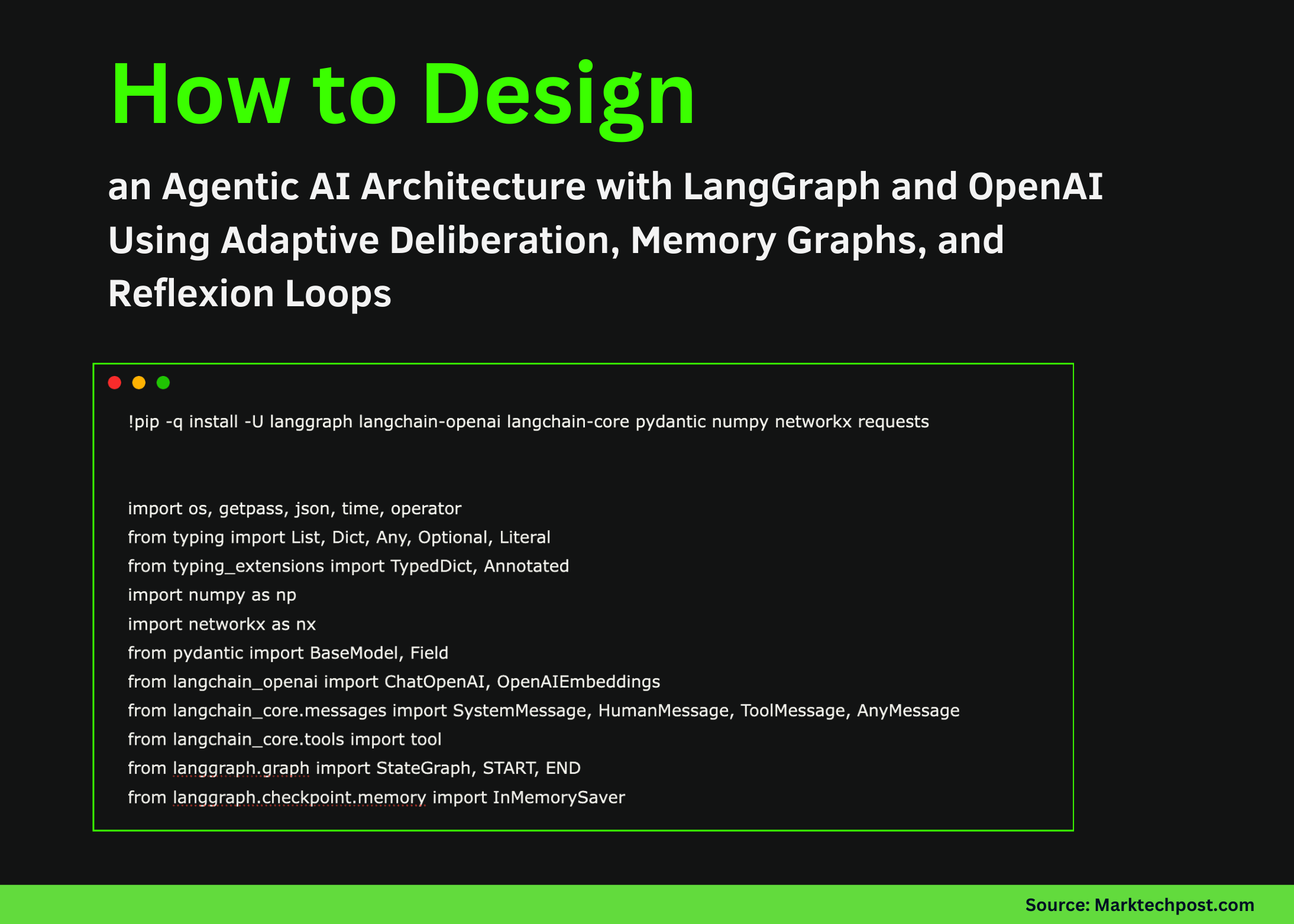
How to Design an Agentic AI Architecture with LangGraph and OpenAI Using Adaptive Deliberation, Memory Graphs, and Reflexion Loops

A recent development in AI architecture leverages LangGraph and OpenAI models to create a truly advanced agentic system that surpasses traditional planner-executor loops. This system incorporates adaptive deliberation, enabling the agent to dynamically switch between rapid and in-depth reasoning processes, and employs a Zettelkasten-style memory graph that autonomously links atomic knowledge and related experiences, enhancing contextual understanding and learning. Additionally, the architecture features a governed tool-use mechanism that enforces operational constraints during execution, integrating structured state management, memory-aware retrieval, reflexive learning, and controlled tool invocation. This combination allows the agent to

Technology
📄 AI News

What PubMatics AgenticOS signals for enterprise marketing

PubMatic's launch of AgenticOS signifies a major advancement in operationalizing agentic AI within digital advertising, transforming it from experimental to a core system-level capability integrated into programmatic infrastructure. This platform enables multiple AI agents to autonomously transact and optimize advertising campaigns aligned with human-defined objectives and guardrails, streamlining decision-making processes and reducing operational complexity across diverse formats, devices, and regulatory constraints. By functioning as an 'operating system' for programmatic advertising, AgenticOS addresses the inefficiencies and operational overhead faced by large marketing teams, promising faster decision cycles and a shift in human

Technology
📄 MarkTechPost

A Coding Guide to Design and Orchestrate Advanced ReAct-Based Multi-Agent Workflows with AgentScope and OpenAI

A recent tutorial demonstrates the development of an advanced multi-agent incident response system utilizing AgentScope, which orchestrates multiple ReAct agents with specialized roles such as routing, triage, analysis, writing, and review. By integrating OpenAI models, lightweight tool calling, and a straightforward internal runbook, the system enables complex, real-world workflows to be composed entirely in Python, minimizing infrastructure complexity and reducing brittle code dependencies. This approach showcases how modular, multi-agent architectures can be effectively implemented for incident management tasks, leveraging OpenAI's GPT-4 models and custom tooling. The implementation emphasizes structured communication through a

Technology
📄 MarkTechPost

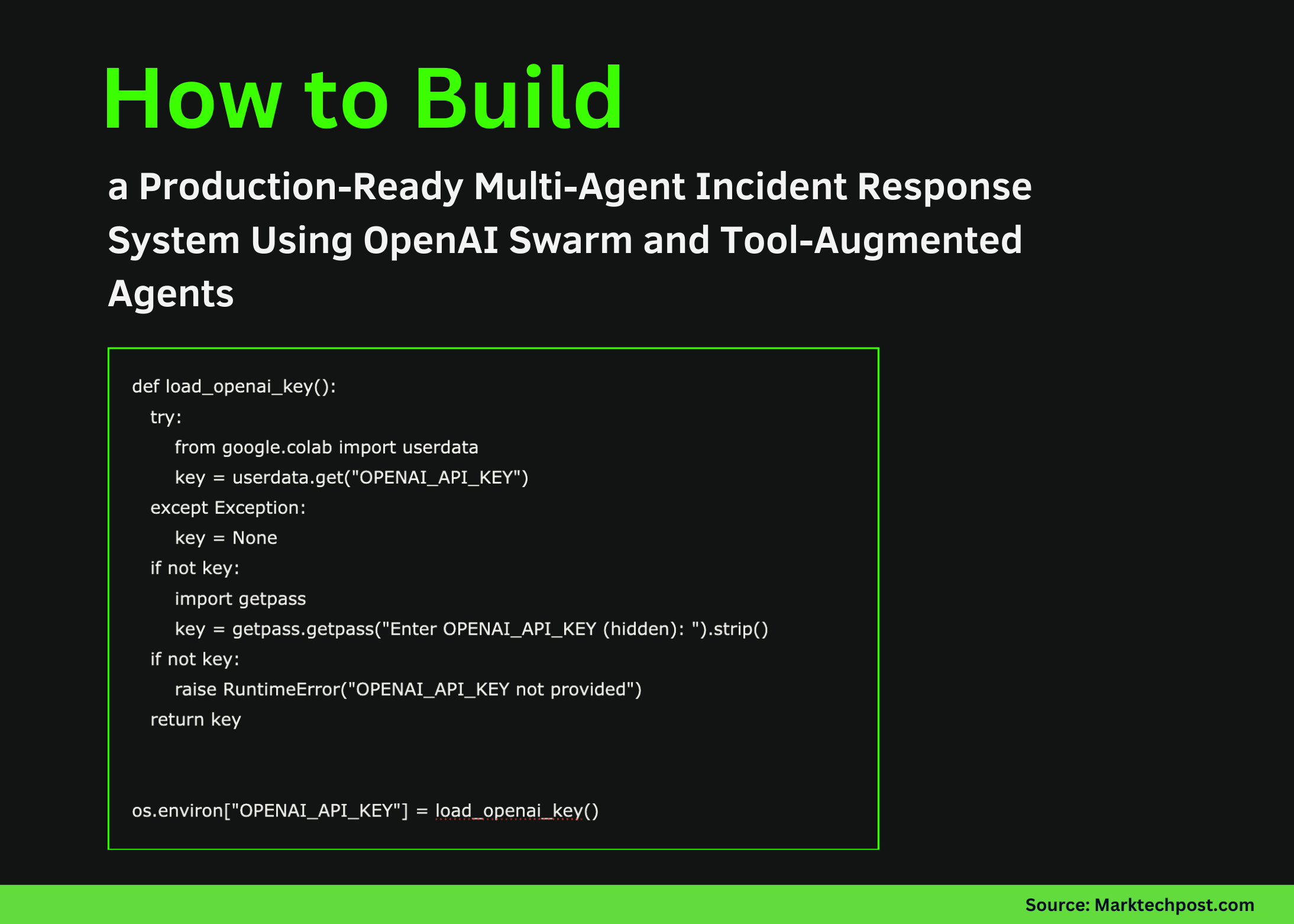
How to Build a Production-Ready Multi-Agent Incident Response System Using OpenAI Swarm and Tool-Augmented Agents

A recent tutorial demonstrates the development of a production-ready multi-agent incident response system utilizing OpenAI Swarm within Google Colab, showcasing how specialized agentssuch as triage, SRE, communications, and critic agentscan collaboratively manage real-world production incidents. The system emphasizes modularity, lightweight integration of tools for knowledge retrieval and decision ranking, and structured agent handoffs, enabling the creation of controllable, agentic workflows without relying on heavy frameworks or complex infrastructure. This approach highlights the practical application of OpenAI Swarm's capabilities to orchestrate complex multi-agent interactions in incident management scenarios, emphasizing

GPT Google AI
Read More
Research
📄 Towards Data Science

How to Keep MCPs Useful in Agentic Pipelines

The article emphasizes the importance of evaluating the tools and mechanisms that large language models (LLMs) utilize within agentic pipelines before opting to replace them with more powerful models. It advocates for maintaining and optimizing existing multi-chain processes (MCPs) to preserve their utility and efficiency, rather than solely focusing on increasing model size or complexity.

Research
📄 MarkTechPost

Recursive Language Models (RLMs): From MITs Blueprint to Prime Intellects RLMEnv for Long Horizon LLM Agents

Recursive Language Models (RLMs) represent a significant advancement in addressing the limitations of traditional large language models regarding context length, accuracy, and computational cost. Instead of processing extensive prompts in a single pass, RLMs treat the prompt as an external environment, enabling the model to dynamically inspect and manipulate the input through code written in an external environment like Python. This approach allows the root model, such as GPT-5, to delegate tasks like slicing, searching, and summarizing to helper functions and smaller models, effectively breaking down long inputs into manageable segments. By leveraging a REPL-based control plane

Startups
📄 Towards AI Newsletter

Start Building AI Projects This January - Live Cohort Kick-Off This Sunday

Towards AI has launched a monthly live cohort kick-off designed to help learners transition from theoretical understanding to practical AI projects, addressing the common challenge of turning curiosity into consistent progress. The upcoming session, led by CEO Louie Peters, will guide participants on selecting effective learning paths, initiating hands-on projects in Python, and working with advanced techniques such as prompting, Retrieval-Augmented Generation (RAG), and AI agents, enabling them to build demonstrable AI systems. This initiative aims to foster active engagement and practical skill development, providing newcomers and explorers with a structured on-ramp into AI development, with the January

Page 20 of 130 • Showing articles 229-240 of 1560