Page 16 of 130 • 1560 Total Articles

createLiveAI

Continue exploring the latest AI breakthroughs, technology insights, and industry analysis. Page 16 of our comprehensive AI news collection.

📰 Latest Intelligence

Showing 12 articles on page 16 of 130

Live feed
General
📄 MarkTechPost

A Coding Guide to Anemoi-Style Semi-Centralized Agentic Systems Using Peer-to-Peer Critic Loops in LangGraph

A recent tutorial introduces a semi-centralized Anemoi-style multi-agent system that enables two peer agentsa Drafter and a Criticto negotiate and refine outputs through direct peer-to-peer feedback, eliminating the need for a central manager. This approach reduces coordination overhead while maintaining high-quality results, demonstrating a practical implementation using LangGraph in Google Colab with OpenAI's GPT models, such as GPT-4. The technical innovation lies in leveraging peer-to-peer critic loops within a semi-centralized framework, allowing agents to iteratively improve outputs through direct communication. The tutorial emphasizes clarity and control flow, providing

GPT Google AI

Read More
Research
📄 Towards Data Science

How to Perform Large Code Refactors in Cursor

Recent advancements demonstrate how large language models (LLMs) can be effectively utilized to automate large-scale code refactoring tasks, significantly improving development efficiency. By leveraging LLMs, developers can perform complex code transformations within integrated development environments (IDEs) like Cursor, enabling precise and scalable modifications across extensive codebases.

Research
📄 Towards Data Science

You Probably Dont Need a Vector Database for YourRAG Yet

Recent discussions suggest that traditional data science libraries like Numpy and SciKit-Learn may sufficiently handle retrieval tasks in retrieval-augmented generation (RAG) systems, potentially eliminating the immediate need for specialized vector databases. This development indicates that for many applications, leveraging these well-established tools could simplify implementation and reduce complexity, challenging the assumption that dedicated vector databases are essential for effective semantic search and retrieval in AI workflows.

Research
📄 Towards Data Science

Using Local LLMs to Discover High-Performance Algorithms

A developer leveraged open-source large language models (LLMs) running locally on a MacBook to advance efficient code generation and discover high-performance algorithms. This approach demonstrates the potential of accessible, on-device AI models to facilitate sophisticated programming tasks without reliance on cloud-based infrastructure, highlighting a shift toward more decentralized and privacy-conscious AI development.

General
📄 AI News

Credit unions, fintech and the AI inflection of financial services

Artificial intelligence has become a fundamental component of modern financial services, integrating into critical functions such as fraud detection, KYC, AML, and customer engagement across banking, payments, and wealth management sectors. This rapid adoption is evidenced by consumer behavior, with over half of users employing AI tools for financial planning and budgeting, especially among younger demographics like Gen Z and millennials, who demonstrate high comfort levels with AI-driven financial transactions and conversational interfaces. For credit unions, this AI-driven transformation presents both opportunities and challenges. While consumer expectations are increasingly shaped by the advanced digital platforms of large fintech firms and digital banks deploying AI

Business
📄 Towards Data Science

Time Series Isnt Enough: How Graph Neural Networks Change Demand Forecasting

Graph Neural Networks (GNNs) are transforming demand forecasting by modeling stock-keeping units (SKUs) as interconnected networks rather than isolated entities, capturing complex relationships and dependencies among products. This approach addresses limitations of traditional forecasting methods, enabling more accurate predictions by leveraging the structural information within SKU networks to better understand demand patterns and substitution effects.

Research
🎓 MIT Tech Review AI

Going beyond pilots with composable and sovereign AI

Despite significant investments in generative AI, only a small fraction of enterprise pilots deliver measurable business value, primarily due to infrastructural challenges such as limited data accessibility, rigid integration, and fragile deployment pathways. To address these issues, companies are increasingly adopting composable and sovereign AI architectures that enhance scalability, reduce costs, and maintain data ownership, with IDC projecting that 75% of global businesses will embrace this shift by 2027. The core problem lies in the disconnect between proof-of-concept (PoC) environments and real-world production settings, where PoCs often succeed in controlled conditions but fail

Academic
Read More
General
📄 MarkTechPost

A Coding Guide to Understanding How Retries Trigger Failure Cascades in RPC and Event-Driven Architectures

This tutorial presents a comparative analysis of synchronous RPC-based systems and asynchronous event-driven architectures by simulating real-world load conditions, including variable latency, overload, and transient errors. It demonstrates how tight coupling in RPC systems can lead to failure cascades, especially under bursty traffic, by examining metrics such as tail latency, retries, and dead-letter queues, highlighting the resilience advantages of asynchronous designs. Key technical insights include the implementation of mechanisms like retries, exponential backoff, circuit breakers, bulkheads, and queues, which are essential for mitigating cascading failures in distributed systems. The tutorial emphasizes how asynchronous event-driven

Research
📄 MarkTechPost

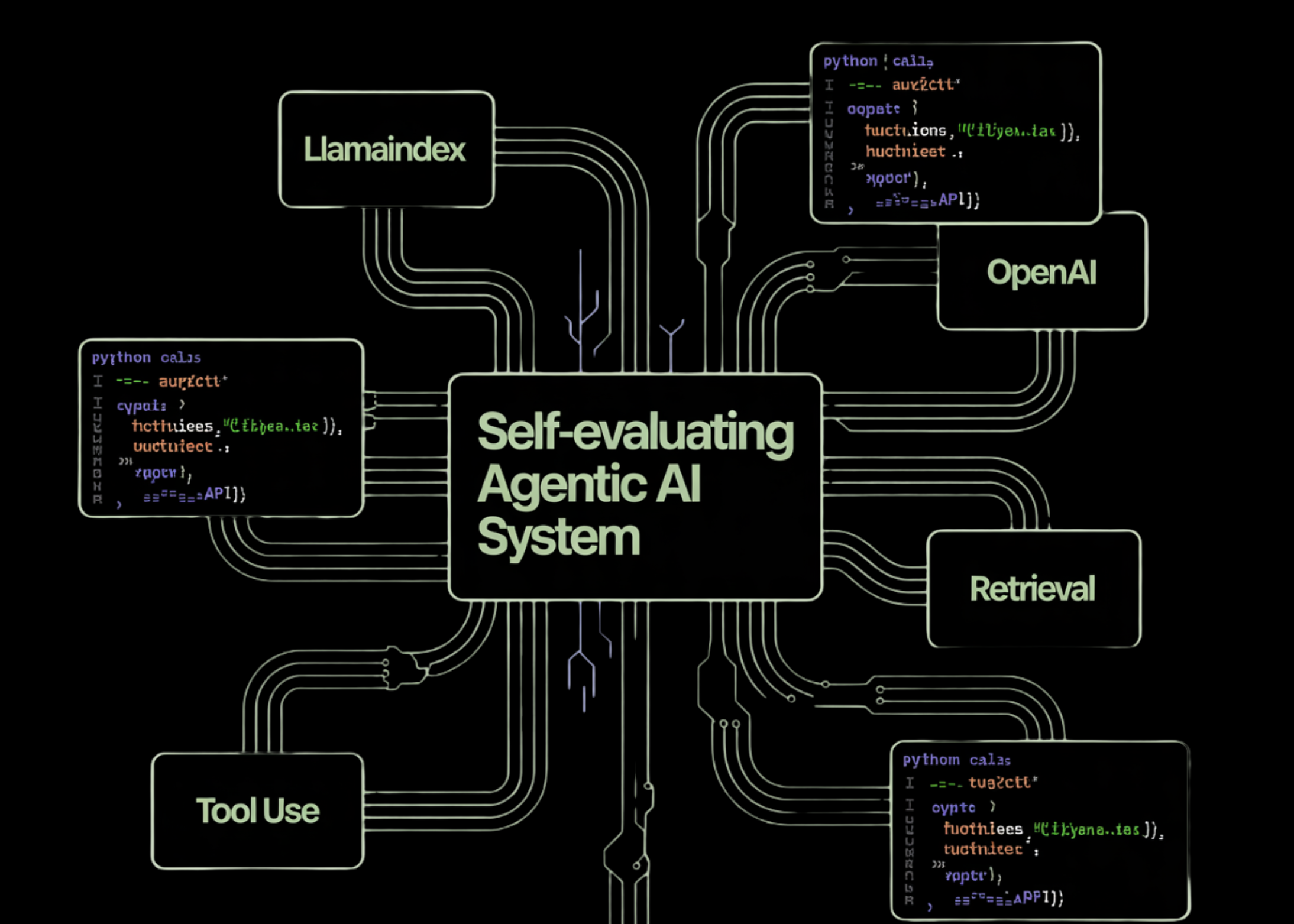
How to Build a Self-Evaluating Agentic AI System with LlamaIndex and OpenAI Using Retrieval, Tool Use, and Automated Quality Checks

A recent tutorial demonstrates the development of an advanced agentic AI system utilizing LlamaIndex and OpenAI models, specifically focusing on creating a retrieval-augmented generation (RAG) agent capable of reasoning over evidence, deliberate tool use, and self-evaluation of output quality. This approach enhances traditional chatbots by integrating structured retrieval, answer synthesis, and automated quality checks, paving the way for more trustworthy and controllable AI applications in research and analytical domains. The implementation involves setting up a secure environment with dependencies like LlamaIndex and OpenAI's GPT-4, emphasizing best practices such as runtime credential

Page 16 of 130 • Showing articles 181-192 of 1560