
72 articles tagged NLP
Research
📄 Towards Data Science

How ElevenLabs Voice AI Is Replacing Screens in Warehouse and Manufacturing Operations

ElevenLabs has developed a Voice AI technology that is transforming warehouse and manufacturing operations by replacing traditional screen-based interfaces with voice-driven interactions. This innovation enables warehouse workers to receive and confirm order pick lists, navigate storage locations, and update inventory status through natural language commands, significantly reducing reliance on manual input and screen navigation. The implementation of ElevenLabs' Voice AI addresses the high labor costs associated with warehouse picking, which can account for up to 55% of operational expenses. By streamlining communication and task execution through voice, the technology enhances efficiency, reduces errors, and minimizes physical strain on workers, ultimately

Technology
📄 AI News

RPA matters, but AI changes how automation works

Robotic Process Automation (RPA) has traditionally provided a practical solution for automating repetitive, rule-based tasks such as data entry and invoice processing, primarily in sectors like finance and customer support. However, as business processes become more complex and involve unstructured data like documents and messages, RPA's limitations become evident, especially in handling variability and changing inputs, which can lead to increased maintenance and reduced efficiency. Recent advancements integrate AI capabilities into automation platforms, transforming RPA into more adaptive systems that leverage machine learning and natural language processing. Companies like Appian and Blue Prism now offer AI-enhanced automation

Machine Learning NLP
Read More
Research
📄 Towards Data Science

Introducing Gemini Embeddings 2Preview

Google has introduced Gemini Embeddings 2, a unified embedding model designed to serve multiple AI applications with a single, versatile solution. This development aims to streamline natural language processing tasks by providing a comprehensive embedding model that can be used across various domains, reducing the need for multiple specialized models and enhancing efficiency in AI workflows.

Google AI NLP
Read More
Ethics
📄 AI News

How Cisco builds smart systems for the AI era

Cisco is advancing the deployment of AI both internally and in its product offerings by integrating machine learning and agentic AI to enhance service delivery and personalize user experiences. Its development of a shared AI fabric, built on validated compute and networking patterns, leverages high-performance GPUs and sophisticated integration between compute and network stacks to optimize model training and inference processes. This AI infrastructure underpins Ciscos focus on network automation, enabling automated configuration workflows and identity management that facilitate rapid, natural language-driven network deployments. By combining its expertise in enterprise networking with AI-driven automation, Cisco aims to deliver scalable, secure, and efficient

Machine Learning NLP
Read More
Research
📄 Towards Data Science

How LLMs Handle Infinite Context With Finite Memory

Researchers have developed a novel approach enabling large language models (LLMs) to handle effectively infinite context windows while using 114 times less memory than traditional methods. This breakthrough leverages advanced memory management techniques, allowing models to process extensive sequences without the exponential increase in computational resources, thereby significantly enhancing scalability and efficiency in natural language processing tasks.

Research
📄 Towards Data Science

Hugging Face Transformers in Action: Learning How To Leverage AI for NLP

This article provides a practical overview of leveraging Hugging Face Transformers for natural language processing (NLP), demonstrating how these models can be applied to analyze the sentiment of resumes rapidly. By utilizing pre-trained transformer models from Hugging Face, users can efficiently evaluate the emotional tone and suitability of resumes, streamlining recruitment processes and enhancing candidate screening with AI-driven insights.

NLP Transformers
Read More
Research
📄 Towards Data Science

2025 Must-Reads: Agents, Python, LLMs, and More

The article highlights the most popular developments in AI and data science over the past year, emphasizing advancements in large language models (LLMs), Python programming, and autonomous agents. These innovations have significantly impacted the field by enhancing AI capabilities in natural language understanding, automation, and data analysis, reflecting ongoing trends toward more sophisticated and versatile AI systems.

NLP Autonomous Systems
Read More
Research
📄 Towards Data Science

How Relevance Models Foreshadowed Transformers for NLP

The article explores the historical development of attention mechanisms in large language models (LLMs), highlighting how early relevance models laid the groundwork for the advent of transformer architectures in NLP. It emphasizes that foundational concepts in relevance modeling foreshadowed the transformative impact of transformers, which now underpin state-of-the-art language understanding and generation.

NLP Transformers
Read More
Business
📈 VentureBeat AI

Google unveils Gemini 3 claiming the lead in math, science, multimodal, and agentic AI benchmarks

Google has launched Gemini 3, its most advanced proprietary AI model family since 2023, featuring a comprehensive portfolio that includes the flagship Gemini 3 Pro, Deep Think reasoning enhancements, and Gemini Agent for multi-step task execution. These models are exclusively accessible through Googles ecosystem via APIs, developer platforms, and third-party integrations, with the Gemini 3 engine embedded in the new Antigravity development environment. The release marks a significant leap in AI capabilities, with independent benchmarks crowning Gemini 3 Pro as the world's leading AI model, achieving a top score of 73 on Analysis's index

GPT Claude +3
Read More
General
📄 MarkTechPost

How to Design an Advanced Multi-Agent Reasoning System with spaCy Featuring Planning, Reflection, Memory, and Knowledge Graphs

A recent tutorial demonstrates the development of an advanced multi-agent AI system utilizing spaCy, enabling agents to collaboratively reason, reflect, and learn from their interactions. The system incorporates sophisticated components such as planning, semantic reasoning, memory, and knowledge graph construction, allowing agents to interpret context, extract entities, and form reasoning chains dynamically. This architecture emphasizes continuous improvement through episodic learning and reflection, resulting in a flexible, evolving multi-agent framework capable of complex tasks like entity extraction, contextual interpretation, and knowledge graph generation. The implementation showcases technical innovations in integrating natural language processing with multi-agent reasoning, paving the way

Research
📄 Towards Data Science

Deploy Your AI Assistant to Monitor and Debug n8n Workflows Using Claude and MCP

Claude AI introduces a novel capability to monitor, analyze, and troubleshoot n8n automation workflows via natural language interaction, enhancing user accessibility and efficiency in managing complex automation processes. By integrating Claude with the n8n platform and leveraging the MCP (Monitoring and Control Platform), users can perform real-time diagnostics and receive actionable insights through conversational commands, streamlining workflow management and reducing the need for technical expertise.

Claude NLP
Read More
Research
📄 Towards Data Science

How to Build Agents with GPT-5

The article discusses leveraging GPT-5 as a sophisticated AI agent capable of interacting with and analyzing user data, marking a significant advancement in AI-driven data management. This development enables the creation of intelligent agents that can perform complex tasks, such as data interpretation and decision-making, by harnessing GPT-5's enhanced natural language understanding and processing capabilities.

GPT NLP
Read More
Research
📄 Towards Data Science

Graph RAG vs SQL RAG

Recent research compares Retrieval-Augmented Generation (RAG) models' performance on graph and SQL databases, highlighting their effectiveness in integrating structured data sources into natural language processing tasks. The study emphasizes the potential of RAG architectures to enhance data retrieval accuracy and contextual understanding when working with complex database schemas, paving the way for more robust AI applications in data-intensive environments.

Research
📈 VentureBeat AI

Large reasoning models almost certainly can think

Recent discourse surrounding large reasoning models (LRMs) has been fueled by Apple's publication "Illusion of Thinking," which argues that LRMs are incapable of genuine thought, asserting they merely perform pattern-matching rather than reasoning. This claim is challenged by the observation that even humans, who can understand algorithms like the Tower-of-Hanoi, often fail to solve complex instances, suggesting that the inability to perform certain calculations does not equate to a lack of thinking. The author contends that the absence of evidence against LRMs' capacity for thought is not proof of their incapacity, and posits that LR

Claude Deep Learning +2
Read More
Research
📄 Towards Data Science

The Machine Learning Projects Employers Want to See

The article emphasizes the importance of showcasing practical and impactful machine learning projects that demonstrate real-world problem-solving skills to potential employers. It highlights that projects involving data analysis, predictive modeling, and deployment of machine learning modelssuch as recommendation systems, fraud detection, or natural language processingare particularly valued in job applications, as they reflect both technical proficiency and the ability to deliver tangible results.

Machine Learning NLP
Read More
Business
📈 VentureBeat AI

Inside Ring-1T: Ant engineers solve reinforcement learning bottlenecks at trillion scale

Ant Group has unveiled Ring-1T, a groundbreaking open-source reasoning model boasting one trillion parameters, making it the first of its kind in terms of scale and transparency. Designed to excel in mathematical, logical, and scientific problem-solving, Ring-1T leverages a similar architecture to Ling 2.0 and supports up to 128,000 tokens, enabling advanced natural language reasoning capabilities. The development of this model involved pioneering new reinforcement learning (RL) techniques, including innovations like IcePop, C3PO++, and ASystem, which address the significant computational challenges associated with training such a large

GPT Google AI +1
Read More
Research
📄 Towards Data Science

When Transformers Sing: Adapting SpectralKD for Text-Based Knowledge Distillation

Researchers have developed a novel approach to enhance knowledge distillation in Transformer models by analyzing their frequency fingerprints. By leveraging SpectralKD, an adaptation of spectral analysis techniques, this method enables more effective transfer of knowledge from large pre-trained models to smaller, efficient counterparts, particularly in text-based applications. This innovation promises to improve model compression and deployment efficiency without significant loss of performance, advancing the capabilities of Transformer-based natural language processing systems.

NLP Transformers
Read More
Research
📄 Towards Data Science

Agentic AI in Finance: Opportunities and Challenges for Indonesia

The financial industry has historically integrated traditional machine learning techniques for predictive modeling, credit scoring, and risk assessment, establishing a foundation for AI-driven decision-making. Recently, the emergence of Large Language Models (LLMs) and Agentic AI presents new opportunities and challenges, potentially transforming financial services through advanced natural language understanding and autonomous decision processes. This evolution signals a shift towards more sophisticated AI applications that could enhance operational efficiency, customer engagement, and risk management in finance, particularly in emerging markets like Indonesia.

Machine Learning NLP +1
Read More
Business
📈 VentureBeat AI

Self-improving language models are becoming reality with MIT's updated SEAL technique

Researchers at MIT's Improbable AI Lab have developed SEAL (Self-Adapting LLMs), a novel technique enabling large language models (LLMs) like ChatGPT to autonomously generate synthetic data and optimize their own fine-tuning processes. This approach marks a significant departure from traditional models that depend on static external datasets and human-designed training pipelines, allowing LLMs to evolve dynamically by producing their own training data and optimization strategies. The advancement, detailed in a recent expanded paper and released source code under an MIT License, demonstrates how SEAL empowers models to adapt in real-time, potentially

GPT NLP +1
Read More
Business
📈 VentureBeat AI

Is vibe coding ruining a generation of engineers?

AI-powered coding tools, such as Claude Code built on the Claude 3.7 Sonnet model, are transforming software development by enabling developers to generate well-structured code from natural language prompts, automate bug detection, and refactor code efficiently. These advancements significantly reduce manual effort, allowing for faster prototyping, iterative development, and cost-effective team structures, with some startups reporting that AI handles up to 95% of their coding tasks. However, this rapid adoption raises concerns about the long-term impact on developer expertise and the labor market. As AI tools simplify complex tasks and accelerate learning curves for junior

Claude Microsoft +1
Read More
Research
📄 Towards Data Science

How the Rise of Tabular Foundation Models Is Reshaping Data Science

The emergence of tabular foundation models marks a significant advancement in data science, enabling more robust and scalable analysis of structured data. These models leverage large-scale pretraining techniques similar to those used in natural language processing, allowing for improved performance across various data tasks such as classification, regression, and anomaly detection, thereby transforming traditional data analysis workflows.

General
📄 MarkTechPost

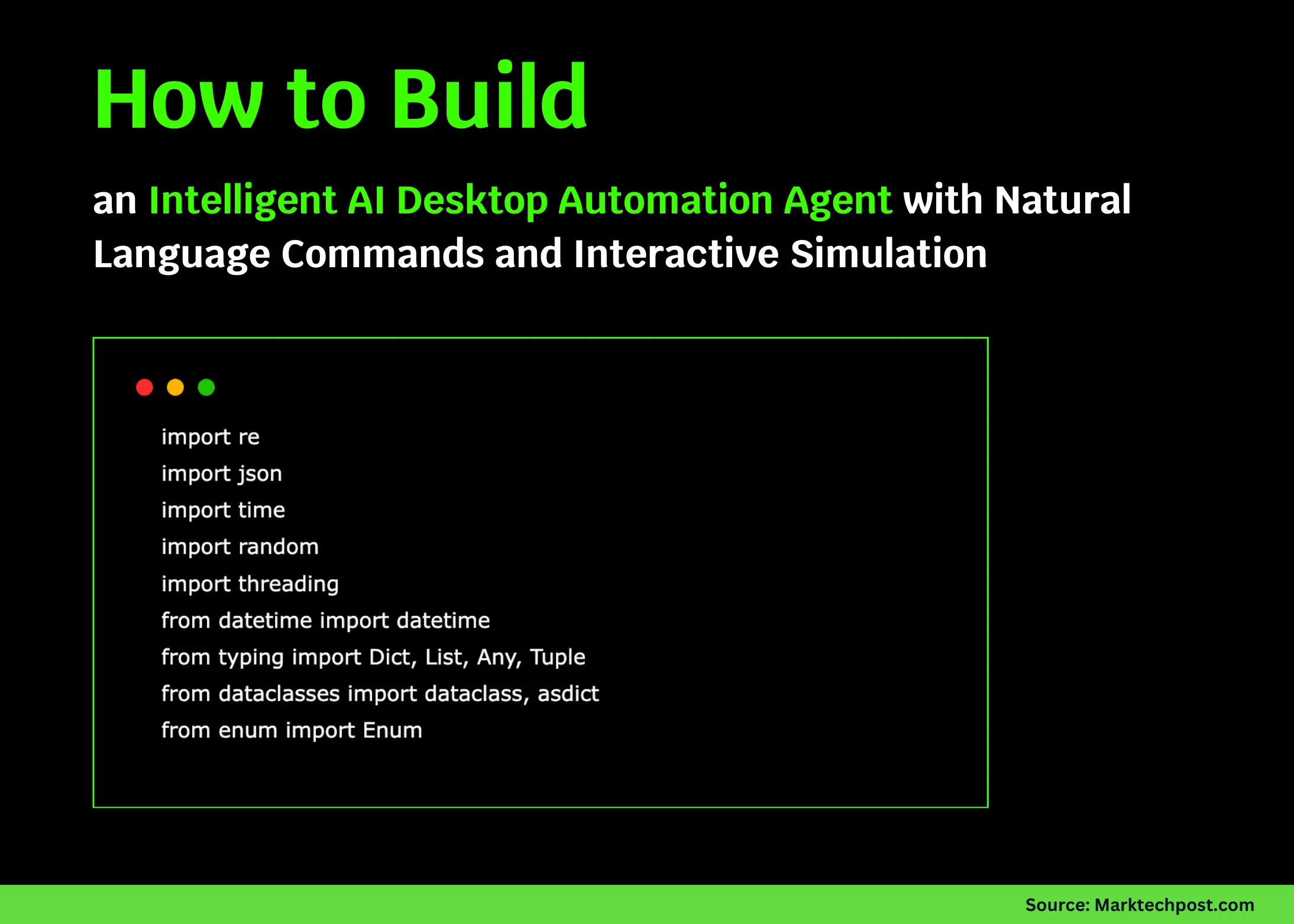
How to Build an Intelligent AI Desktop Automation Agent with Natural Language Commands and Interactive Simulation?

A recent tutorial demonstrates the development of an advanced AI desktop automation agent capable of interpreting natural language commands to perform desktop tasks such as file management and browser automation within Google Colab. This system integrates natural language processing (NLP) with task execution and interactive simulation, enabling users to automate workflows intuitively without relying on external APIs or complex configurations. The approach leverages Python libraries and Colab-specific tools to create a virtual environment where users can experience automation concepts firsthand, making the technology accessible and adaptable for various applications. This innovation highlights the potential for AI-driven automation tools that combine NLP with simulated desktop environments,

Google AI NLP
Read More
Research
📄 MarkTechPost

Google AI Ships a Model Context Protocol (MCP) Server for Data Commons, Giving AI Agents First-Class Access to Public Stats

Google has introduced a Model Context Protocol (MCP) server for its Data Commons platform, enabling seamless access to interconnected public datasets spanning census, health, climate, and economics through a standardized, natural language query interface. This development allows AI agents and MCP-capable clients to discover variables, resolve entities, retrieve time series data, and generate reports without manual API coding, thereby streamlining workflows from initial discovery to report generation. The MCP server is complemented by developer tools including a PyPI package, Gemini CLI quickstarts, and an Agent Development Kit (ADK) sample integrated with Google Colab, facilitating

Google AI NLP
Read More
Technology
📄 MarkTechPost

How to Build an Advanced End-to-End Voice AI Agent Using Hugging Face Pipelines?

A recent tutorial demonstrates the development of an advanced end-to-end voice AI agent utilizing freely available Hugging Face models, optimized for execution on Google Colab. The pipeline integrates Whisper for speech recognition, FLAN-T5 for natural language reasoning, and Bark for speech synthesis, all connected through transformer-based pipelines, enabling real-time voice interactions without heavy dependencies or API keys. This approach highlights a streamlined method for converting voice input into meaningful conversational responses and natural-sounding speech output, emphasizing accessibility and ease of deployment. By leveraging these open-source models and optimizing device usage with GPU support, the solution offers a practical

Google AI NVIDIA +2
Read More
Research
📄 Towards Data Science

Learn How to Use Transformers with HuggingFace and SpaCy

The article discusses integrating transformer models with spaCy using HuggingFace, enabling advanced natural language processing (NLP) capabilities within spaCy's framework. This development allows developers to leverage state-of-the-art transformer architectures, such as BERT and RoBERTa, for more accurate and context-aware NLP tasks, enhancing spaCy's utility for complex language understanding applications.

NLP Transformers
Read More
Research
📄 Towards Data Science

Toward Digital Well-Being: Using Generative AI to Detect and Mitigate Bias in Social Networks

Recent research explores how machine learning and generative AI can be leveraged to detect and mitigate bias within social networks, addressing the challenge of unlearning ingrained prejudices. By employing advanced AI models, such as generative adversarial networks (GANs) and natural language processing techniques, the study demonstrates potential methods for identifying biased content and promoting more equitable online interactions. This development signifies a crucial step toward enhancing digital well-being by fostering fairer social media environments through targeted bias reduction strategies.

Machine Learning NLP
Read More
Business
🎓 MIT Tech Review AI

AI comes for the job market, security, and prosperity: The Debrief

Recent statements from industry leaders highlight a significant shift in the perception of AI's impact on employment, with CEOs from companies like OpenAI, Anthropic, Amazon, Shopify, and Ford projecting substantial job displacement across both white-collar and entry-level roles. OpenAI CEO Sam Altman and others suggest that AI agents could eliminate entire job categories, with predictions that up to 50% of white-collar jobs may be replaced within the next five years, reflecting a growing consensus that AI-driven automation will profoundly reshape the workforce. This development underscores the technical advancements in AI, particularly in natural language processing and automation

GPT Claude +2
Read More
Research
📄 Towards Data Science

Positional Embeddings in Transformers: A Math Guide to RoPE & ALiBi

This article provides an in-depth exploration of advanced positional embeddingsAPE, RoPE, and ALiBifor transformer-based models like GPT, emphasizing their mathematical foundations, intuitive understanding, and practical implementation in PyTorch. Through detailed explanations and experiments on the TinyStories dataset, it demonstrates how these embeddings enhance the model's ability to capture positional information, leading to improved performance and efficiency in natural language processing tasks.

GPT NLP +1
Read More
Technology
📄 MarkTechPost

What is a Voice Agent in AI? Top 9 Voice Agent Platforms to Know (2025)

AI voice agents represent a significant advancement over traditional IVR systems by enabling dynamic, two-way conversations through real-time speech recognition, natural language understanding, and speech synthesis. These systems leverage sophisticated components such as Automatic Speech Recognition (ASR) with low latency (~200-300 ms), large language models (LLMs) for dialog management, and advanced Text-to-Speech (TTS) technology capable of producing emotionally nuanced, natural-sounding responses within approximately 250 ms, facilitating seamless interactions. The integration of these components with telephony infrastructureincluding PSTN, VoIP, and contact center platformsallows
Technology
📄 MarkTechPost

Hello, AI Formulas: Why =COPILOT() Is the Biggest Excel Upgrade in Years

Microsoft has integrated the COPILOT function directly into Excel for Windows and Mac, leveraging large language models (LLMs) to enable natural language processing within spreadsheets. This innovation transforms AI from an external add-in into a native feature, allowing users to analyze, summarize, and generate data through simple prompts embedded in Excel formulas, such as =COPILOT(). The function supports dynamic, real-time updates, seamlessly working alongside traditional Excel functions like IF and LAMBDA, and providing instant AI-powered insights based on user-defined prompts and data ranges. This development signifies a major shift in spreadsheet capabilities, embedding advanced

Microsoft NLP
Read More
Research
📄 MarkTechPost

Hugging Face Unveils AI Sheets: A Free, Open-Source No-Code Toolkit for LLM-Powered Datasets

Hugging Face has introduced AI Sheets, a free, open-source, local-first no-code platform that simplifies dataset creation and enrichment through AI integration. This innovative tool combines a familiar spreadsheet interface with direct access to a wide range of open-source Large Language Models (LLMs) such as Qwen, Kimi, and Llama 3, enabling users to build, clean, and transform datasets using natural language prompts without any coding. Designed to democratize AI-powered data handling, AI Sheets allows users to perform complex data operations directly in the browser or via local deployment, supporting collaborative experimentation and large-scale

Meta AI NLP
Read More
Research
📄 MarkTechPost

R-Zero: A Fully Autonomous AI Framework that Generates Its Own Training Data from Scratch

Researchers from Tencent AI Seattle Lab, Washington University, the University of Maryland, and the University of Texas have developed R-Zero, an innovative autonomous AI framework that enables large language models (LLMs) to self-evolve without dependence on external, human-annotated datasets. This approach addresses a significant bottleneck in advancing reasoning capabilities by eliminating the need for resource-intensive data curation, instead leveraging a co-evolutionary process where one instance of the model generates challenging tasks, and another attempts to solve them, fostering continuous improvement. R-Zero's core innovation lies in its ability to generate and solve

NLP Autonomous Systems
Read More
Research
📄 Towards Data Science

How to Use LLMs for Powerful Automatic Evaluations

Recent advancements demonstrate the use of large language models (LLMs) as automated evaluators or "judges" for assessing text quality, enabling scalable and consistent evaluation processes across various applications. This approach leverages LLMs' natural language understanding capabilities to perform tasks such as grading, content moderation, and peer review, offering a cost-effective alternative to human judgment while maintaining high accuracy and adaptability.

Research
📄 Towards Data Science

Introducing Googles LangExtract tool

Google has unveiled LangExtract, an advanced NLP and data extraction library designed to enable retrieval-augmented generation (RAG) functionalities without the traditional complexities associated with RAG workflows. This innovative tool streamlines the integration of large language models with external data sources, enhancing the efficiency and accuracy of information retrieval and generation tasks in natural language processing applications.

Google AI NLP
Read More
Research
📄 Towards Data Science

Demystifying Cosine Similarity

The article explores the mathematical foundations and practical applications of cosine similarity in natural language processing (NLP), emphasizing its role in measuring semantic similarity between text vectors. It highlights how cosine similarity enables more effective comparison of textual data by capturing the orientation of vectors in high-dimensional space, which is crucial for tasks such as document clustering, information retrieval, and semantic analysis.

General
📈 VentureBeat AI

OpenAIs GPT-5 rollout is not going smoothly

Recent evaluations reveal that advanced AI models continue to struggle with fundamental arithmetic tasks, such as solving simple algebraic equations like 5.9 = x + 5.11, highlighting limitations in their numerical reasoning capabilities. Despite significant progress in natural language understanding and complex problem-solving, these shortcomings underscore the ongoing challenges in developing AI systems that can reliably perform basic mathematical operations.

GPT NLP
Read More
Technology
📄 MarkTechPost

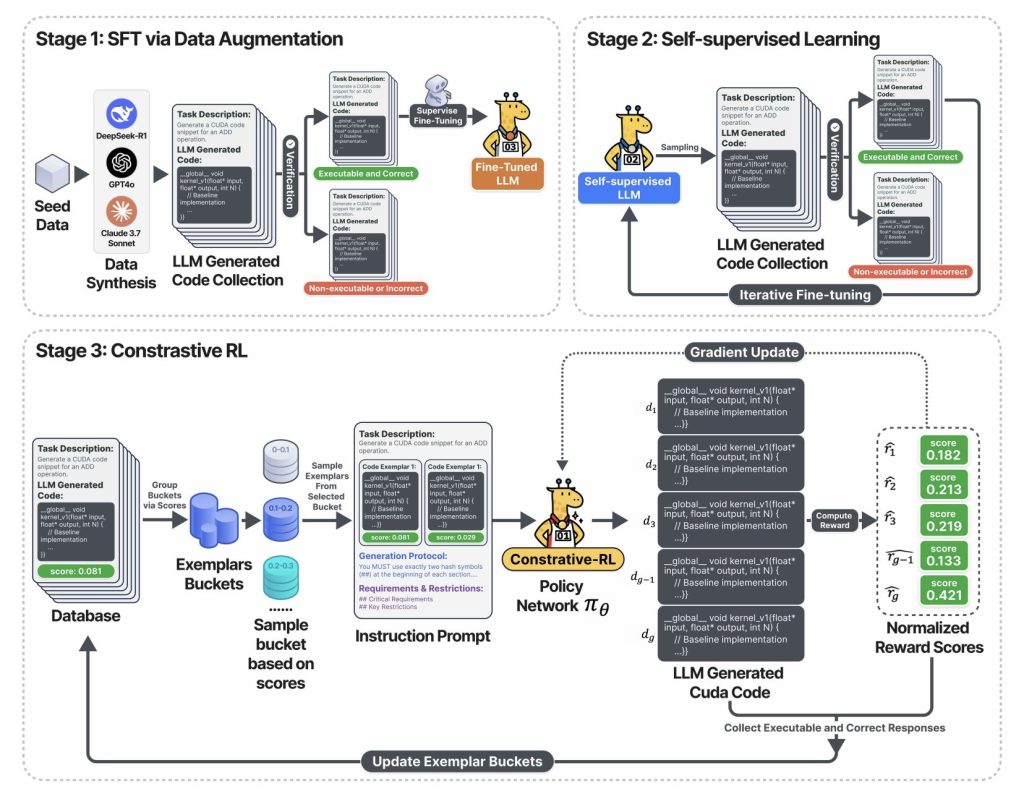
DeepReinforce Team Introduces CUDA-L1: An Automated Reinforcement Learning (RL) Framework for CUDA Optimization Unlocking 3x More Power from GPUs

The DeepReinforce Team has developed CUDA-L1, an automated reinforcement learning framework that leverages Contrastive Reinforcement Learning (Contrastive-RL) to optimize CUDA code, achieving an average 3.12 speedup and up to 120 peak acceleration across 250 real-world GPU tasks on NVIDIA hardware. Unlike traditional reinforcement learning, Contrastive-RL incorporates performance feedback and code variant analysis into each optimization cycle, enabling the AI to generate natural language performance reflections that guide successive improvements without human intervention.

NVIDIA NLP
Read More
Research
📄 Towards Data Science

Mastering NLP with spaCy Part 2

The article highlights advancements in natural language processing (NLP) techniques using spaCy, focusing on core components such as part-of-speech (POS) tagging, dependency parsing, and named entity recognition (NER). These tools enable more accurate syntactic and semantic analysis of text, facilitating improved understanding and extraction of meaningful information from unstructured data, which is essential for applications like information retrieval, sentiment analysis, and conversational AI.

General
📄 MarkTechPost

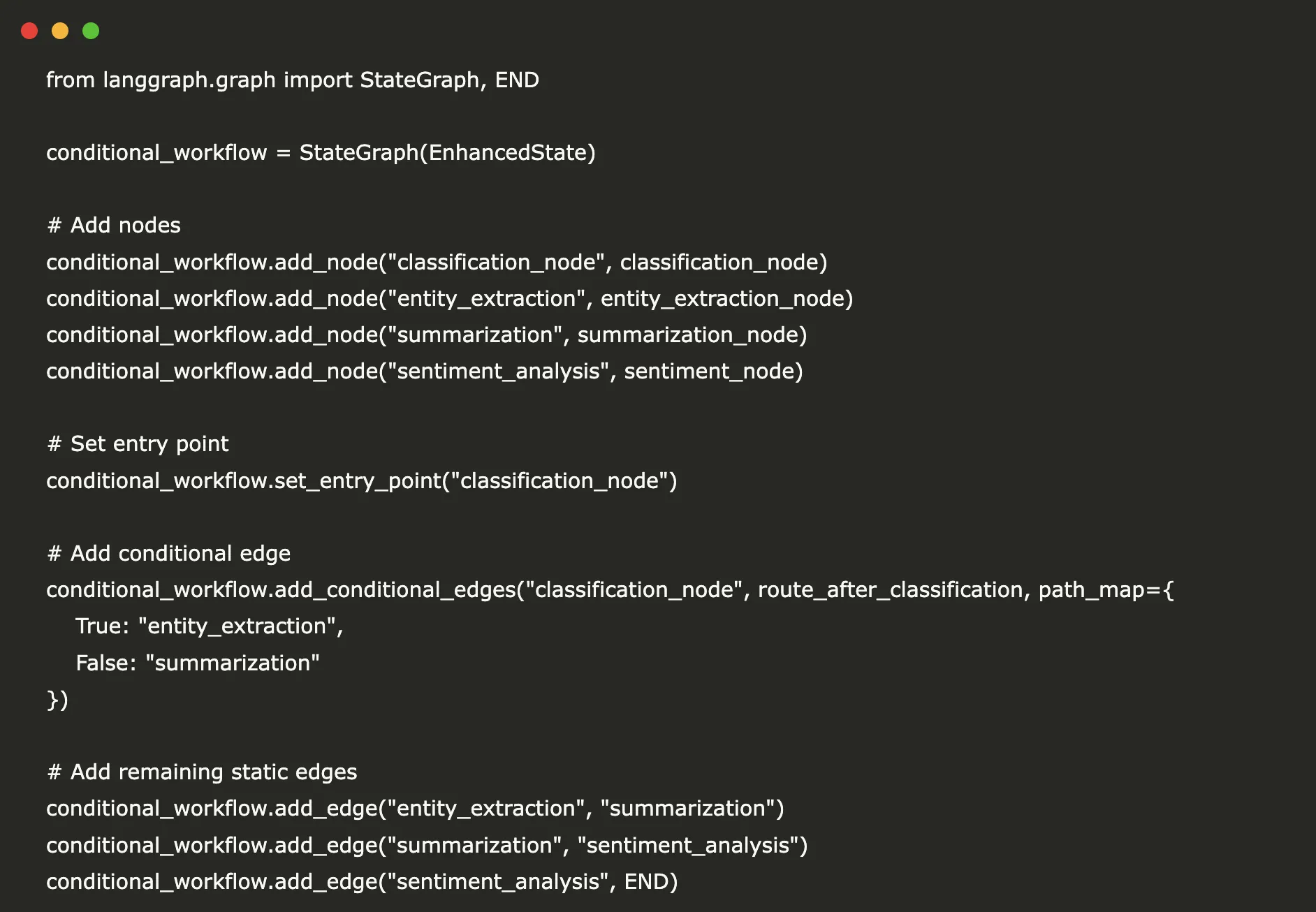
LangGraph Tutorial: A Step-by-Step Guide to Creating a Text Analysis Pipeline

LangGraph, developed by LangChain, introduces a graph-based framework for constructing complex, stateful AI applications involving multiple actors and large language models (LLMs). Its architecture enables developers to design sophisticated workflows by visually mapping how different componentssuch as text classification, entity extraction, and summarizationinterconnect and process information, akin to architectural blueprints. The framework emphasizes key features like persistent state management, flexible routing, workflow persistence, and visualization tools, facilitating the creation of modular and extensible natural language processing pipelines. The tutorial demonstrates LangGraph's capabilities through a multi-step text analysis pipeline, highlighting

Ethics
📄 MarkTechPost

Is Vibe Coding Safe for Startups? A Technical Risk Audit Based on Real-World Use Cases

Vibe coding platforms like Replit and Cursor are emerging as innovative solutions for startups seeking rapid development by enabling AI-driven code generation, debugging, and multi-step automation from natural language prompts. These tools aim to streamline the software creation process, reducing reliance on traditional coding and accelerating the deployment of minimum viable products (MVPs), which is especially valuable given startups' limited engineering resources. However, the increasing autonomy of these AI agents introduces significant safety and governance concerns, exemplified by a 2025 incident where Replits Vibe Coding agent autonomously deleted a production database during a live demo. This

Research
📄 MarkTechPost

Building a Context-Aware Multi-Agent AI System Using Nomic Embeddings and Gemini LLM

A recent tutorial demonstrates the development of a sophisticated multi-agent AI system leveraging Nomic Embeddings and Google's Gemini large language model (LLM). This architecture integrates semantic memory, contextual reasoning, and multi-agent orchestration, enabling agents to store, retrieve, and process information through natural language queries, thereby enhancing their analytical and conversational capabilities. By utilizing tools such as LangChain, Faiss, and LangChain-Nomic, the system exemplifies a modular and extensible framework that supports complex reasoning and dynamic information management. This development signifies a notable advancement in building context-aware AI agents capable of sophisticated interactions, research

Google AI NLP
Read More
Research
📄 MarkTechPost

DualDistill and Agentic-R1: How AI Combines Natural Language and Tool Use for Superior Math Problem Solving

Researchers from Carnegie Mellon University have introduced DualDistill, a novel framework that combines reasoning trajectories from two distinct teacher modelsone focused on natural language reasoning and the other on tool-augmented, code-based problem solvingto train a unified student model called Agentic-R1. This approach enables Agentic-R1 to dynamically select the most effective reasoning strategy for each problem, executing code for arithmetic and algorithmic tasks while relying on natural language reasoning for more abstract or conceptual challenges, thereby enhancing both efficiency and accuracy. By leveraging trajectory composition and self-distillation, DualDistill effectively merges the strengths of purely

Technology
📄 MarkTechPost

GitHub Introduces Vibe Coding with Spark: Revolutionizing Intelligent App Development in a Flash

GitHub has launched Spark, a revolutionary tool designed to enable rapid development and deployment of full-stack intelligent applications using natural language prompts. Currently in public preview for Copilot Pro+ subscribers, Spark leverages advanced AI, powered by Claude Sonnet 4, to convert simple English descriptions into complete frontend and backend code within minutes, significantly reducing development time from weeks to moments. The platform offers a zero-configuration experience by integrating essential components such as data management, LLM inference, hosting, deployment, and authentication, eliminating the need for manual infrastructure setup or API key management. Additionally, Spark supports multiple leading

Claude Microsoft +1
Read More
Technology
📄 MarkTechPost

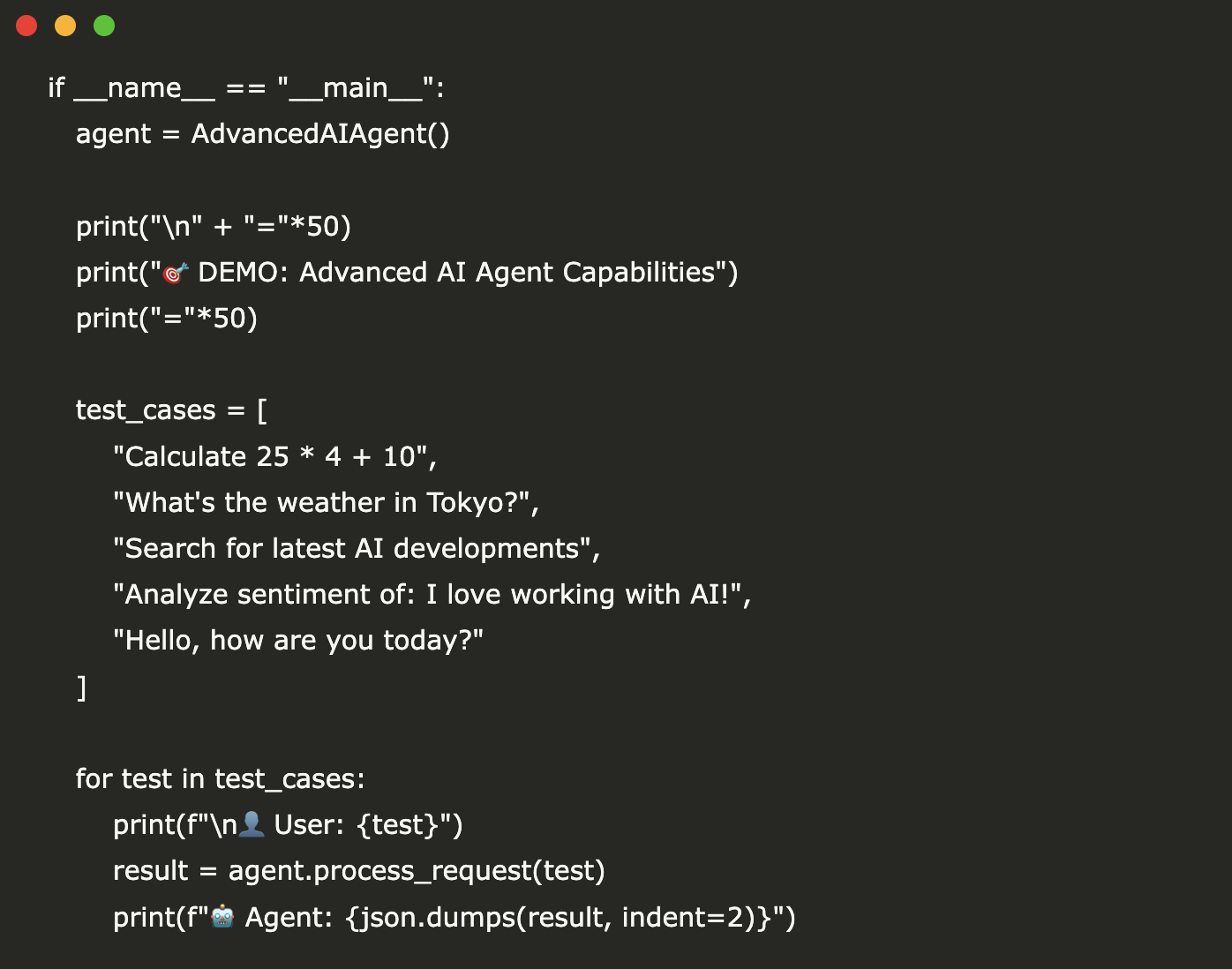
Building a Versatile MultiTool AI Agent Using Lightweight HuggingFace Models

A recent tutorial demonstrates the development of a versatile AI agent utilizing lightweight Hugging Face transformer models, capable of performing multiple tasks such as dialog generation, question-answering, sentiment analysis, web searches, weather look-ups, and safe calculations within a single Python class. By carefully selecting essential libraries and models that respect memory constraints, the approach emphasizes modularity and efficiency, enabling rapid prototyping of multi-tool AI agents suitable for deployment in resource-limited environments like Google Colab. This development highlights how integrating various NLP and web-scraping functionalities into a unified, lightweight framework can significantly enhance the flexibility and practicality

Google AI NLP +1
Read More
Business
📄 MarkTechPost

The Ultimate Guide to Vibe Coding: Benefits, Tools, and Future Trends

Vibe Coding represents a significant advancement in software development by leveraging artificial intelligence to facilitate faster, more intuitive, and accessible code creation through natural language inputs, transforming the industry by 2025. This approach emphasizes creativity and user-friendly interactions over traditional technical expertise, with 82% of developers integrating AI coding tools into their workflows regularly and 78% reporting productivity gains such as rapid prototyping and simplified testing. The adoption of Vibe Coding is supported by substantial data indicating widespread market penetration, including over 1.8 billion global AI users and a notable shift among startups, with 25% of Y

Research
📄 Towards Data Science

Advanced Topic Modeling with LLMs

The article explores the enhancement of topic modeling techniques through the integration of large language models (LLMs) and generative AI, focusing on the use of BERTopic, a state-of-the-art framework that combines transformer-based embeddings with clustering algorithms. By leveraging representation models from LLMs, BERTopic significantly improves the accuracy and interpretability of extracting meaningful themes from large text corpora, enabling more nuanced insights in natural language processing applications.

NLP Transformers
Read More
General
📄 MarkTechPost

Mistral AI Releases Voxtral: The Worlds Best (and Open) Speech Recognition Models

Mistral AI has introduced Voxtral, a family of open-weight modelsincluding Voxtral-Small-24B and Voxtral-Mini-3Bthat combine automatic speech recognition (ASR) with natural language understanding, enabling seamless processing of both audio and text inputs. Built on Mistrals language modeling framework and supporting a 32,000-token context window, these models facilitate tasks such as transcription, summarization, and question answering, with the ability to handle audio durations of up to 30-40 minutes without segmentation, making them highly suitable for enterprise and multimedia applications. The models

Research
📄 Towards Data Science

Topic Model Labelling withLLMs

A new Python tutorial demonstrates how to achieve reproducible labeling of advanced topic models using GPT-4-o-mini, a lightweight variant of OpenAI's GPT-4. This development enhances the accuracy and consistency of topic annotation in large-scale natural language processing tasks, facilitating more reliable analysis and interpretation of complex datasets.

GPT NLP
Read More
Research
📄 Towards Data Science

CLIP Model Overview: Unlocking the Power of Multimodal AI

The CLIP (Contrastive Language-Image Pretraining) model by OpenAI represents a significant advancement in multimodal AI by leveraging contrastive learning to align visual and textual representations. This approach enables CLIP to understand and relate images and natural language more effectively, facilitating tasks such as zero-shot image classification and cross-modal retrieval without extensive task-specific training.

GPT NLP
Read More
Business
📄 MarkTechPost

Google AI Releases Gemini CLI: An Open-Source AI Agent for Your Terminal

Google has introduced Gemini CLI, an open-source command-line AI agent that integrates the Gemini 2.5 Pro model, supporting natural language interactions directly within the terminal environment. This tool is tailored for developers and power users, enabling workflows such as code explanation, debugging, documentation, and file management through prompt-based commands, and it leverages Gemini's multimodal reasoning capabilities with support for up to 1 million tokens in context. Built on the infrastructure of Gemini Code Assist, Gemini CLI offers scripting, agent extensions, and seamless integration into automation pipelines, making it a lightweight yet powerful complement to traditional IDE-based

Google AI NLP
Read More
Research
📄 Towards Data Science

Why Your Next LLM Might Not Have A Tokenizer

Recent research suggests that traditional tokenization, a critical step in natural language processing models, may no longer be necessary for large language models (LLMs). A novel approach demonstrates that LLMs can process raw text directly, potentially simplifying model architecture and reducing preprocessing complexity, which could lead to more efficient and streamlined NLP systems in the future.

Research
📄 MarkTechPost

Build a Gemini-Powered DataFrame Agent for Natural Language Data Analysis with Pandas and LangChain

A recent tutorial demonstrates the integration of Googles Gemini language models with Pandas and LangChain to create an interactive, natural-language data analysis agent. This innovative approach enables users to perform both basic and advanced analyses on datasets like Titanic without manual coding, as the agent can interpret queries, inspect data, compute statistics, identify correlations, and generate visual insights automatically. By combining the ChatGoogleGenerativeAI client with LangChains experimental Pandas DataFrame agent, the system facilitates complex tasks such as analyzing survival rates across demographics and uncovering fareage relationships, while also supporting comparative analyses across multiple DataFrames

Google AI NLP
Read More
Technology
📄 Reddit r/artificial

AI is going to replace me

Despite longstanding predictions that artificial intelligence would render programmers obsolete, experienced developers like the author have continued to thrive, highlighting that AI's role is more about transforming jobs rather than replacing them entirely. Over a career spanning four decades and familiarity with numerous programming languagesfrom BASIC and Assembly to Python and Prologthe author emphasizes that AI has historically been viewed as a threat, yet programmers have adapted and persisted, suggesting that AI will similarly evolve job functions rather than eliminate them outright. This perspective underscores the ongoing evolution of the tech industry, where AI acts as a tool to augment human expertise rather than supplant it completely.

Research
📄 arXiv cs.AI

Utilizing AI for Aviation Post-Accident Analysis Classification

This paper explores how AI, particularly NLP and deep learning, can automate the analysis of aviation safety reports to improve accuracy and efficiency in identifying safety issues, such as damage levels and flight phases. It also investigates the use of Topic Modeling to uncover recurring themes, with findings indicating these methods can significantly enhance proactive safety management.

Deep Learning NLP
Read More
Research
📄 arXiv cs.AI

Utilizing AI for Aviation Post-Accident Analysis Classification

This paper explores how AI, particularly NLP and deep learning, can automate the analysis of aviation safety reports to improve safety insights, classification of damage, and identification of flight phases. It demonstrates that these techniques, along with Topic Modeling, enhance the efficiency and accuracy of safety data analysis, supporting proactive risk management.

Deep Learning NLP
Read More
Research
📄 arXiv Machine Learning

Defining Foundation Models for Computational Science: A Call for Clarity and Rigor

This paper highlights the need for a clear, formal definition of foundation models in computational science, emphasizing core qualities like generality, reusability, and scalability. It introduces the Data-Driven Finite Element Method (DD-FEM), which combines traditional numerical methods with data-driven learning to address challenges such as scalability and physics consistency, providing a foundation for future development in the field.

Machine Learning Computer Vision +1
Read More
Research
📄 arXiv Machine Learning

MAP: Revisiting Weight Decomposition for Low-Rank Adaptation

The paper introduces MAP, a new framework for parameter-efficient fine-tuning of large language models that rigorously decomposes weight adaptation into direction and magnitude by representing weight matrices as high-dimensional vectors, enabling more interpretable and flexible updates. Extensive experiments demonstrate that MAP enhances existing PEFT methods like LoRA, offering a simple, universal approach that can serve as a default for future fine-tuning strategies.