Page 55 of 130 • 1560 Total Articles

createLiveAI

Continue exploring the latest AI breakthroughs, technology insights, and industry analysis. Page 55 of our comprehensive AI news collection.

📰 Latest Intelligence

Showing 12 articles on page 55 of 130

Live feed
Research
📄 Towards Data Science

Evaluating Your RAG Solution

The article discusses leveraging large language models (LLMs) as evaluative "judges" to enhance retrieval-augmented generation (RAG) systems, enabling more accurate assessment of their outputs. This approach involves using LLMs to systematically evaluate and improve RAG solutions by providing nuanced feedback, thereby optimizing the relevance and quality of generated responses in complex information retrieval tasks.

Research
📄 MarkTechPost

Meta AI Researchers Release MapAnything: An End-to-End Transformer Architecture that Directly Regresses Factored, Metric 3D Scene Geometry

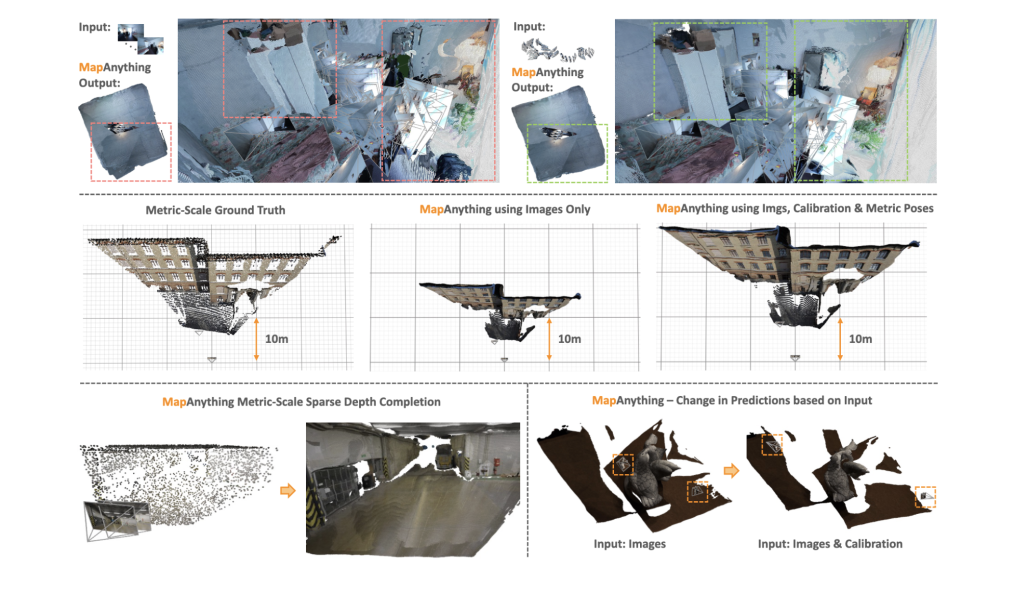
Meta Reality Labs and Carnegie Mellon University have developed MapAnything, an innovative end-to-end transformer architecture capable of directly regressing factored metric 3D scene geometry from images and sensor inputs. Unlike traditional modular pipelines that require extensive task-specific tuning and post-processing, MapAnything supports over 12 distinct 3D vision tasks within a single feed-forward pass, significantly streamlining the 3D reconstruction process. This model advances the field by accepting up to 2,000 input images simultaneously and flexibly incorporating auxiliary data such as camera intrinsics, poses, and depth maps. It produces accurate metric

Meta AI Transformers
Read More
Technology
📄 MarkTechPost

How to Build an Advanced End-to-End Voice AI Agent Using Hugging Face Pipelines?

A recent tutorial demonstrates the development of an advanced end-to-end voice AI agent utilizing freely available Hugging Face models, optimized for execution on Google Colab. The pipeline integrates Whisper for speech recognition, FLAN-T5 for natural language reasoning, and Bark for speech synthesis, all connected through transformer-based pipelines, enabling real-time voice interactions without heavy dependencies or API keys. This approach highlights a streamlined method for converting voice input into meaningful conversational responses and natural-sounding speech output, emphasizing accessibility and ease of deployment. By leveraging these open-source models and optimizing device usage with GPU support, the solution offers a practical

Google AI NVIDIA +2
Read More
Research
📄 AI News

AI-enabled threats and stricter regulation in France

A recent ISG report highlights how AI-enabled threats and stricter regulatory frameworks are transforming France's cybersecurity landscape, prompting enterprises to reevaluate their security strategies. In response to these evolving challenges, French companies are increasing security budgets and increasingly adopting AI-powered defense solutions to address complex, layered security needs driven by regulatory demands, cloud migration, and workforce shortages. The report emphasizes a shift toward integrated, all-in-one security solutions and a preference for service providers that can augment internal security teams, especially as organizations navigate multicloud environments with heightened integration and visibility challenges. This trend reflects a broader move toward more sophisticated,

Ethics
📄 The Hacker News

Rethinking AI Data Security: A Buyer's Guide

Generative AI has rapidly evolved from a novelty to an essential component of enterprise productivity, with large language models (LLMs) integrated into office suites and specialized platforms enabling employees to perform tasks such as coding, analysis, and drafting more efficiently. However, this swift adoption presents security challenges for CISOs and security architects, as the increasing power and ubiquity of these AI tools amplify risks related to data privacy, malicious use, and system vulnerabilities, necessitating robust security frameworks to mitigate potential threats.

Research
📄 Towards Data Science

How to Enrich LLM Context to Significantly Enhance Capabilities

The article discusses methods to enhance large language models (LLMs) by incorporating supplementary metadata into their context, thereby improving their performance and capabilities. By enriching input data with relevant metadatasuch as structured information, annotations, or contextual signalsdevelopers can enable LLMs to generate more accurate, context-aware, and nuanced responses, leading to significant advancements in their practical applications.

Business
🎓 MIT Tech Review AI

De-risking investment in AI agents

The latest advancement in AI-driven customer experience is the development of "agentic AI" systems capable of planning, acting, and adapting toward specific goals, significantly enhancing automation capabilities beyond traditional scripted interactions. These generative AI agents enable handling complex service tasks, supporting employees in real-time, and scaling dynamically with customer demands, reflecting a shift from deterministic to non-deterministic, flexible systems that align with evolving customer expectations. However, this transition introduces challenges related to testing unpredictability, balancing safety and flexibility, and managing ethical risks, costs, and transparency. Companies like NICE are exploring how to implement these advanced

Academic
Read More
Technology
📄 MarkTechPost

MoonshotAI Released Checkpoint-Engine: A Simple Middleware to Update Model Weights in LLM Inference Engines, Effective for Reinforcement Learning

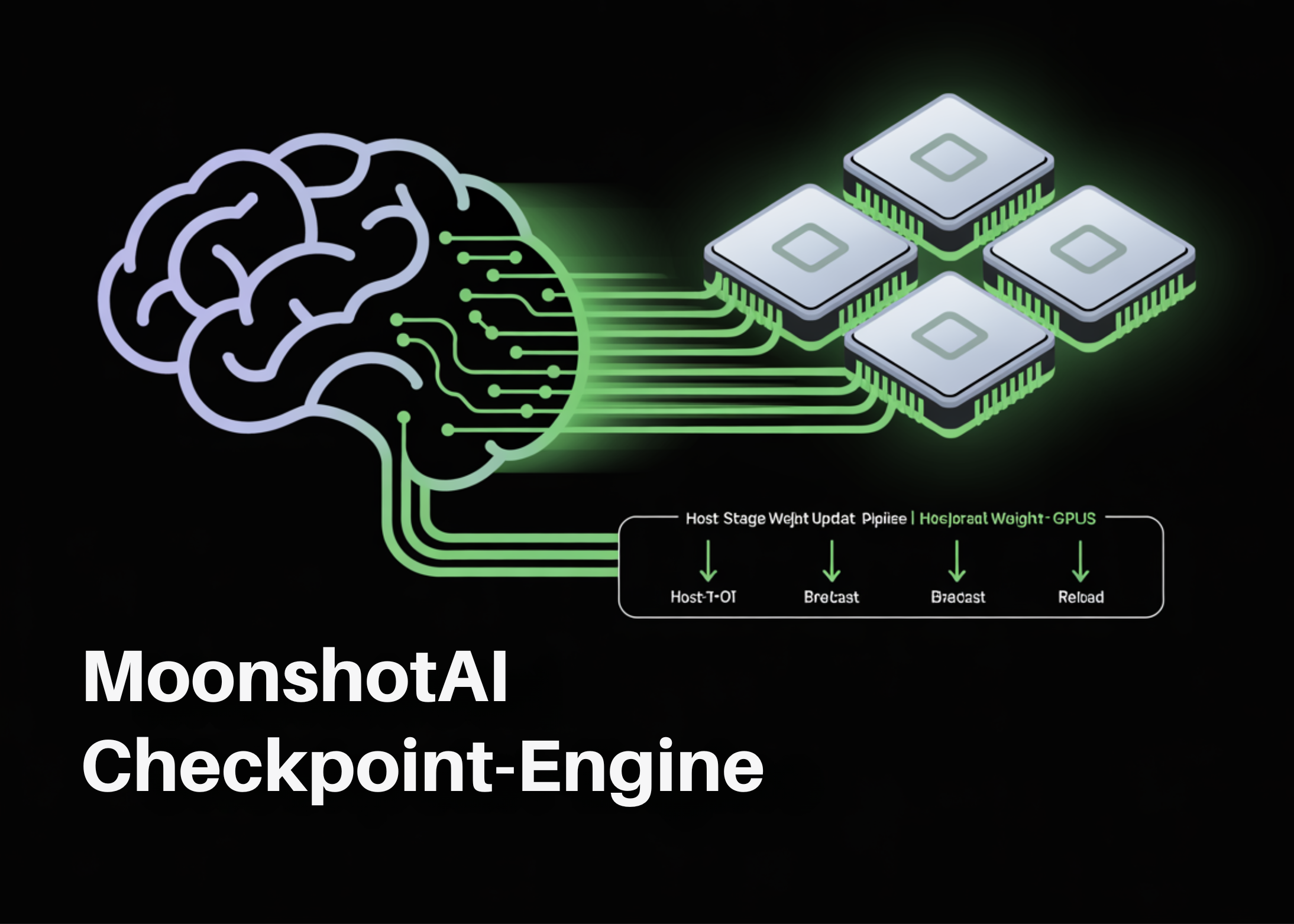
MoonshotAI has open-sourced checkpoint-engine, a lightweight middleware designed to enable rapid updates of model weights across thousands of GPUs in large language model (LLM) deployments, particularly benefiting reinforcement learning (RL) and reinforcement learning with human feedback (RLHF). This innovation addresses a critical bottleneck by reducing the update time for a 1-trillion parameter model from several minutes to approximately 20 seconds, significantly enhancing system throughput and reducing downtime during model updates. The checkpoint-engine achieves this feat through a combination of broadcast updates for static clusters, peer-to-peer (P2P) updates for dynamic clusters

Research
📄 Towards Data Science

Learn How to Use Transformers with HuggingFace and SpaCy

The article discusses integrating transformer models with spaCy using HuggingFace, enabling advanced natural language processing (NLP) capabilities within spaCy's framework. This development allows developers to leverage state-of-the-art transformer architectures, such as BERT and RoBERTa, for more accurate and context-aware NLP tasks, enhancing spaCy's utility for complex language understanding applications.

NLP Transformers
Read More
Research
📄 Towards Data Science

How to Become a Machine Learning Engineer (Step-by-Step)

The article provides a comprehensive, step-by-step roadmap for aspiring machine learning engineers, emphasizing essential skills such as programming in Python, understanding algorithms, and mastering data preprocessing techniques. It highlights the importance of practical experience through projects, familiarity with popular frameworks like TensorFlow and PyTorch, and continuous learning to stay current with evolving AI methodologies, thereby equipping readers with a structured pathway to enter the field.

Machine Learning
Read More

Page 55 of 130 • Showing articles 649-660 of 1560