
Page 39 of 130 • 1560 Total Articles

createLiveAI

Continue exploring the latest AI breakthroughs, technology insights, and industry analysis. Page 39 of our comprehensive AI news collection.

📰 Latest Intelligence

Showing 12 articles on page 39 of 130

Live feed
Research
📄 Towards Data Science

The Three Ages of Data Science: When to Use Traditional Machine Learning, Deep Learning, or a LLM (Explained with One Example)

The article explores the evolution of the data scientist role across three generations of machine learning: traditional machine learning, deep learning, and large language models (LLMs). It highlights how each era has shifted the focus of data scientists from feature engineering and classical algorithms to designing neural network architectures and fine-tuning massive pre-trained models, exemplified through a practical use case that demonstrates the appropriate application of each approach depending on the problem complexity and data availability.

Machine Learning Deep Learning
Read More
Research
📄 Towards Data Science

How to Build Agents with GPT-5

The article discusses leveraging GPT-5 as a sophisticated AI agent capable of interacting with and analyzing user data, marking a significant advancement in AI-driven data management. This development enables the creation of intelligent agents that can perform complex tasks, such as data interpretation and decision-making, by harnessing GPT-5's enhanced natural language understanding and processing capabilities.

GPT NLP
Read More
Business
📄 AI News

Chinese AI startup Moonshot outperforms GPT-5 and Claude Sonnet 4.5: What you need to know

Chinese AI startup Moonshot has achieved a significant breakthrough with its open-source Kimi K2 Thinking model, outperforming OpenAIs GPT-5 and Anthropics Claude Sonnet 4.5 across multiple benchmarks, including Humanitys Last Exam where it scored 44.9% compared to GPT-5s 41.7%. This development challenges the prevailing narrative of US dominance in AI by demonstrating that cost-efficient Chinese models can rival or surpass leading Western counterparts in reasoning, coding, and multi-tool execution, with the Kimi K2 model capable of executing 200-300 sequential tool calls

GPT Claude
Read More
Technology
📄 MarkTechPost

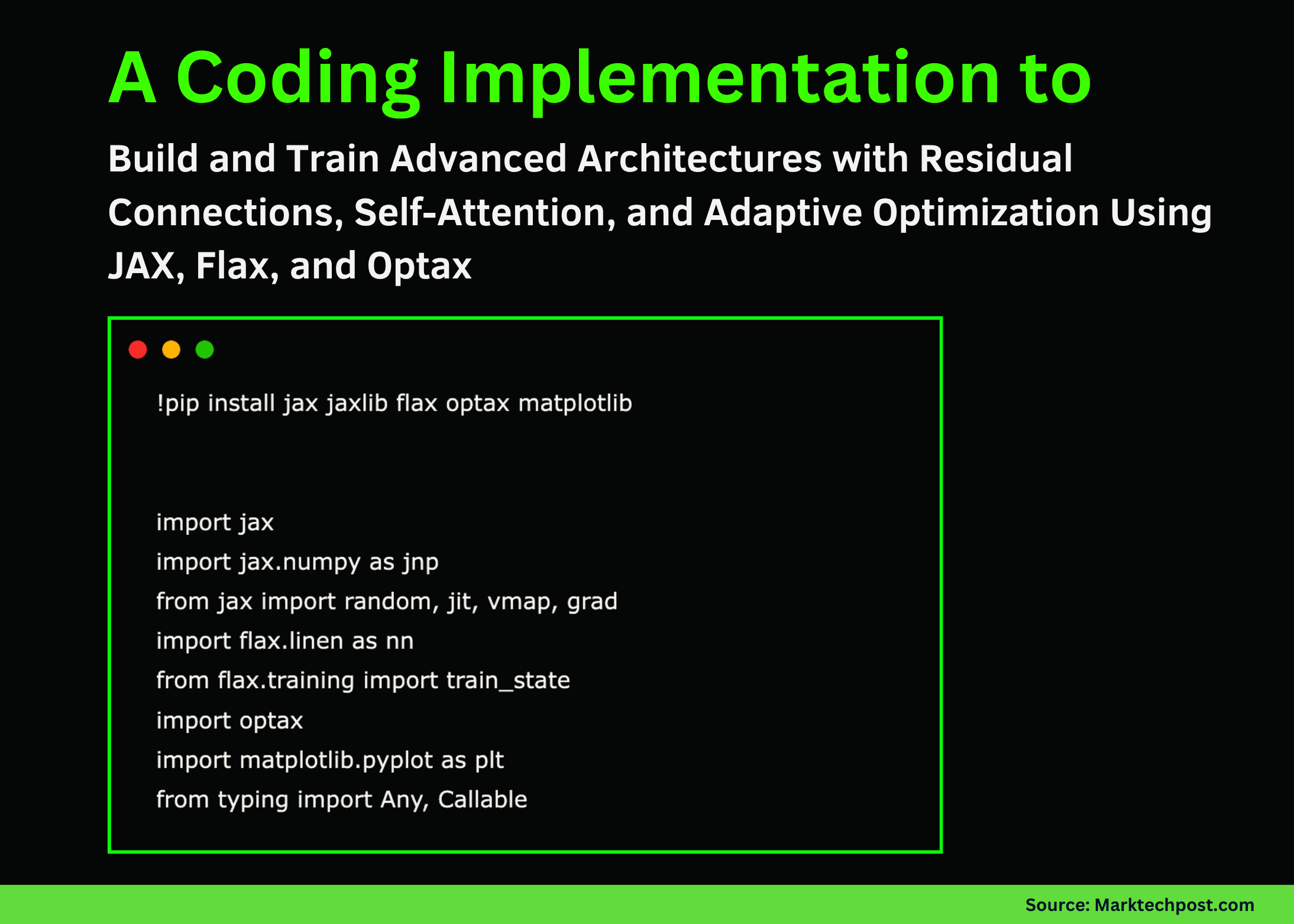
A Coding Implementation to Build and Train Advanced Architectures with Residual Connections, Self-Attention, and Adaptive Optimization Using JAX, Flax, and Optax

A recent tutorial demonstrates how to construct and train sophisticated neural networks utilizing JAX, Flax, and Optax, emphasizing modularity and efficiency. The core innovation involves integrating residual connections and self-attention mechanisms within a deep architecture to enhance feature learning capabilities, supported by advanced optimization techniques such as learning rate scheduling, gradient clipping, and adaptive weight decay. By leveraging JAX transformations like jit, grad, and vmap, the approach accelerates computation and ensures scalable training across multiple devices, showcasing a robust framework for developing high-performance AI models. This development underscores the growing importance of combining flexible neural network components

Deep Learning Transformers
Read More
General
📄 MarkTechPost

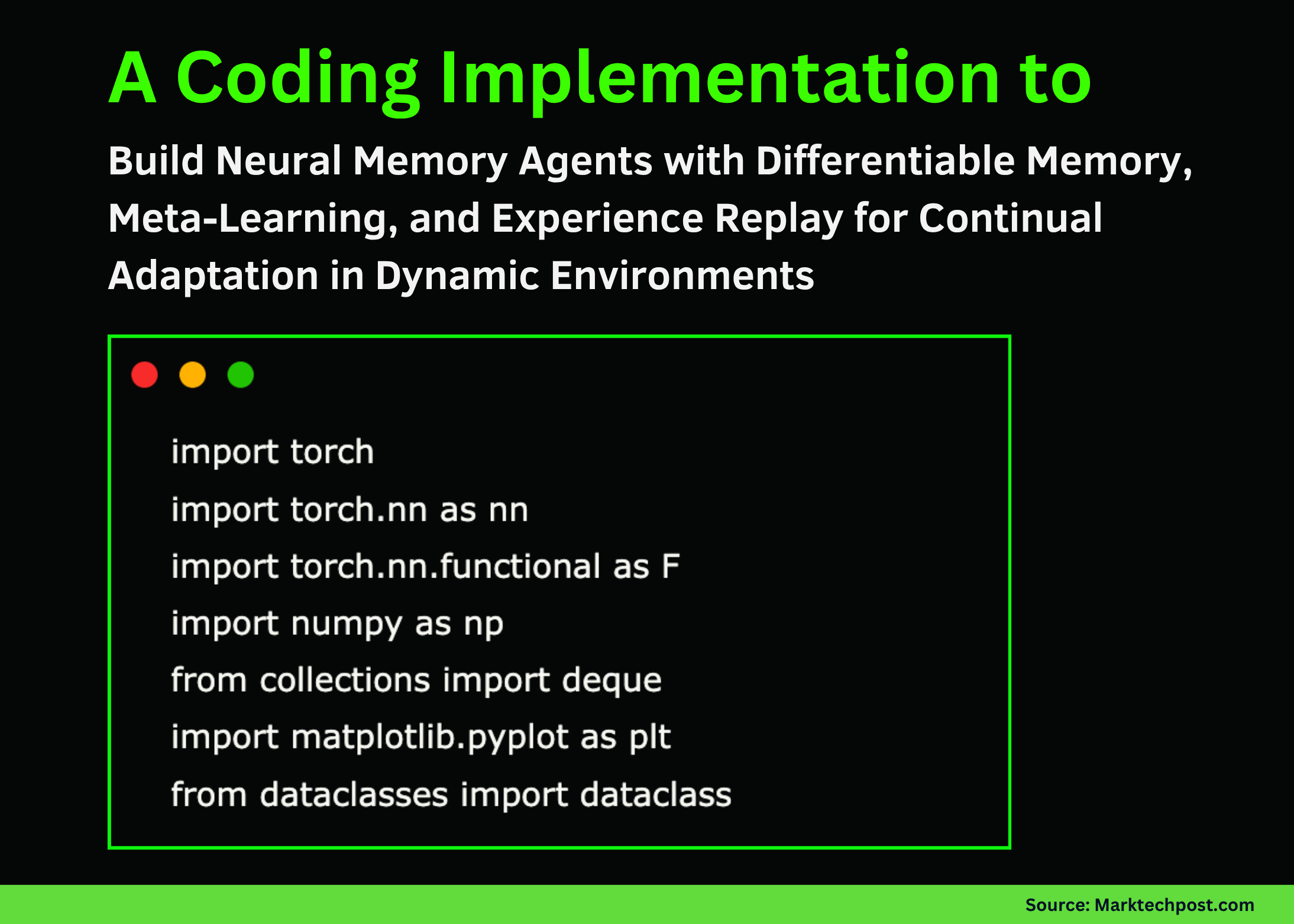
A Coding Implementation to Build Neural Memory Agents with Differentiable Memory, Meta-Learning, and Experience Replay for Continual Adaptation in Dynamic Environments

A recent development in AI involves the creation of neural memory agents capable of continual learning without catastrophic forgetting. By integrating a Differentiable Neural Computer (DNC) with experience replay and meta-learning techniques within a PyTorch framework, researchers have designed a memory-augmented neural network that can adapt rapidly to new tasks while preserving previously acquired knowledge. This approach leverages content-based memory addressing and prioritized replay mechanisms, enabling the model to maintain high performance across multiple learning environments. This innovation addresses a longstanding challenge in neural network trainingretaining past experiences amid ongoing learningby enhancing memory management and task adaptation.

Meta AI Deep Learning
Read More
Startups
📄 MarkTechPost

AI Interview Series #1: Explain Some LLM Text Generation Strategies Used in LLMs

Recent advancements in large language models (LLMs) highlight the importance of decoding strategies in shaping generated text. Techniques such as Greedy Search, Beam Search, Nucleus Sampling, and Temperature Sampling enable LLMs to balance coherence, creativity, and diversity by guiding token selection during response generation, with each method offering different trade-offs in speed and output quality. For instance, Greedy Search selects the highest-probability token at each step, providing fast but often repetitive results, while Beam Search maintains multiple candidate sequences to improve coherence and contextual relevance. These decoding strategies are crucial for optimizing LLM performance across

General
📄 MarkTechPost

How to Build an Agentic Voice AI Assistant that Understands, Reasons, Plans, and Responds through Autonomous Multi-Step Intelligence

A recent tutorial demonstrates the development of an Agentic Voice AI Assistant capable of real-time natural speech understanding, reasoning, and response generation by integrating advanced speech recognition models like Whisper and SpeechT5. This system employs a self-contained pipeline that combines speech-to-text, intent detection, multi-step reasoning, and text-to-speech synthesis, enabling autonomous conversational interactions that can interpret commands, formulate plans, and deliver spoken responses seamlessly. The innovation lies in the cohesive integration of perception, reasoning, and execution modules, showcasing how these components work together to create a sophisticated, autonomous voice assistant. This approach advances conversational

Autonomous Systems
Read More
Research
📈 VentureBeat AI

Terminal-Bench 2.0 launches alongside Harbor, a new framework for testing agents in containers

The developers of Terminal-Bench have released version 2.0 alongside Harbor, a new framework designed to enhance the testing, optimization, and scalability of autonomous AI agents operating in containerized environments. Terminal-Bench 2.0 introduces a more challenging and rigorously validated set of 89 terminal-based tasks, replacing the previous version to set a higher standard for evaluating the capabilities of frontier models in realistic developer scenarios. Harbor complements this update by enabling large-scale evaluation across thousands of cloud containers and supporting integration with both open-source and proprietary AI agents and training pipelines. This dual release aims to address previous

GPT Claude +1
Read More
Technology
📄 MarkTechPost

Google AI Releases ADK Go: A New Open-Source Toolkit Designed to Empower Go Developers to Build Powerful AI Agents

Google has introduced the Agent Development Kit (ADK) for Go, an open-source framework that enables Go developers to build, develop, and deploy AI agents within their existing Go toolchain, eliminating the need for separate Python or Java stacks. This development bridges a significant gap for backend and AI developers by allowing them to express agent logic, orchestration, and tool integration directly in Go, facilitating seamless integration with Google Cloud services like Vertex AI Agent Builder and Agent Engine for production deployment. The ADK is designed to be model-agnostic and deployment-agnostic, optimized for Googles Gemini and Google

Google AI
Read More

Page 39 of 130 • Showing articles 457-468 of 1560