Page 32 of 130 • 1560 Total Articles

createLiveAI

Continue exploring the latest AI breakthroughs, technology insights, and industry analysis. Page 32 of our comprehensive AI news collection.

📰 Latest Intelligence

Showing 12 articles on page 32 of 130

Live feed
Technology
📄 MarkTechPost

Meta AI Researchers Introduce Matrix: A Ray Native a Decentralized Framework for Multi Agent Synthetic Data Generation

Meta AI researchers have developed Matrix, a decentralized framework designed to enhance the generation of synthetic data for large language models (LLMs) by leveraging peer-to-peer agent scheduling on a Ray cluster. Unlike traditional centralized control systems that bottleneck scalability and GPU utilization, Matrix serializes control and data flow into message objects called orchestrators, enabling more efficient and diverse synthetic conversations while achieving 2 to 15 times higher token throughput on real workloads. This approach addresses the limitations of existing systems by distributing control logic across multiple agents, reducing coordination overhead, and significantly improving scalability for synthetic data generation. By replacing centralized controllers

Meta AI NVIDIA
Read More
Research
📄 Towards Data Science

How to Scale Your LLM Usage

The article emphasizes strategies to scale Large Language Model (LLM) deployment to enhance productivity, highlighting methods for optimizing usage across various applications. It discusses technical approaches and best practices for increasing LLM engagement, enabling organizations to leverage these models more effectively for improved operational efficiency.

Ethics
📄 MarkTechPost

A Coding Guide to Design an Agentic AI System Using a Control-Plane Architecture for Safe, Modular, and Scalable Tool-Driven Reasoning Workflows

A recent tutorial introduces the design of an advanced Agentic AI utilizing a control-plane architecture, positioning the control plane as the central orchestrator responsible for coordinating tools, enforcing safety protocols, and structuring the reasoning process. This modular system integrates components such as a retrieval subsystem, defined tools, and an agentic reasoning layer that enables dynamic planning and execution of actions, resulting in a scalable, safe, tool-aware AI capable of knowledge retrieval, interaction logging, and adaptive learning. This approach emphasizes a disciplined, scalable framework that enhances AI safety, modularity, and reasoning capabilities by centralizing control and integrating retrieval

Research
📄 Towards Data Science

Why Weve Been Optimizing the Wrong Thing in LLMs for Years

A recent breakthrough in large language model (LLM) training reveals that optimizing for next-token prediction alone has limited the models' foresight, inference speed, and reasoning capabilities. By shifting the training focus towards alternative objectives that better align with reasoning and predictive accuracy, researchers have demonstrated significant improvements in LLM performance, enabling faster inference and more sophisticated reasoning abilities.

General
📄 AI News

How background AI builds operational resilience & visible ROI

Recent advancements highlight that the most impactful AI systems in enterprise environments are those operating behind the scenes, rather than front-end chatbots or customer support tools. These backend AI solutions enhance operational resilience by silently monitoring complex processes such as risk assessments, data lineage, and compliance, thereby preventing costly errors and regulatory issues without disrupting workflows. For example, a global logistics company implemented an AI system that continuously analyzed procurement documents and email communications, successfully identifying vendor inconsistencies and patternssuch as inventory padding near quarter-endthat human analysts had previously overlooked, ultimately saving millions and strengthening operational integrity. This shift underscores that AI's

Research
📈 VentureBeat AI

Beyond math and coding: New RL framework helps train LLM agents for complex, real-world tasks

Researchers at the University of Science and Technology of China have introduced a novel reinforcement learning (RL) framework tailored for training large language models (LLMs) to perform complex, agentic tasks that extend beyond traditional well-defined problems like math and coding. This new approach redefines the Markov Decision Process (MDP) paradigm to better accommodate the dynamic, multi-turn, and environment-interacting nature of real-world applications, enabling models to handle multi-stage reasoning, retrieval, and tool interaction more effectively. The framework is compatible with existing RL algorithms and demonstrates significant improvements in reasoning tasks that involve multiple retrieval steps and

GPT Google AI
Read More
Research
📄 Towards Data Science

Neural Networks Are Blurry, Symbolic Systems Are Fragmented. Sparse Autoencoders Help Us Combine Them.

Sparse Autoencoders (SAEs) represent a significant advancement in integrating neural and symbolic AI models by providing a means to bridge their fundamentally different approaches to world representation. While neural models tend to produce blurry, distributed representations, and symbolic systems offer fragmented, discrete structures, SAEs facilitate the compression and combination of these paradigms, enabling more cohesive and interpretable AI systems. This development opens pathways for creating hybrid models that leverage the strengths of both neural learning and symbolic reasoning, potentially enhancing AI's ability to understand and manipulate complex, structured information.

Ethics
📄 AI News

SAP outlines new approach to European AI and cloud sovereignty

SAP is advancing its European AI and cloud sovereignty initiatives through the development of EU AI Cloud, a unified platform designed to enhance data control and flexibility for organizations across Europe. This platform supports deployment across SAP data centers, European providers, or on-premise infrastructures, enabling enterprises to tailor their AI and cloud services according to regional data residency and security requirements. By integrating models and tools from partners such as Cohere, Mistral AI, and OpenAI into the SAP Business Technology Platform (SAP BTP), SAP aims to provide industry-specific AI solutions that adhere to European standards for data protection and sovereignty. A

General
📄 MarkTechPost

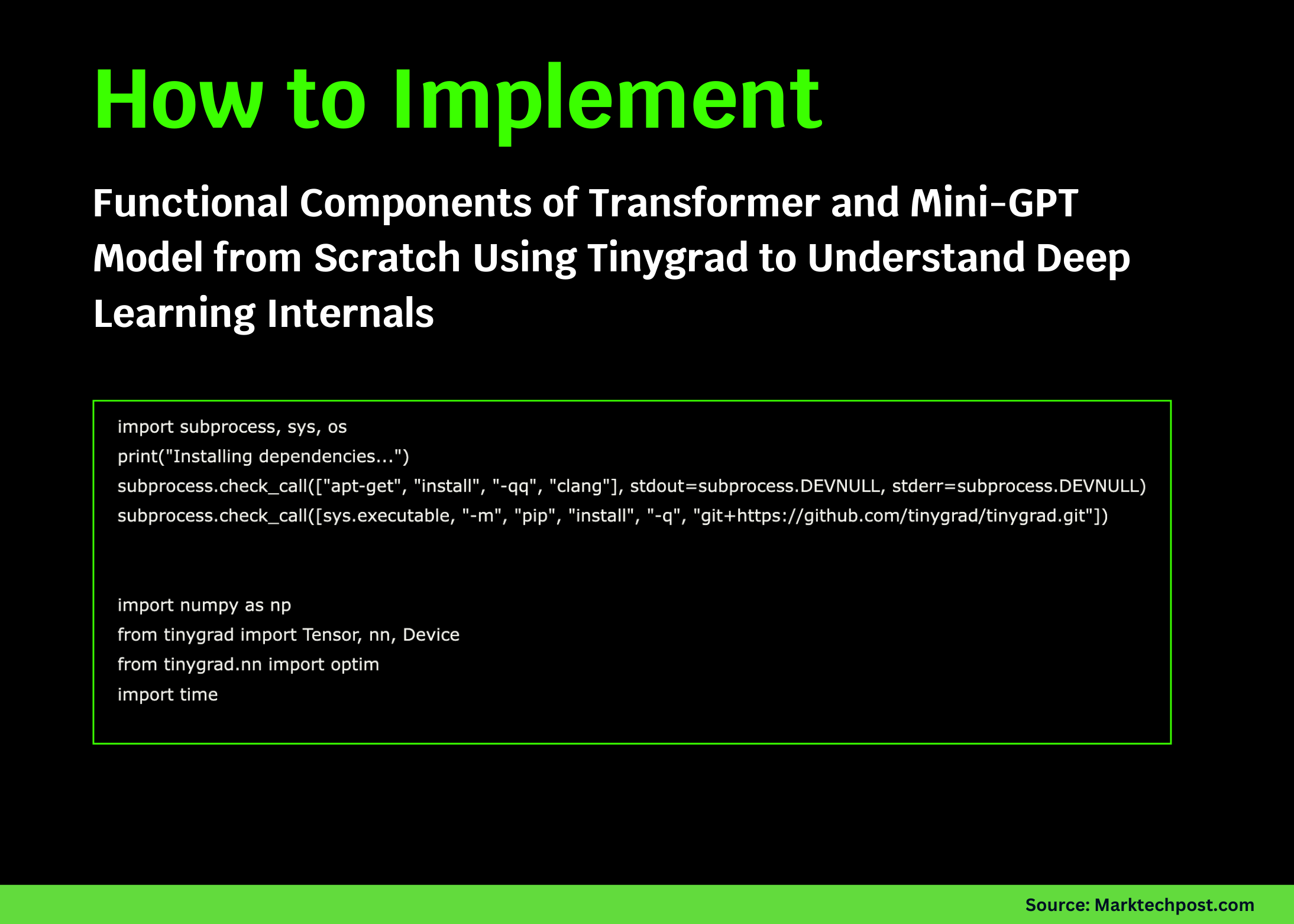
How to Implement Functional Components of Transformer and Mini-GPT Model from Scratch Using Tinygrad to Understand Deep Learning Internals

A recent tutorial demonstrates how to construct neural networks from scratch using Tinygrad, a minimalist deep learning framework, by meticulously building components such as tensors, autograd, multi-head attention, transformer blocks, and a mini-GPT model. This hands-on approach emphasizes understanding the internal workings of deep learning models, illustrating how Tinygrad's simplicity facilitates insights into training dynamics, kernel fusion, and optimization processes. By progressively assembling these components, the tutorial provides a clear, technical pathway to grasp complex transformer architectures and language models without relying on high-level libraries. This approach not only enhances comprehension of core AI mechanisms but also

GPT Deep Learning +1
Read More

Page 32 of 130 • Showing articles 373-384 of 1560