Page 26 of 130 • 1560 Total Articles

createLiveAI

Continue exploring the latest AI breakthroughs, technology insights, and industry analysis. Page 26 of our comprehensive AI news collection.

📰 Latest Intelligence

Showing 12 articles on page 26 of 130

Live feed
Business
📄 The Hacker News

Featured Chrome Browser Extension Caught Intercepting Millions of Users' AI Chats

A widely used Google Chrome extension, Urban VPN Proxy, with over six million users and a "Featured" badge, has been found silently collecting all user prompts entered into various AI-powered chatbots such as OpenAI's ChatGPT, Anthropic's Claude, and Google's Gemini. This raises significant privacy concerns, as the extension potentially exposes sensitive user data to third parties without explicit consent or transparency. The development highlights the risks associated with browser extensions that have extensive access to user input, especially when they are not transparent about data collection practices. It underscores the need for increased scrutiny and regulation of third-party extensions to

GPT Claude +3
Read More
Research
📄 The Algorithmic Bridge

Why Industry Leaders Are Betting on Mutually Exclusive Futures

Ilya Sutskever and Andrej Karpathy, both influential figures in AI and former OpenAI founders, are pursuing divergent research paths that reflect their distinct visions for the future of artificial intelligence. Sutskever, with a background under Geoffrey Hinton and experience at Google Brain, maintains a pragmatic focus on advancing AI capabilities toward superintelligence, emphasizing practical applications and long-term potential. Conversely, Karpathy, renowned for his contributions to computer vision and AI education through Stanford's CS231n course, has taken a more exploratory and educational approach, fostering open access to AI knowledge and innovation.

GPT Google AI +1
Read More
Business
📈 VentureBeat AI

Bolmos architecture unlocks efficient bytelevel LM training without sacrificing quality

The Allen Institute for AI (Ai2) has introduced Bolmo, a family of fully open, byte-level multilingual language models designed to operate directly on raw UTF-8 bytes, eliminating the need for traditional tokenization. This approach enhances robustness in noisy, low-resource, or multilingual text environments, making it particularly suitable for enterprise applications requiring moderation, edge deployment, or handling unconventional inputs. Bolmo 7B and Bolmo 1B are the first of their kind to be fully open-source byte-level models, demonstrating competitive or superior performance compared to existing character-based models. Built using Ai2s

Meta AI Transformers
Read More
Research
📄 Towards Data Science

The Machine Learning Advent Calendar Day 14: Softmax Regression in Excel

Softmax Regression extends logistic regression to handle multiple classes by computing a linear score for each class and normalizing these scores with the Softmax function to produce multiclass probabilities, all while maintaining the same loss function, gradients, and optimization process. This approach increases the number of parallel scores but preserves the core logic, enabling straightforward adaptation to multi-class classification problems. Implementing Softmax Regression in Excel enhances model transparency, allowing users to directly observe class scores, probabilities, and the evolution of coefficients over time, which facilitates better understanding and debugging of the model's behavior. This accessible implementation underscores the method's simplicity

Machine Learning
Read More
Research
📈 VentureBeat AI

Why most enterprise AI coding pilots underperform (Hint: It's not the model)

Generative AI in software engineering has advanced from simple autocomplete functions to sophisticated agentic workflows capable of planning, executing, and iterating across multiple steps, driven by reasoning across design, testing, and validation processes. However, enterprise deployments often underperform because the primary challenge is not the AI models themselves but the surrounding system environment, including workflow design, context, and orchestration, which are crucial for enabling effective agentic behavior. Recent developments include the creation of dedicated orchestration platforms like GitHub's Agent and Agent HQ, aimed at facilitating multi-agent collaboration within enterprise pipelines. Despite these innovations, early field

GPT Claude +2
Read More
Research
📄 Towards Data Science

The Machine Learning Advent Calendar Day 13: LASSO and Ridge Regression in Excel

Ridge and Lasso regression are often misunderstood as adding complexity to linear models, but in reality, they maintain the same prediction structure while modifying the training objective through regularization penalties. These penalties, applied to the coefficients, promote more stable and robust solutions, particularly when features are correlated, by effectively imposing a preference for certain coefficient values rather than increasing model complexity. Implementing Ridge and Lasso regression step-by-step in Excel demonstrates that regularization techniques do not complicate the model but instead serve as a form of regularization that guides the model toward more stable solutions. This perspective clarifies that the core

Machine Learning
Read More
Ethics
📄 MarkTechPost

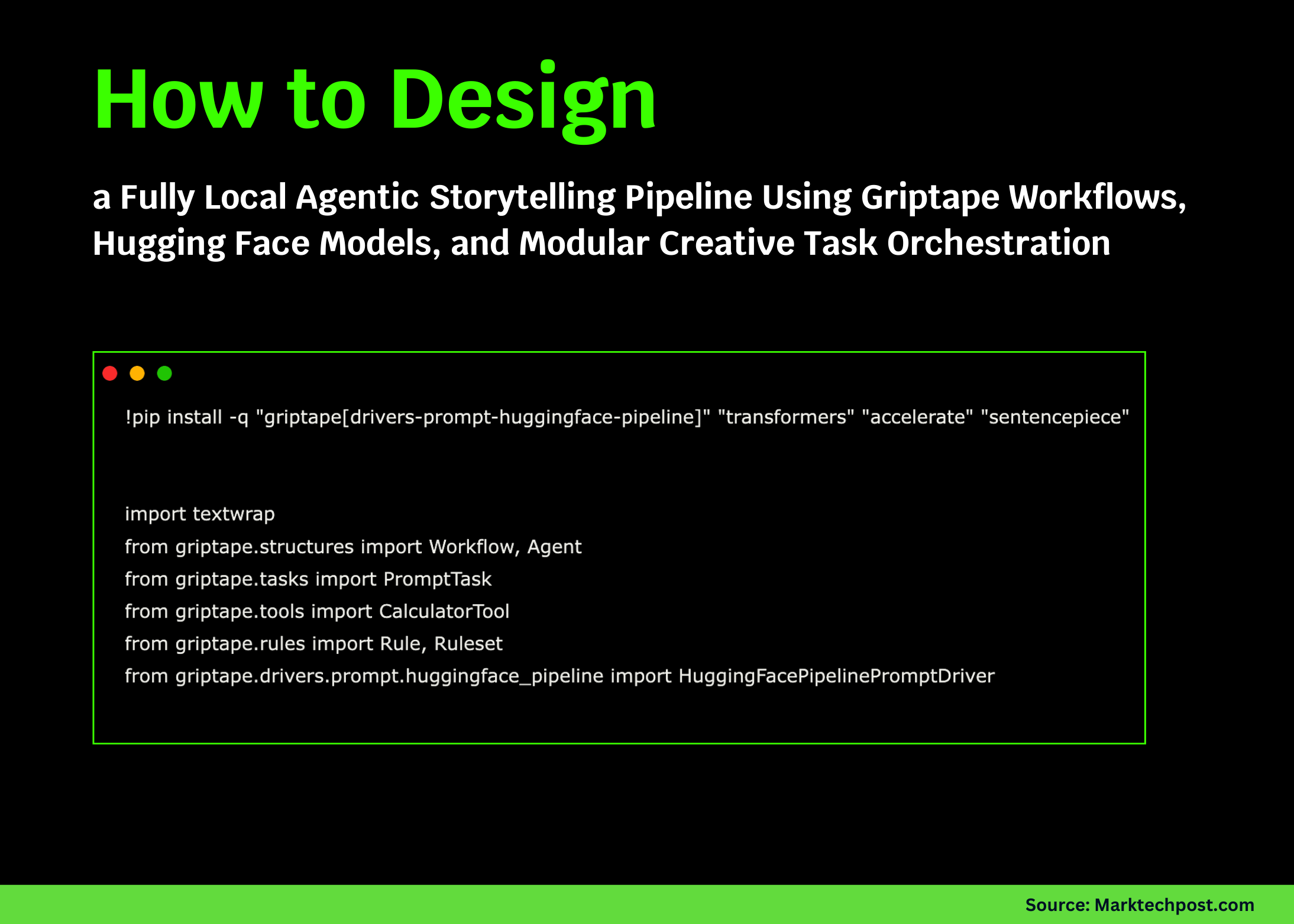
How to Design a Fully Local Agentic Storytelling Pipeline Using Griptape Workflows, Hugging Face Models, and Modular Creative Task Orchestration

A recent tutorial demonstrates the development of a fully local, API-free agentic storytelling system utilizing Griptape workflows combined with a lightweight Hugging Face model, specifically TinyLlama-1.1B-Chat-v1.0. This system enables the creation of an autonomous agent capable of tool use, generating fictional worlds, designing characters, and orchestrating multi-stage creative workflows to produce coherent short stories, all within a modular and end-to-end pipeline. By leveraging Griptape's modular architecture and Hugging Face's local inference capabilities, the approach eliminates reliance on external APIs, enhancing privacy and control

Autonomous Systems
Read More
Ethics
📄 The Hacker News

Fake OSINT and GPT Utility GitHub Repos Spread PyStoreRAT Malware Payloads

Cybersecurity researchers have identified a novel campaign exploiting GitHub-hosted Python repositories, which are disguised as development utilities or OSINT tools, to distribute PyStoreRAT, a previously undocumented JavaScript-based Remote Access Trojan. These repositories contain minimal code that covertly downloads and executes a remote HTA (HTML Application) file, enabling attackers to establish persistent remote access. This development highlights a sophisticated method of malware delivery that leverages legitimate code hosting platforms to evade detection and underscores the need for vigilant monitoring of open-source repositories for malicious activity.

GPT Transformers
Read More
Research
📄 Towards Data Science

The Machine Learning Advent Calendar Day 12: Logistic Regression in Excel

A recent educational approach demonstrates how to reconstruct logistic regression directly within Excel, providing a transparent and step-by-step visualization of the model's learning process. By starting with a binary dataset, the method illustrates the limitations of linear regression as a classifier, explains how the logistic function addresses these issues, and shows how log-loss naturally emerges from the likelihood function. This approach employs a clear gradient descent table, allowing users to observe the iterative updates of model parameters in real-time, making the learning process intuitive and accessible. Such visualizations enhance understanding of core machine learning concepts, bridging theoretical foundations with practical implementation, all within

Machine Learning
Read More
General
📄 AI News

AI in 2026: Experimental AI concludes as autonomous systems rise

The article highlights a pivotal shift in AI development, with 2026 expected to mark the transition from experimental generative models to fully autonomous systems capable of reasoning, planning, and executing complex workflows with minimal human oversight. This evolution emphasizes agency, energy efficiency, and the ability to navigate intricate industrial environments, particularly in sectors like telecommunications and heavy industry, where autonomous network operations (ANO) and multiagent systems (MAS) are being deployed to enhance efficiency and reduce operational costs. Technologically, the focus is moving toward multiagent systems that enable collaborative, multi-step task execution among distinct AI agents, surpassing

Autonomous Systems
Read More
Research
📄 Towards Data Science

Decentralized Computation: The Hidden Principle Behind Deep Learning

Recent insights reveal that the foundational principle underpinning advancements in deep learning, including large language models, is decentralization. Unlike traditional centralized systems, these models thrive because numerous simple units interact locally, enabling complex behaviors without a central controller. This shift towards decentralized computation emphasizes the importance of local interactions among neural network components, which has driven the scalability and effectiveness of modern AI architectures.

Deep Learning
Read More
Ethics
📄 The Hacker News

Securing GenAI in the Browser: Policy, Isolation, and Data Controls That Actually Work

The integration of Generative AI into web browsers has transformed them into primary interfaces for enterprise AI applications, enabling functionalities such as email drafting, document summarization, coding assistance, and data analysis through tools like web-based LLMs, copilots, and agentic browsers like ChatGPT Atlas. This shift allows employees to directly interact with AI models within their browsing environment, often involving the transfer of sensitive data via copy-paste or file uploads, raising significant concerns around data privacy and security.

Page 26 of 130 • Showing articles 301-312 of 1560